
Hook — A knock you cannot ignore
Pain arrives like a sudden knock at the door. Sometimes it is a sharp, undeniable alarm that tells you to pull your hand away from a hot stove. Other times it is the slow, persistent ache that makes mornings heavy and conversations harder. I have lived with both kinds — as patient, observer and occasional student — and I keep returning to the same uneasy question: is pain simply a malfunction to be erased, or is it, in uncomfortable ways, part of what makes us human?
The biological alarm: why pain exists
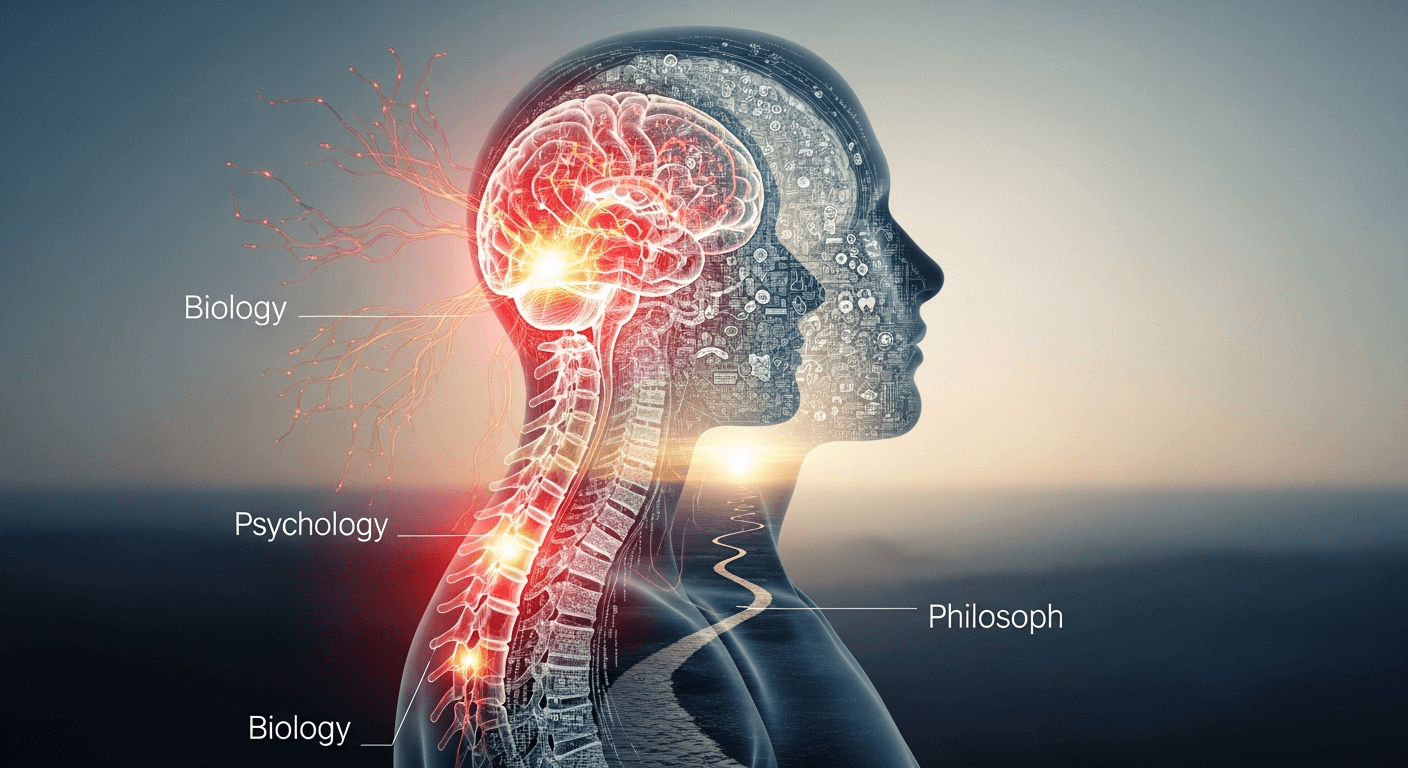
At its most basic, pain is information. Specialized nerve cells called nociceptors detect damage or threat and send signals through the spinal cord to the brain. That signal triggers reflexes, learning and behaviour changes that protect the body. From this perspective, pain is an elegant safety system — costly, yes, but exquisitely useful.
The biology, however, is not just hardware. The brain filters, amplifies and sometimes fabricates pain. Chronic pain shows how this system can go awry: signals persist long after tissue has healed, driven by rewired neural circuits and neurochemical changes. This biological reality humbles the idea that pain is merely a sign of injury; it can be a disease in its own right.
The psychological lens: pain as story and meaning
Psychology adds another layer. Two people with similar injuries can have very different pain experiences. Thoughts, attention, fear, and past memories shape how pain is perceived. Catastrophizing — the tendency to imagine the worst — magnifies suffering. Conversely, acceptance and focused attention can reduce the felt intensity.
Therapies like cognitive behavioural therapy (CBT) and acceptance-based approaches work not by removing the biological signal, but by changing the relationship to it. Patients learn to notice pain without letting it become the whole of their identity. In my own life I’ve seen how a small shift in narrative — from “This pain defines me” to “This pain is part of my current experience” — can open space for action, social life and, occasionally, joy.
Philosophical reflections: suffering, growth and meaning
Philosophy asks a different question: what does pain mean for a life well lived? Some traditions see suffering as intrinsic to existence — a test, a teacher, or a forge that tempers character. Others insist that meaning must never be manufactured from harm; any romanticisation of pain risks ignoring avoidable suffering.
I find nuance more honest than extremes. Pain can be destructive and degrading, and it can also catalyse insight, compassion and ethical action. When I reflect on loss or illness in my own circles, I notice both reactions: people who harden and those who soften. The critical question becomes not whether pain exists, but how we respond to it personally and collectively.
Social and cultural dimensions
Pain is not only private. How societies recognise, interpret and treat pain matters. In some cultures, stoicism is prized; in others, vocal expression attracts help. Economic inequality and healthcare access shape who receives diagnosis, relief and empathy. I’ve written before about technological dreams of sharing or redistributing pain as a thought experiment — a way to probe how we value suffering and who should bear it Equalizing / Distributing / Transferring , Pain ?.
These ideas are speculative, but they underline a persistent truth: pain is embedded in systems — medical, economic and moral — and those systems determine how pain is alleviated or compounded.
Real-world examples that bring theory down to earth
A runner who sprains an ankle and learns to stop, rest, and rehab: biology signals danger; psychology manages fear of lost progress; philosophy asks how identity ties to endurance.
A person with chronic back pain who sees specialists, but also finds relief through acceptance-focused therapy and community support: biological signals persist, but psychological and social tools reshape the lived experience.
A family caring for an elderly relative: their collective response — whether compassionate or resentful — transforms pain into either a shared burden or a source of isolation.
These examples show pain’s hybrid nature: it is at once neural firing, a felt story, and a social event.
Practical takeaways — living with the price
Treat pain seriously, early. Get a proper medical assessment when pain is new or severe.
Learn to separate signal from story. Ask: “What is my body telling me?” and “What is my mind adding?”
Use a toolbox. Combine medical care with psychological strategies (breathing, mindfulness, CBT techniques) and social support.
Resist heroic narratives that glorify needless suffering. Courage can coexist with sensible self-care.
Advocate for systems that recognise invisible pain: better access to care, disability accommodations and social support reduce needless hardship.
Conclusion — a balanced acceptance
Pain is both biological alarm and existential teacher. It is costly, intimate and often unjust. I do not romanticise it; I do, however, accept that pain will visit every human life in some form. The question that remains is not whether pain should exist, but how we organise our medicine, our psychology and our communities so that pain, when it comes, does not become an irredeemable sentence.
Some of my earlier thinking on the social imagination of pain explored speculative ways we might share or ease suffering, not to trivialise it but to force a conversation about responsibility and empathy Equalizing / Distributing / Transferring , Pain ?. Today I am more convinced that the most practical path lies in combining good science with humane policy and steady personal practices.
When pain arrives, answer the knock with curiosity, care and community. That is the pragmatic, human response — and perhaps the fairest price for being alive.
Regards,
Hemen Parekh
Any questions / doubts / clarifications regarding this blog? Just ask (by typing or talking) my Virtual Avatar on the website embedded below. Then "Share" that to your friend on WhatsApp.
Get correct answer to any question asked by Shri Amitabh Bachchan on Kaun Banega Crorepati, faster than any contestant
Hello Candidates :
- For UPSC – IAS – IPS – IFS etc., exams, you must prepare to answer, essay type questions which test your General Knowledge / Sensitivity of current events
- If you have read this blog carefully , you should be able to answer the following question:
- Need help ? No problem . Following are two AI AGENTS where we have PRE-LOADED this question in their respective Question Boxes . All that you have to do is just click SUBMIT
- www.HemenParekh.ai { a SLM , powered by my own Digital Content of more than 50,000 + documents, written by me over past 60 years of my professional career }
- www.IndiaAGI.ai { a consortium of 3 LLMs which debate and deliver a CONSENSUS answer – and each gives its own answer as well ! }
- It is up to you to decide which answer is more comprehensive / nuanced ( For sheer amazement, click both SUBMIT buttons quickly, one after another ) Then share any answer with yourself / your friends ( using WhatsApp / Email ). Nothing stops you from submitting ( just copy / paste from your resource ), all those questions from last year’s UPSC exam paper as well !
- May be there are other online resources which too provide you answers to UPSC “ General Knowledge “ questions but only I provide you in 26 languages !



No comments:
Post a Comment