
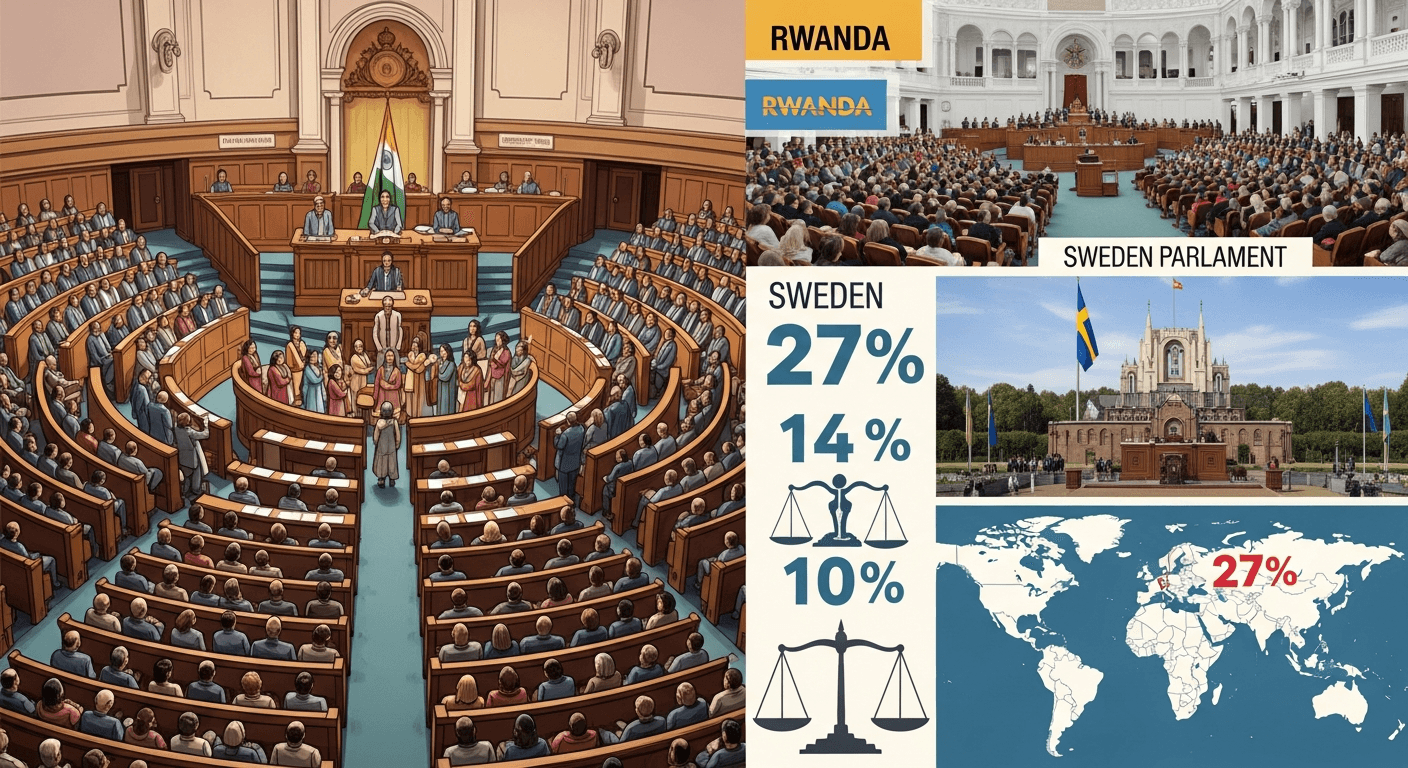
I write about numbers because numbers tell stories — and the story of women in our legislatures is a story of slow, uneven change. I want to walk readers through where India stands today, how we compare internationally, why progress stalls, what higher representation brings, and practical measures that can accelerate change.
Where India stands (2024 snapshot)
- Lok Sabha: ~74 women elected to the 18th Lok Sabha — roughly 13.6% of seats (Election Commission of India; Lok Sabha results) — a small decline from 2019. (Election Commission of India; Lok Sabha)
- Rajya Sabha: women occupy roughly mid‑teens share (~16–17% of seats) of the upper chamber, depending on timing of nominations and retirements. (Inter‑Parliamentary Union (IPU))
- State legislative assemblies: the national average is low, about 9% women MLAs in recent aggregates; some states cross the double‑digit threshold while many lag far behind. (PRS Legislative Research)
These domestic figures sit well below the global average — and that gap matters in policy and practice.
Global context and selected comparisons
- Global average (national parliaments): about 27% women in 2024 (Inter‑Parliamentary Union).
- United States (federal legislature): roughly the high‑20s percent of Congressional seats are held by women after the 2024 cycle (Center for American Women and Politics / Pew Research analyses).
- United Kingdom: the 2024 House of Commons saw a record rise to around 40% women MPs after that election (House of Commons analyses / IPU reporting).
- Rwanda: an outlier and a model in numeric terms — over 60% women in the lower house following the 2024 renewals (Rwanda Parliament; IPU).
- Sweden: nearly parity — mid‑40s percent women in the Riksdag (national statistics / World Bank aggregates).
These differences reflect choices: electoral systems, party strategies, laws, and social norms.
Why representation is low (barriers and causes)
The causes are multi‑layered and mutually reinforcing:
- Social and cultural norms: persistent stereotypes about leadership, public life and gender roles reduce encouragement and local support for women candidates (UN Women; IPU).
- Supply constraints: fewer women are selected as candidates by parties in winnable seats; in many contests women remain a small fraction of total candidates. (Election Commission / ADR analyses)
- Economic barriers: campaign costs, lack of access to donor networks and economic independence make running difficult.
- Political and structural obstacles: single‑member, first‑past‑the‑post systems tend to favour incumbents and entrenched party networks that are male‑dominated; party gatekeepers matter hugely.
- Safety and hostility: intimidation, online abuse and threats deter women from public life — a problem documented in global surveys. (IPU / UN Women)
- Institutional inertia: absence of internal party quotas, weak candidate training, and limited media spotlight on women’s policy contributions.
What higher women's representation changes (evidence and effects)
The evidence — from local councils to national parliaments — points to clear benefits:
- Policy focus: increased representation often correlates with stronger attention to healthcare, education, child and family welfare, gender‑based violence prevention, and social protection measures (IPU; UN Women).
- Governance style: studies show that women legislators can bring different priorities and problem‑solving approaches — for instance, better delivery on local public goods in contexts where women lead local bodies. (Academic studies summarized in comparative reviews)
- Role modelling and norms: visible women leaders change expectations and inspire more women and girls to consider public life.
- Institutional change: higher representation can shift committee cultures, legislative questions and oversight practices to be more inclusive.
Numbers alone don’t guarantee change — quality of participation, seniority, committee roles and leadership positions matter — but descriptive gains are frequently the first step to substantive representation.
Measures that work (and how to design them)
- Reservations / quotas
- Candidate quotas, reserved seats or legislated gender quotas produce the fastest numerical gains where properly designed and enforced. Countries with robust quota mechanisms typically see higher shares of women in legislatures. (IPU)
- Design matters: placement mandates, penalty mechanisms for non‑compliance and rotation rules influence effectiveness.
- Political party action
- Parties must actively recruit, shortlist and support women in winnable constituencies; voluntary party quotas and all‑women shortlists have moved numbers in some democracies.
- Transparent selection processes and mentoring for aspirants reduce gatekeeper bias.
- Capacity building and funding support
- Training in campaigning, legislative skills, media handling and constituency management helps new women candidates convert nominations into wins.
- Dedicated funds or public finance provisions for women candidates can reduce economic barriers.
- Electoral and institutional reforms
- Proportional representation and multimember districts tend to elect more women than single‑member first‑past‑the‑post systems.
- Strengthening rules on gender balance for party lists and improving vacancy rules (so women replacements are not sidelined) helps maintain gains.
- Safety, anti‑harassment rules and public awareness
- Parliamentary codes, swift redress for harassment, and public campaigns to counter online abuse make politics less hostile to women. (IPU / UN Women)
- Media must avoid stereotyping and focus on policy substance rather than gendered tropes.
- Civic engagement and long‑term awareness
- Grassroots civic education, alliances with women’s groups and local leadership pipelines (from panchayats to town councils) are the talent pools for future national leaders.
My reading: a practical agenda for India
I believe India needs a combination of the legal and the cultural. The recent constitutional amendment journey on women’s reservation — once implemented with careful delimitation and rotational clarity — could change the arithmetic. But implementation must be coupled with party reforms, candidate finance measures, safety protections, and systematic training for women leaders at state and local levels. Targets without the institutional ecosystem will risk tokenism; ecosystem without targets risks stagnation.
We should also measure quality: who sits on which committees, who chairs oversight, and whether women’s presence translates into sustained policy attention. Finally, public conversation matters — celebrating local successes, sharing best practices from state assemblies with higher shares, and holding parties accountable for candidate gender balance.
The slow but undeniable global momentum shows change is possible. India’s democratic strength is its diversity — ensuring women occupy their rightful share of legislative seats is not charity; it’s democracy doing what it promises.
Regards,
Hemen Parekh
Any questions / doubts / clarifications regarding this blog? Just ask (by typing or talking) my Virtual Avatar on the website embedded below. Then "Share" that to your friend on WhatsApp.
Get correct answer to any question asked by Shri Amitabh Bachchan on Kaun Banega Crorepati, faster than any contestant
Hello Candidates :
- For UPSC – IAS – IPS – IFS etc., exams, you must prepare to answer, essay type questions which test your General Knowledge / Sensitivity of current events
- If you have read this blog carefully , you should be able to answer the following question:
- Need help ? No problem . Following are two AI AGENTS where we have PRE-LOADED this question in their respective Question Boxes . All that you have to do is just click SUBMIT
- www.HemenParekh.ai { a SLM , powered by my own Digital Content of more than 50,000 + documents, written by me over past 60 years of my professional career }
- www.IndiaAGI.ai { a consortium of 3 LLMs which debate and deliver a CONSENSUS answer – and each gives its own answer as well ! }
- It is up to you to decide which answer is more comprehensive / nuanced ( For sheer amazement, click both SUBMIT buttons quickly, one after another ) Then share any answer with yourself / your friends ( using WhatsApp / Email ). Nothing stops you from submitting ( just copy / paste from your resource ), all those questions from last year’s UPSC exam paper as well !
- May be there are other online resources which too provide you answers to UPSC “ General Knowledge “ questions but only I provide you in 26 languages !



No comments:
Post a Comment