
Why a name still matters
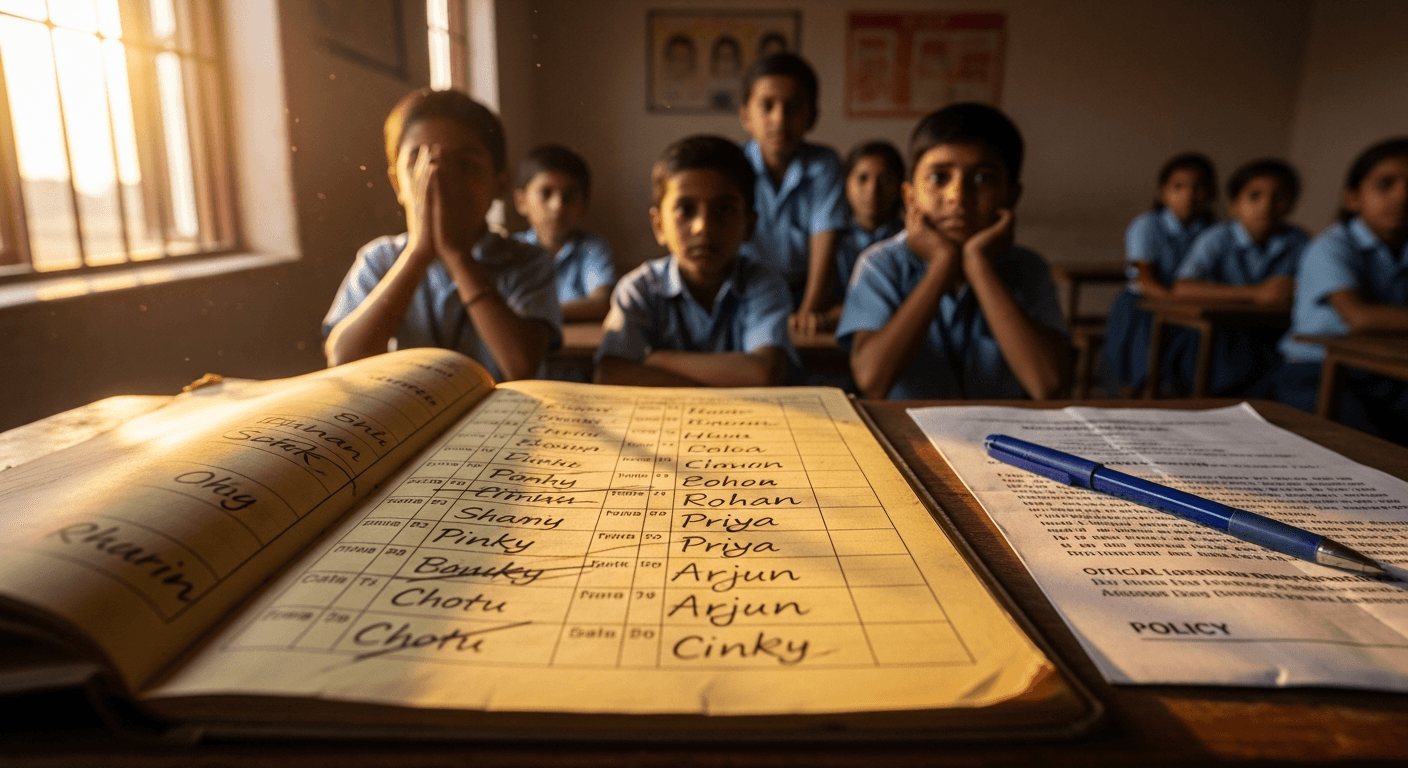
When a state education department asks schools and parents to replace nicknames and derogatory entries in registries with "meaningful" alternatives under a campaign like the Saarthak Naam Abhiyan, I read it as more than an administrative exercise. It is a small mirror held up to how we imagine dignity, belonging, and the architecture of identity.
I have long believed that identity — whether shaped by a name, a memory, or the digital traces we leave behind — is a fragile, living thing. Years ago I wrote about the ways we outsource our intimate selves to technology and how a person’s recorded identity can outlive and reshape them (see my essay "Share - Your - Soul").Share - Your - Soul
What the campaign tries to fix
On paper, the idea is simple and humane: children who are listed in school registers under nicknames or terms that carry mockery, caste stigma, or negative connotations should have the option — with parental consent — to adopt names that convey dignity and respect. The initiative aims to:
- reduce sources of ridicule in classrooms,
- offer parents curated, culturally-rooted alternatives, and
- allow schools to update official records so a child’s school identity better supports self‑esteem.
A government directive can make this administrative — updating registers, giving parents choice, and promising voluntary consent. But the reality is messier.
The thorny questions beneath good intentions
Even well-meaning policies bump into social, historical and practical problems:
- Power and taste: Who decides which names are "meaningful"? There is a risk that curated lists reflect one cultural vocabulary and exclude other lived traditions.
- Bureaucracy vs. intimacy: A name is intimate. Turning it into a checkbox on a form can feel like an intrusion into family choices.
- Slippage into cultural policing: Efforts meant to remove ridicule can slide toward standardising identities in ways that erase regional, caste-based, or community-based naming practices.
- Implementation errors: Large curated lists created quickly often contain mistakes — misclassifications, gender mismatches, and odd or insensitive suggestions that defeat the program’s purpose.
- The stigma paradox: Telling a child their name is "inappropriate" may unintentionally signal that their family or community is deficient.
What I look for when policy meets identity
If we are to respect both the child and the family, policymakers and educators should treat name-change initiatives as a social conversation rather than a top-down correction. Practical guardrails I would press for include:
- Absolute voluntariness with time and emotional support for families making the choice.
- Community consultation so suggested alternatives reflect local cultures and languages rather than a single prescriptive canon.
- Sensitivity training for teachers and administrators so that name correction is not just administrative but restorative.
- A transparent appeals process when suggested lists have errors or feel culturally tone-deaf.
- Measurement of outcomes over time: does a changed registry entry actually reduce stigma and improve a child’s attendance, participation, or confidence?
A wider reflection: names, data and the life we record
My fascination with names is also technological. A school register is a tiny database; it follows a child into portals of identity that last a lifetime. As I have written before, when we digitise memory and personal data, those records begin to act like living artifacts — shaping how others perceive us long after the moment of entry.Share - Your - Soul
That means two things:
- Fixing hurtful entries is worthwhile because records matter.
- We must be humble about the permanence we create. Once an official record is changed, the original social context and the reasons for a name may be lost — and with it, family histories and meanings.
An invitation, not a verdict
I welcome efforts that try to protect children from mockery and to build confidence in classrooms. But I worry whenever the state or any institution rushes to substitute one cultural vocabulary for another without listening. Names live at the intersection of love, history, and ridicule — and any attempt to change them should be handled as carefully as a conversation between a parent and a child.
If the exercise is truly voluntary, locally accountable, and accompanied by community dialogue, it can be kind. If it becomes a checklist of corrections from above, it risks replacing one wound with another.
Where we go from here
Policymakers should remember that dignity cannot be engineered solely by lists and forms. It grows in classrooms where children are treated as whole people, in families where histories are honoured, and in communities that give shape to names through stories and care.
As we digitise those stories and lock names into databases, we must also build the social practices that protect the dignity behind every record.
References
- Coverage of the recent state initiative and its rollout: "A lot's in a name: Rajasthan govt launches drive to change student names if derogatory." (Tribune) A lot's in a name
- My earlier reflection on identity, data and the outsourcing of the soul: "Share - Your - Soul" Share - Your - Soul
Regards,
Hemen Parekh
Any questions / doubts / clarifications regarding this blog? Just ask (by typing or talking) my Virtual Avatar on the website embedded below. Then "Share" that to your friend on WhatsApp.
Get correct answer to any question asked by Shri Amitabh Bachchan on Kaun Banega Crorepati, faster than any contestant
Hello Candidates :
- For UPSC – IAS – IPS – IFS etc., exams, you must prepare to answer, essay type questions which test your General Knowledge / Sensitivity of current events
- If you have read this blog carefully , you should be able to answer the following question:
- Need help ? No problem . Following are two AI AGENTS where we have PRE-LOADED this question in their respective Question Boxes . All that you have to do is just click SUBMIT
- www.HemenParekh.ai { a SLM , powered by my own Digital Content of more than 50,000 + documents, written by me over past 60 years of my professional career }
- www.IndiaAGI.ai { a consortium of 3 LLMs which debate and deliver a CONSENSUS answer – and each gives its own answer as well ! }
- It is up to you to decide which answer is more comprehensive / nuanced ( For sheer amazement, click both SUBMIT buttons quickly, one after another ) Then share any answer with yourself / your friends ( using WhatsApp / Email ). Nothing stops you from submitting ( just copy / paste from your resource ), all those questions from last year’s UPSC exam paper as well !
- May be there are other online resources which too provide you answers to UPSC “ General Knowledge “ questions but only I provide you in 26 languages !


No comments:
Post a Comment