
Introduction
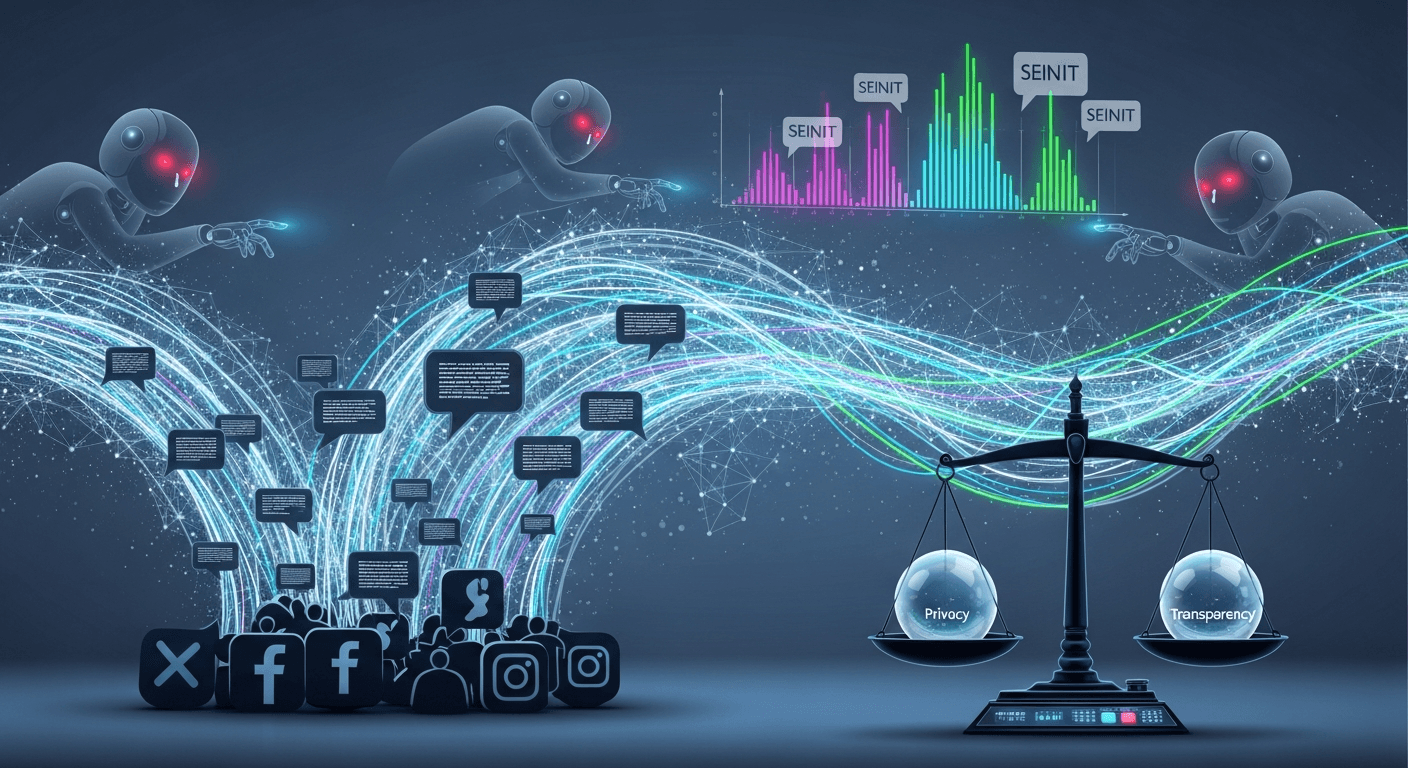
I’ve watched the election-tech landscape shift from broad broadcast ads to whispers in private chats and automated amplification. Today, bots are no longer just noise generators on public timelines — they’re instruments in a much larger playbook that moves from sentiment tracking to ultra-targeted messaging across open and closed platforms. In this post I’ll walk through how this battlefield looks, what we’ve learned from real-world cases, the ethical stakes, and practical steps policymakers and engineers can take.
Why bots matter now
Bots are cheap to run, scale easily, and can be combined with analytics to produce feedback loops: measure sentiment, refine creative, and re-deploy. That loop turns social platforms and messaging apps into laboratories for persuasion.
Sentiment tracking — the reconnaissance phase
- What it does: harvesting public posts, reactions, and behavioral signals to build near-real-time maps of emotional trends and topical hotspots.
- Why it matters: high-resolution sentiment maps let operators identify persuadable audiences, friction points, and emotional triggers.
Real-world example: the data-driven era of 2016–2018
The Cambridge Analytica episode crystallized how harvested platform data and psychographic models could be used to tailor political messages at scale. The scandal exposed both the surveillance-style data pipelines and the idea that micro-targeting could substitute for mass persuasion. The exact magnitude of its electoral effect remains contested, but the methods exposed a new anatomy of political messaging: collect, profile, target, iterate.Facebook–Cambridge Analytica data scandal
Another case study is the operation of state and commercial troll farms around the 2016 U.S. election. Analyses of the Internet Research Agency’s activity showed coordinated bot/troll tactics used to amplify divisive narratives and to seed conversations in targeted communities. Academic work since then has quantified both the reach and the complexity of these campaigns — and the ambiguous evidence about their ability to change minds at scale.Suspended accounts align with the Internet Research Agency …
Closed messaging as a new front: WhatsApp and the 2019 Indian elections
Closed, end-to-end encrypted platforms are a separate challenge: they’re harder to observe and moderate, but are prized by campaigns for their intimacy and distribution. India’s 2019 election cycle — frequently called a “WhatsApp election” — showed how parties use group hierarchies, volunteer networks and broadcast mechanics to disseminate tailored narratives, images and forwards. These systems combine automation, volunteer labor and curated content to create enormous distribution with limited public scrutiny.India had its first 'WhatsApp election.' We have a million messages …
Bots and influence mechanics — how persuasion is operationalized
- Amplification bots: create the illusion of consensus by boosting content visibility.
- Targeted delivery: combine audience segments (demographic, behavioral, psychographic) with creative variants.
- Sentiment-to-content loop: automated systems measure response and choose the best-performing creative.
- Closed-channel seeding: use public channels to route content into private groups where it’s harder to counter.
Ethical considerations — why we should worry
- Opacity and accountability: micro-targeted political ads and private-channel campaigns evade public audit and democratic scrutiny.
- Manipulation vs persuasion: tailored messaging can cross from legitimate persuasion into exploitation of emotional vulnerabilities.
- Data privacy and consent: harvesting and reusing behavioral traces (often from friends or third parties) without informed consent subverts autonomy.
- Disinformation and harm: coordinated bot networks can amplify falsehoods and heighten communal tensions, sometimes with real-world violence.
What policymakers should do — pragmatic steps
- Mandate transparency for political messaging across channels
- Require platforms to publish archives of targeted political ads and the targeted criteria (granularity balanced against personal privacy).
- Regulate data provenance and consent for political profiling
- Prohibit third-party transfers of personally identifiable behavioral data for political targeting unless express consent is obtained.
- Strengthen audit rights and independent oversight
- Fund independent researchers’ safe access to platform data under strict privacy safeguards to assess election integrity risks.
- Close the accountability gap for encrypted messaging
- Encourage development of privacy-preserving monitoring tools (e.g., secure tiplines, opt-in public group monitoring) and support fact-checking operations focused on closed networks.
- Public literacy and election-time norms
- Invest in digital media literacy campaigns and clear election-time rules governing automated political outreach.
What platform engineers can do — practical defenses
- Build provenance and labeling into ad delivery systems: force explicit provenance metadata on political creatives so downstream forwarding preserves context.
- Improve bot detection and rate-limiting at scale: combine client-side signals with server behavior to detect automated amplification early.
- Rate-limit and label forwards in private messaging: throttles and “forwarded” flags matter; adaptive limits during elections help slow viral misinformation.
- Provide safe researcher APIs: curated, privacy-respecting datasets for auditors and researchers reduce opacity without betraying user privacy.
- Offer targeted-ad explainability to users: let people query why they saw a political message and what attributes were used for targeting.
A note on extremes and nuance
It’s easy to talk about bots as a single villain. In reality, the ecosystem mixes paid operatives, volunteers, opportunistic sharers, and genuine grassroots content. Some automated activity surfaces under-resourced but legitimate campaigns; other times it’s a deliberate weapon. Policy and engineering responses need to reflect this nuance — not all automation is bad, but the decisions that matter are transparency, consent, and verifiability.
Where I’ve written about this before
I’ve been thinking out loud about conversational AI and the responsibilities that come with automation in public discourse. In earlier posts I explored how digital avatars and chat interfaces reshape attention and trust — ideas that feed into how we should think about bots in elections (see my earlier piece on digital avatars and chatbot responsibility).ChatGPT vs www.hemenparekh.ai
Conclusion
The poll battlefield is no longer decided solely by rallies and televised ads. It’s shaped by data pipelines, automated amplification, closed-channel distribution, and the rapid iteration of creative messaging. My view is simple: these technical capabilities can be repurposed for public good — better voter information and tailored civic outreach — but the current incentives push many actors toward opacity and manipulation. The path forward requires coordinated policy, careful engineering, and a public that demands transparency.
Connect with me: Hemen Parekh — hcp@recruitguru.com
Regards,
Hemen Parekh
Any questions / doubts / clarifications regarding this blog? Just ask (by typing or talking) my Virtual Avatar on the website embedded below. Then "Share" that to your friend on WhatsApp.
Get correct answer to any question asked by Shri Amitabh Bachchan on Kaun Banega Crorepati, faster than any contestant
Hello Candidates :
- For UPSC – IAS – IPS – IFS etc., exams, you must prepare to answer, essay type questions which test your General Knowledge / Sensitivity of current events
- If you have read this blog carefully , you should be able to answer the following question:
- Need help ? No problem . Following are two AI AGENTS where we have PRE-LOADED this question in their respective Question Boxes . All that you have to do is just click SUBMIT
- www.HemenParekh.ai { a SLM , powered by my own Digital Content of more than 50,000 + documents, written by me over past 60 years of my professional career }
- www.IndiaAGI.ai { a consortium of 3 LLMs which debate and deliver a CONSENSUS answer – and each gives its own answer as well ! }
- It is up to you to decide which answer is more comprehensive / nuanced ( For sheer amazement, click both SUBMIT buttons quickly, one after another ) Then share any answer with yourself / your friends ( using WhatsApp / Email ). Nothing stops you from submitting ( just copy / paste from your resource ), all those questions from last year’s UPSC exam paper as well !
- May be there are other online resources which too provide you answers to UPSC “ General Knowledge “ questions but only I provide you in 26 languages !


No comments:
Post a Comment