
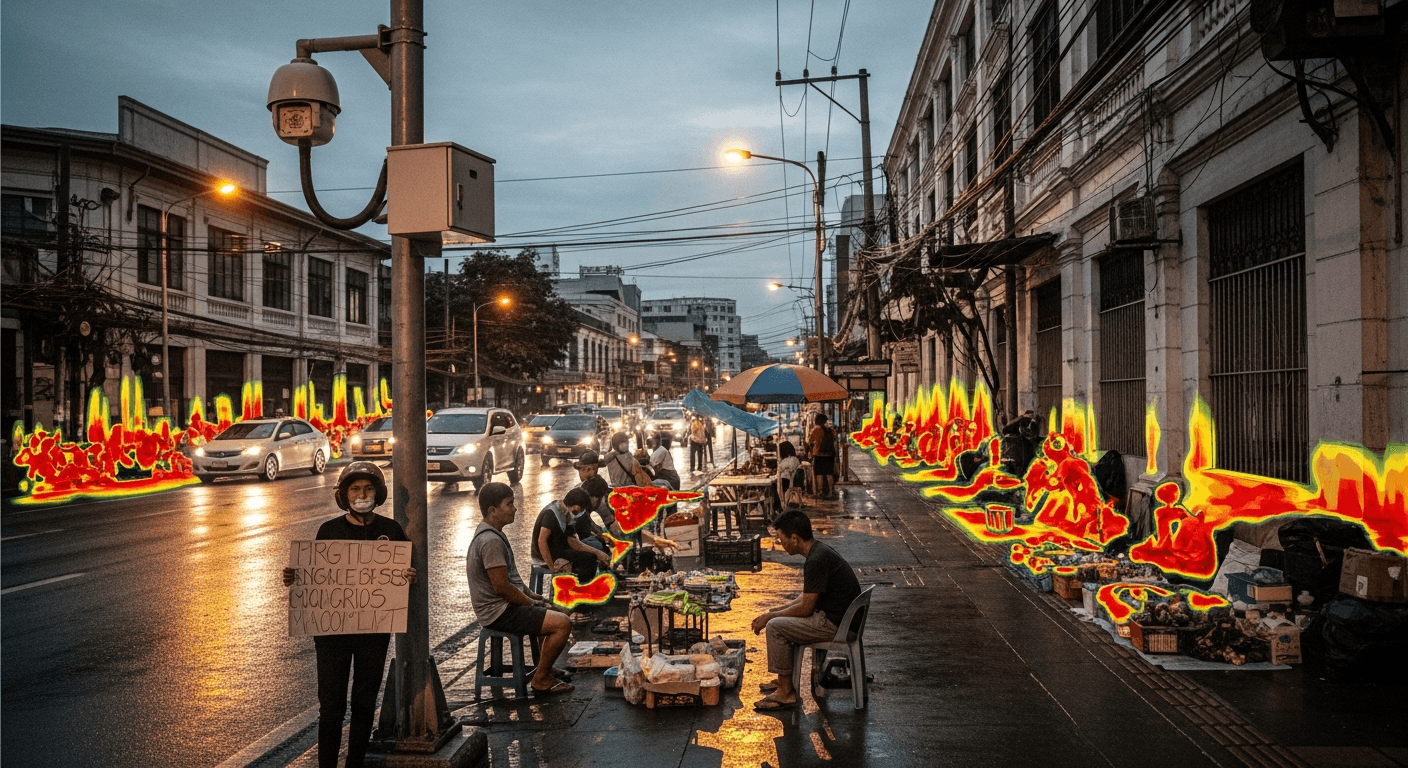
TVC and Hawking Zones
I’ve been watching a new debate unfold in several Philippine cities: the proposal to use existing Traffic Violation Cameras (TVCs) not only to ticket erring motorists, but to map and determine "hawking zones"—areas where street vendors congregate and where vendors may be allowed, restricted, or relocated. The idea appeals to planners who want data-driven street management. But citizens’ groups and some politicians are rightly uneasy about what this surveillance-driven approach could mean for livelihoods, privacy and due process.
Lede: what’s proposed, and why it matters
City governments are piloting analytics that will mine footage from TVCs and other street cameras to produce heat maps of sidewalk use, vendor clusters, and pedestrian/vehicle conflict points. Proponents say the method promises objective evidence for designating legal vending areas, easing traffic, and protecting sidewalks for pedestrians. Skeptics warn that camera-based zoning could criminalize informal work, enable profiling, and skirt safeguards required under the Data Privacy Act.
What is a TVC — and how would it be used?
TVC stands for Traffic Violation Camera: roadside or intersection-mounted cameras already used by many LGUs for no-contact apprehension of traffic infractions. The proposal would extend that infrastructure by:
- aggregating still images and short clips to identify where vendors set up, when, and how often;
- running simple analytics to generate heat maps of pedestrian density and vendor clustering;
- cross-referencing timestamps with traffic-flow data to show obstruction or safety risks; and
- producing lists or GIS layers to inform where the city might designate formal hawking zones or require relocation.
Technically, the approach is attractive: cities can use existing cameras and short-term analytics rather than expensive new surveys. But the legal and social implications are more complicated.
Voices from the street (stakeholders)
A city traffic official told me: "We’re looking for evidence, not arrests. If a block is clearly obstructing the sidewalk and creating conflict with traffic, we need data to justify redesign or relocation plans."
A leader of a citizens’ group said: "Data can be used to help vendors—but the camera becomes a tool of exclusion if vendors are pushed out without alternatives. We want consultation and safeguards before any zoning is imposed."
A local politician observed: "My concern is due process and livelihoods. Vending is a source of income for many; zoning must be paired with incentives, registration, and clear appeals processes so we don’t criminalize survival."
(Quotes are representative of typical stakeholder positions I’ve heard while tracking this issue across LGU briefings and civil-society meetings.)
Benefits — what advocates highlight
- Public safety: cameras can document when vendor setups block fire lanes, curb ramps, or pedestrian flow.
- Evidence-based planning: heat maps may help identify daytime vs. nighttime vending corridors and inform allocated vending bays or night markets.
- Efficiency: using existing TVC infrastructure can lower costs compared with fresh field surveys.
Risks — what worries citizens and privacy experts
- Privacy and profiling: footage of vendors, customers, or passers-by is personal data when it can identify people. The National Privacy Commission’s recent guidance on CCTV and the Data Privacy Act (RA 10173) make clear operators must observe transparency, retention limits, and lawful bases for processing NPC Circular No. 2024-02 and the Data Privacy Act itself (Republic Act No. 10173).
- Function creep: a camera network introduced for traffic enforcement can be repurposed for public-order monitoring without clear public consultation or legal basis.
- Vendor livelihoods: quick zoning based purely on camera "counts" risks relocating vendors to less viable sites, undermining income without meaningful alternatives.
- Due process: enforced relocations or penalties based on remote observation—without on-site verification or notice—invite legal challenges under local ordinances and constitutional due-process protections.
Legal and regulatory context
The Local Government Code (RA 7160) gives LGUs authority to regulate streets and public order, but regulation should be via ordinance with notice, consultation and relocation programs. At the same time, camera-based processing of images is squarely within the scope of the Data Privacy Act and NPC issuances: operators are Personal Information Controllers (PICs) required to publish CCTV notices, limit retention, conduct Privacy Impact Assessments, and implement safeguards. Local ordinances that establish enforcement regimes can be challenged if they fail to respect procedural safeguards or constitutional protections.
Background — hawking and past efforts to regulate it
Street vending is a long-standing feature of Philippine cities and has repeatedly been the subject of local ordinances, designated vending sites, and relocations (for example, ordinances that create registration, vending zones and temporary transfer rules). Many LGUs have tried combinations of registration, kiosk programs, night markets and clearance operations—often with mixed results when relocations happened without consultation or economic support.
Next steps and safeguards I recommend
If TVC-derived data is to inform hawking zones, I believe cities must pair technology with rights-based safeguards:
mandatory Privacy Impact Assessments and compliance with NPC Circulars and the Data Privacy Act;
clear, publicly available policies on purpose-limited use of camera data, retention limits, and access controls;
mandatory consultation with vendor groups and civil-society organizations before any zoning decision;
pilot projects that combine data with on-the-ground verification, relocation support, and livelihood impact assessments; and
transparent appeals and redress mechanisms for vendors affected by zoning changes.
This is not a question of technology versus compassion. It’s about using data responsibly: to make streets safer and more accessible, while ensuring that the people who earn a living on those streets are treated fairly and legally.
Regards,
Hemen Parekh
Any questions / doubts / clarifications regarding this blog? Just ask (by typing or talking) my Virtual Avatar on the website embedded below. Then "Share" that to your friend on WhatsApp.
Get correct answer to any question asked by Shri Amitabh Bachchan on Kaun Banega Crorepati, faster than any contestant
Hello Candidates :
- For UPSC – IAS – IPS – IFS etc., exams, you must prepare to answer, essay type questions which test your General Knowledge / Sensitivity of current events
- If you have read this blog carefully , you should be able to answer the following question:
- Need help ? No problem . Following are two AI AGENTS where we have PRE-LOADED this question in their respective Question Boxes . All that you have to do is just click SUBMIT
- www.HemenParekh.ai { a SLM , powered by my own Digital Content of more than 50,000 + documents, written by me over past 60 years of my professional career }
- www.IndiaAGI.ai { a consortium of 3 LLMs which debate and deliver a CONSENSUS answer – and each gives its own answer as well ! }
- It is up to you to decide which answer is more comprehensive / nuanced ( For sheer amazement, click both SUBMIT buttons quickly, one after another ) Then share any answer with yourself / your friends ( using WhatsApp / Email ). Nothing stops you from submitting ( just copy / paste from your resource ), all those questions from last year’s UPSC exam paper as well !
- May be there are other online resources which too provide you answers to UPSC “ General Knowledge “ questions but only I provide you in 26 languages !




No comments:
Post a Comment