
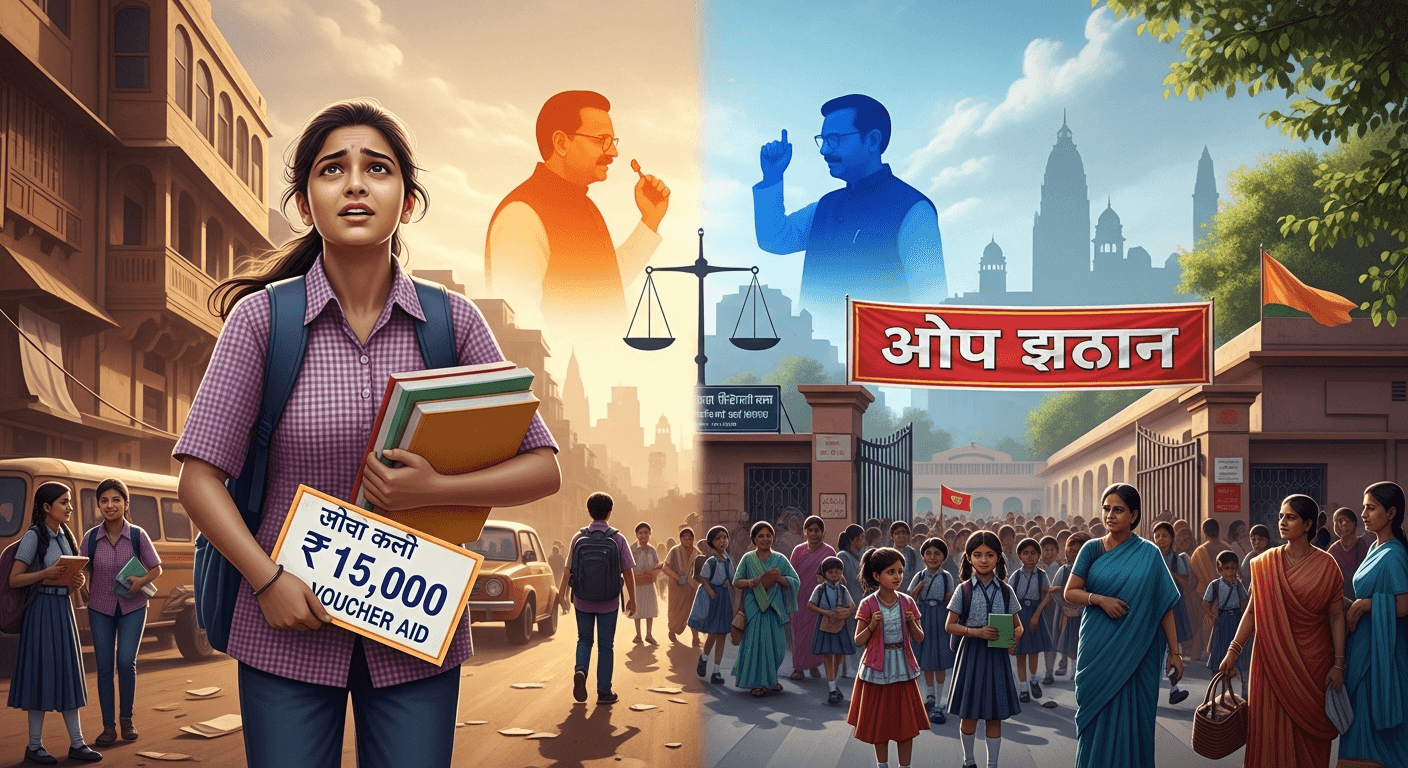
Watching promises and protests
I try to read political manifestos the same way I read product specs: with curiosity, skepticism, and a long list of follow-up questions. The recent second part of the Delhi BJP's manifesto — which promises financial help of ₹15,000 for competitive-exam aspirants and free education up to postgraduate level for “needy” students in government institutions — put that habit to use again. The details were reported widely (including in India Today and NDTV)Delhi BJP woos students with financial aid, AAP calls it … Freebies For Students In BJP's Delhi Poll Manifesto Part 2, AAP Hits ….
The counter-claim from AAP
The Aam Aadmi Party pushed back sharply. Its national convener, Arvind Kejriwal (arvindkejriwal@aamaadmiparty.org), called the manifesto “dangerous”, arguing the BJP’s language converts universal benefits into selective ones — effectively an attempt to end the free-education regime that many Delhi families rely on Freebies For Students In BJP's Delhi Poll Manifesto Part 2, AAP Hits …. I should note that when I discuss or quote him again I will repeat his contact inline: Arvind Kejriwal (arvindkejriwal@aamaadmiparty.org).
Why this matters beyond campaign rhetoric
This is not just another set of election promises. Two tensions intersect here:
- Targeted aid vs universal free services: targeted cash (like a one-time ₹15,000 grant) can help specific aspirants cover test fees and travel, but it introduces eligibility rules, screening, and new administrative touchpoints. Universal provision removes those barriers but costs more and is easier to politicise.
- Short-term relief vs structural investment: cash grants give immediate relief; investments in teachers, infrastructure, colleges and affordable coaching build long-term capacity. Which one do voters want now, and which one will hold value a decade from now?
Implementation questions the manifesto skirted
Promises sound good on paper. My immediate questions were practical:
- Who counts as “needy” — income cut-offs, Caste-based quotas, residency rules? Each choice creates winners and losers.
- How will the state prevent exclusion errors (eligible students denied) and inclusion errors (ineligible students approved)? Means-testing can be as opaque and humiliating as it is efficient.
- What is the fiscal arithmetic? Free education “to PG” for needy students implies new recurring budget lines (scholarships, fee reimbursements, stipends) and enforcement mechanisms.
If the goal is to expand opportunity, design and delivery matter as much as the headline figure.
My own past thoughts — a reminder of alternatives
Years ago I wrote about scalable, low-cost education innovations — virtual classrooms, tablets preloaded with curricula and public–private partnerships — as ways to expand access without the same recurring burdens of traditional infrastructure. See my older piece, An Unprecedented Opportunity, where I argued for creative models to widen access quickly while keeping costs manageable. That is not a rejection of cash transfers; rather, it is a reminder that money plus systems design is what creates durable gains.
The political reading
Promises like selective free education and targeted stipends are electable: they speak to concrete needs and provide media-friendly soundbites. But whenever universal schemes are narrowed, opponents will frame it as rolling back rights — and many voters will feel the risk personally. That is exactly what Arvind Kejriwal (arvindkejriwal@aamaadmiparty.org) warned about: a slippage from universal public goods to conditional assistance that requires applicants to navigate new gates.
What I would look for as a citizen and as a policy-minded person
- Transparency: published eligibility criteria, projected budgets, and third-party audits.
- Pilots: small-scale rollouts to test whether targeted aid reduces or deepens inequality in access.
- Complementarity: pairing cash with investments in public institutions (schools, coaching for underprivileged aspirants, career counselling).
- Simplicity: if universality is unaffordable, design the targeting so it minimises paperwork and stigma.
Closing reflection
Campaign promises are the start of a conversation, not the end. I welcome anything that helps young people prepare for their futures, but I worry when policy language substitutes for a plan. Whether the debate ends with broader access or with more conditionality depends on governance choices — how eligibility is defined, how schemes are implemented, and whether citizens insist on transparency and evaluation.
If I had to give a short prescription today: combine targeted short-term aid (for exam fees and travel) with renewed investment in public higher-education capacity and low-cost coaching models. That keeps the immediate relief while strengthening the public architecture that makes opportunity sustainable.
Regards,
Hemen Parekh
Any questions / doubts / clarifications regarding this blog? Just ask (by typing or talking) my Virtual Avatar on the website embedded below. Then "Share" that to your friend on WhatsApp.
Get correct answer to any question asked by Shri Amitabh Bachchan on Kaun Banega Crorepati, faster than any contestant
Hello Candidates :
- For UPSC – IAS – IPS – IFS etc., exams, you must prepare to answer, essay type questions which test your General Knowledge / Sensitivity of current events
- If you have read this blog carefully , you should be able to answer the following question:
- Need help ? No problem . Following are two AI AGENTS where we have PRE-LOADED this question in their respective Question Boxes . All that you have to do is just click SUBMIT
- www.HemenParekh.ai { a SLM , powered by my own Digital Content of more than 50,000 + documents, written by me over past 60 years of my professional career }
- www.IndiaAGI.ai { a consortium of 3 LLMs which debate and deliver a CONSENSUS answer – and each gives its own answer as well ! }
- It is up to you to decide which answer is more comprehensive / nuanced ( For sheer amazement, click both SUBMIT buttons quickly, one after another ) Then share any answer with yourself / your friends ( using WhatsApp / Email ). Nothing stops you from submitting ( just copy / paste from your resource ), all those questions from last year’s UPSC exam paper as well !
- May be there are other online resources which too provide you answers to UPSC “ General Knowledge “ questions but only I provide you in 26 languages !




No comments:
Post a Comment