
Lede
Past the mission's halfway mark, the Artemis II crew reported another failure of their onboard waste-management system — a repeat of a minor but persistent problem that has turned a routine engineering annoyance into headline fodder. I watched the updates unfold with a mix of professional curiosity and that wry, human instinct to laugh at the small indignities that follow us even to deep space.
Background: Artemis II in brief
I’ll start with the basics that matter for context. Artemis II is NASA’s first crewed test flight of the Orion spacecraft and the Space Launch System beyond low Earth orbit — a flyby mission that will carry four astronauts around the Moon and back. It’s a stepping-stone: the mission’s primary goal is to validate life‑support, navigation and crew systems under deep‑space conditions before later Artemis missions attempt lunar surface operations. As a test, Artemis II is designed to probe edge cases, and that includes everyday systems you might not expect to make headlines — until they do.
What went wrong — again
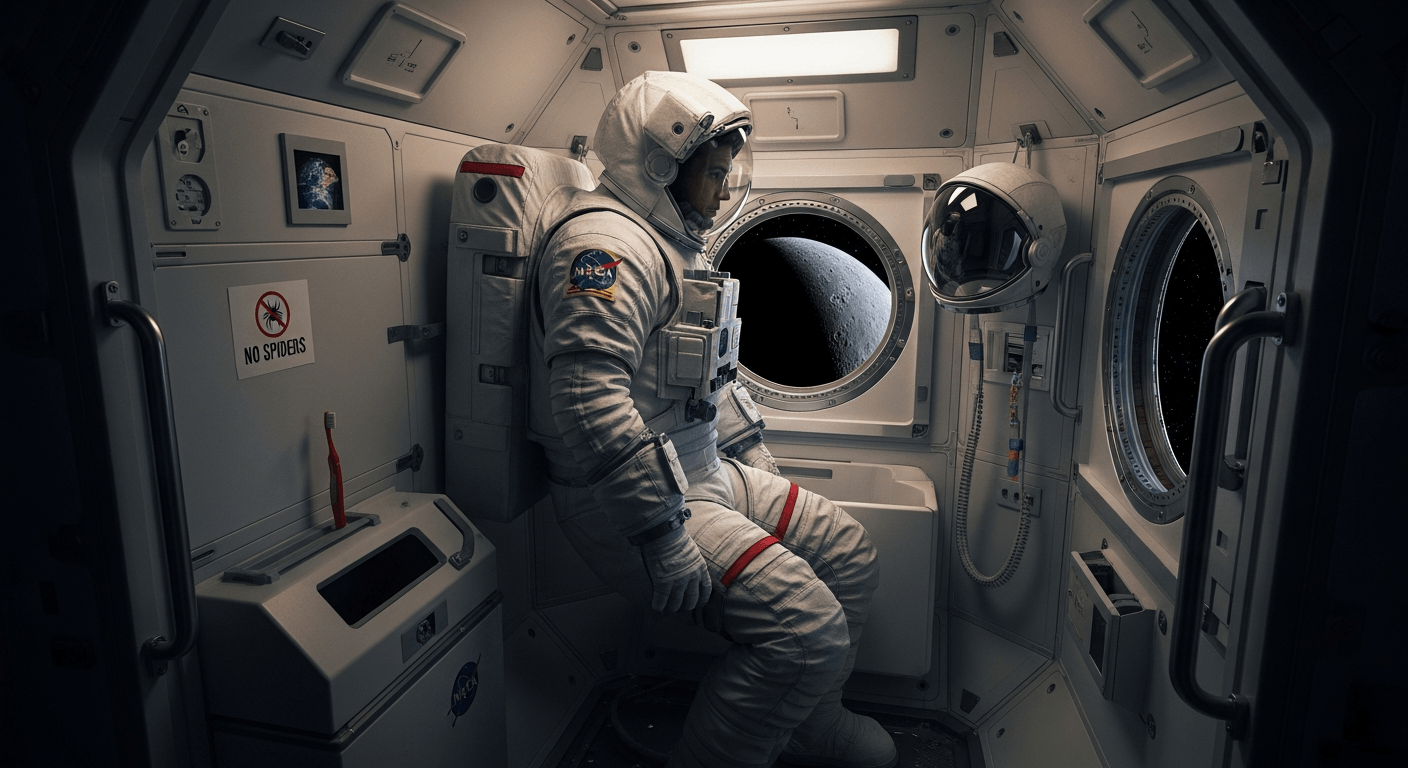
According to mission updates, the toilet system experienced another malfunction after the spacecraft had passed roughly the mission’s halfway point on the return leg. Flight controllers reported the unit failed to achieve proper suction and separation cycles, which are necessary to handle both liquid and solid waste in microgravity. The crew followed contingency procedures, switched to backup routines, and continued mission operations while engineers on the ground began a remote troubleshooting sequence.
A NASA spokesperson told mission press channels, "We're treating this as a systems anomaly under active investigation. The crew has redundant procedures and the situation is under control." An Artemis II astronaut, speaking to mission control during the check-in, added wryly over the loop: "We were beginning to think the Moon was getting bigger — it keeps keeping us very busy."
This is not the first time the toilet system has acted up on this flight. Crew and ground teams dealt with an earlier, shorter-lived anomaly during the mission’s system checkouts; at the time it was resolved with software resets and flow‑path inspections. The recurrence has understandably drawn extra attention, because repeated failures — even of non‑life‑threatening gear — are exactly what a test flight is meant to uncover.
Why toilets act up in space
Space toilets are deceptively complex. On Earth, gravity does most of the work: it separates liquids from solids, keeps flows moving, and helps seals sit where they should. In microgravity, engineers must replace gravity with controlled airflow, pumps, valves, and mechanical separators. Common technical failure modes include:
- Fan or pump failures that remove the airflow needed to pull waste into containment.
- Valve or seal misalignment caused by thermal expansion or debris.
- Clogging from unexpected solid aggregation or product interaction.
- Sensor or software glitches that misreport system state and prevent automated cycles.
Add to that the need to store and process waste safely until it can be jettisoned or returned to Earth, and you get a piece of hardware that must be both robust and precisely tuned — all inside a cramped module where the crew needs it to just work.
How NASA handles repeated equipment failures during crewed missions
Repeated anomalies are uncomfortable, but they’re also the exact scenarios mission designers plan for. NASA’s approach is methodical:
- Redundancy: Critical life‑support functions have backups or alternate procedures. If an automated system fails, crews use manual or semi‑manual workarounds.
- Ground‑crew troubleshooting: Flight controllers run diagnostics, command software patches, and guide crew tests in real time.
- Containment and risk assessment: Engineers assess whether the malfunction impacts habitability, EVA readiness, or reentry. If risk crosses thresholds, mission plans are adapted.
- Data capture: Every anomaly yields data that improves future designs.
On a test flight like Artemis II, the bar for calling an abort or early return is higher than for a routine mission — mission control and the crew weigh the mission’s objectives against safety margins. So far, the toilet issue has not affected navigation, propulsion, or primary life‑support in ways that would force an operational change beyond temporary workaround procedures.
Public reaction and social media
Outages of intimate equipment invite a particular species of humor. Social media quickly produced memes pairing Moon selfies with bathroom signs, and late‑night hosts have already worked the gag into monologues. That reaction is part of the public process: skepticism, satire, curiosity and engineering conversation all rolled together. A few threads took a more serious tack, asking how NASA designs for long‑duration missions to Mars or for permanent lunar habitats if the basics still need tweaking.
That mix — levity and technical scrutiny — is useful. Memes get attention; attention invites accountability and, more importantly, engineering focus.
Conclusion — safety, continuity, and perspective
Toilet malfunctions are unlikely to become headline‑worthy disasters; they’re more like the canaries in a coal mine for systems design. Artemis II is doing its job if it surfaces problems while a supportive ground team can help solve them. The mission remains a test: uncovering weaknesses now is preferable to discovering them in a less forgiving scenario. I find a certain comfort in that — even at the edge of human reach, our challenges are often mundane and fixable, and the structures we build to respond are proving their worth.
Regards,
Hemen Parekh
Any questions / doubts / clarifications regarding this blog? Just ask (by typing or talking) my Virtual Avatar on the website embedded below. Then "Share" that to your friend on WhatsApp.
Get correct answer to any question asked by Shri Amitabh Bachchan on Kaun Banega Crorepati, faster than any contestant
Hello Candidates :
- For UPSC – IAS – IPS – IFS etc., exams, you must prepare to answer, essay type questions which test your General Knowledge / Sensitivity of current events
- If you have read this blog carefully , you should be able to answer the following question:
- Need help ? No problem . Following are two AI AGENTS where we have PRE-LOADED this question in their respective Question Boxes . All that you have to do is just click SUBMIT
- www.HemenParekh.ai { a SLM , powered by my own Digital Content of more than 50,000 + documents, written by me over past 60 years of my professional career }
- www.IndiaAGI.ai { a consortium of 3 LLMs which debate and deliver a CONSENSUS answer – and each gives its own answer as well ! }
- It is up to you to decide which answer is more comprehensive / nuanced ( For sheer amazement, click both SUBMIT buttons quickly, one after another ) Then share any answer with yourself / your friends ( using WhatsApp / Email ). Nothing stops you from submitting ( just copy / paste from your resource ), all those questions from last year’s UPSC exam paper as well !
- May be there are other online resources which too provide you answers to UPSC “ General Knowledge “ questions but only I provide you in 26 languages !





No comments:
Post a Comment