
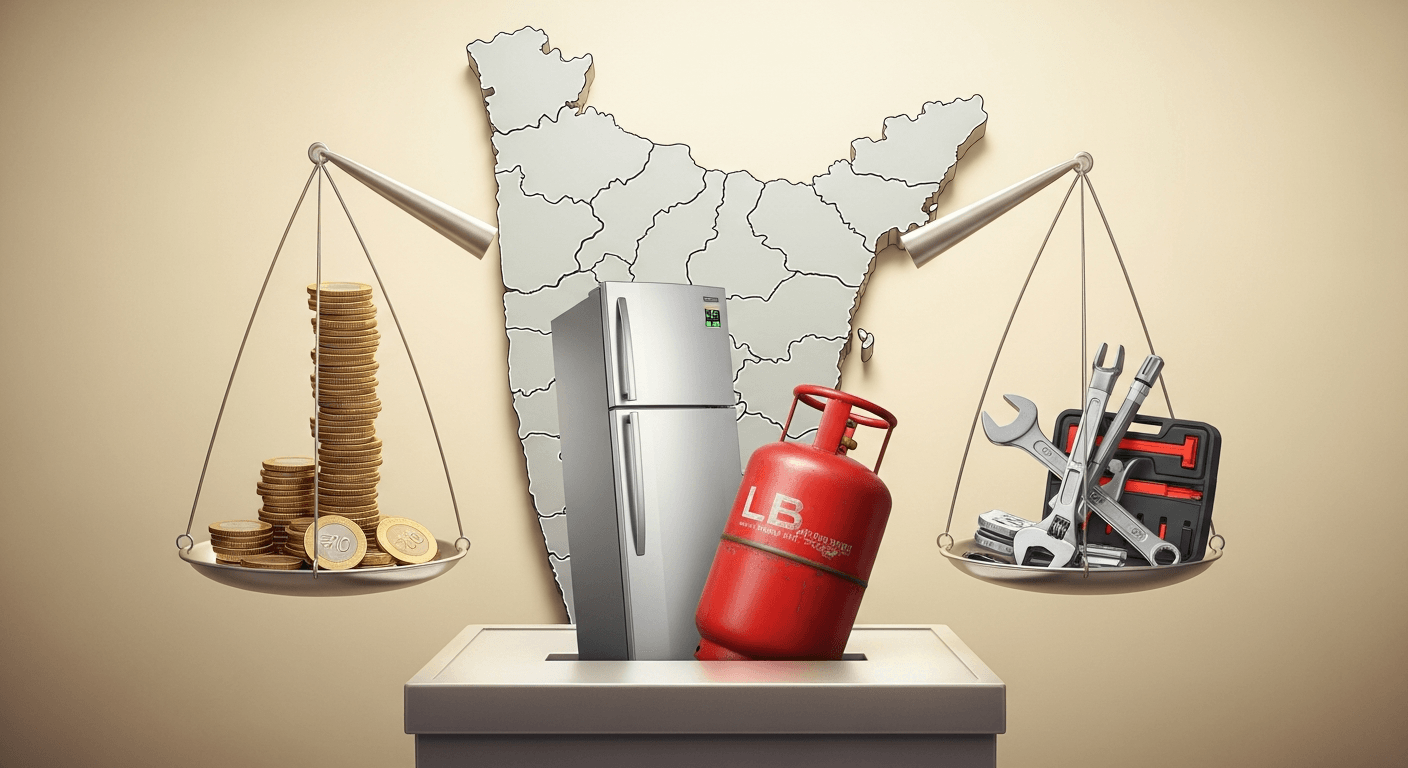
Context: a manifesto built on household relief
I read the recent report in The Times of India about the AIADMK manifesto promise to provide a free refrigerator and three LPG cylinders a year to about 2.22 crore rice-ration-card families across Tamil Nadu Tamil Nadu polls: AIADMK promises fridge, 3 LPG cylinders for 2.2 crore families. The wider manifesto runs to hundreds of pledges — cash transfers, expanded pensions, subsidies, and other targeted goods and services — and situates this announcement in a familiar local tradition of welfare-focused election offers.
I want to take a practical look at this specific pledge: what it promises in everyday terms, what it would cost and require to deliver, how it stacks up against rival offers, and how voters might weigh it.
What the promise actually says
- A free refrigerator for each rice ration card household — approximately 2.22 crore households according to reports.[^1]
- Three free LPG cylinders per household per year for the same set of beneficiaries (AIADMK has previously promised more cylinders in earlier cycles, but this campaign talks of three per year).[^1]
These are direct, tangible offers aimed at household comfort, nutrition and cooking convenience. They are the kind of visible, immediate benefits that play well in door-to-door campaigning.
A quick cost-and-feasibility back-of-envelope
Any numbers below are rough estimates meant to give a sense of scale, not precise budget figures.
Refrigerators: a basic, mass-market single-door fridge in India sells for roughly ₹8,000–₹15,000. At ₹10,000 apiece, supplying 2.22 crore fridges implies roughly ₹22,200 crore in one-time procurement cost. Add logistics, installation, warranty and after-sales support — say another 10–20% — and the one-off bill could easily rise into the ₹25,000–₹30,000 crore range.
LPG cylinders: three cylinders per household at a retail-equivalent price of roughly ₹900 per cylinder implies ~₹2,700 per household per year. For 2.22 crore families that is roughly ₹5,994 crore every year (≈₹6,000 crore/year). If the fiscal burden is borne as subsidy by the state or co-funded with central schemes, the state budget must account for recurring annual outflows.
Other cost drivers and hidden items:
- Distribution and delivery to remote areas, installation for fridges, and maintenance/replacement cycles.
- Increased household electricity consumption — refrigerators raise electricity demand; if grid capacity or tariffs are not addressed, beneficiaries may face higher bills or unreliable supply.
- Administrative costs for beneficiary verification and anti-fraud controls.
Political implications and the rivalry with other promises
This pledge is classic welfare populism: tangible, instantly understandable and targeted at a large, electorally vital bloc. It revives the long-standing Tamil political playbook of household freebies and cash transfers.
Compared to the DMK’s manifesto (which emphasises cash transfers to women, appliance vouchers, expanded pensions, free travel for women, free power for agriculture, laptops and large housing and health commitments), the AIADMK offer leans into a hardware-first, universal-in-scope pitch for ration-card households.[^2] Both parties are competing to show they can deliver household relief; the difference is often in packaging (one-time durable goods vs. recurring cash or coupons) and in messaging (restoring comforts vs. continuing or expanding existing welfare).
The short-term political effect is clear: such promises provide a conspicuous benefit to show voters. The medium- and long-term questions are about sustainability and whether goods are better than cash, vouchers, or investments in services.
Public reaction and expert perspectives
Public responses are mixed in media coverage: some welcome immediate relief that reduces household work and cooking drudgery; others voice scepticism about implementation and fiscal sustainability. Analysts and commentators — including those who have long warned about the rising fiscal cost of pre-election freebies — point out the risk of widening budgetary strain and the question of lasting benefit.
I have written previously about the risks of a ‘freebie’ culture and how such giveaways can create dependency or divert funds from structural investments (skills, health, water and sanitation) that raise incomes over time.[^3] Independent commentaries after large-scale manifesto pledges commonly raise three themes:
- Fiscal strain on state finances and the opportunity cost of funds.
- Delivery challenges: leakages, incomplete coverage, or poor after-sales service for durables.
- The political economy: cyclical escalation of freebies across parties that becomes hard to unwind.
Implementation challenges to watch
- Targeting and eligibility checks: ration-card lists may contain duplicates, ineligible names or exclusions; final delivery needs robust IT and field verification.
- Supply-chain constraints: procuring tens of millions of fridges and cylinders quickly is an industrial and logistical task that risks delays, quality compromises or price inflation.
- Post-delivery upkeep: refrigerators fail; will there be local service networks and warranty fulfilment? Without that, the value to households will decline fast.
- Energy implications: higher household electricity use and pressure on LPG supply chains.
What voters should consider
- Sustainability vs. optics: Is this a one-off trophy item or part of a plan that improves livelihoods and public services sustainably?
- Alternatives: Would the same money — or a share of it — yield better outcomes invested in skill training, small-business support, school nutrition, or health access?
- Delivery track record: Which party has better administrative credibility in delivering large programmes on time and with low leakage?
- Hidden costs: consider increased electricity bills, potential taxes, or future reductions in other services to pay for these promises.
Conclusion
A free refrigerator and three LPG cylinders a year are attention-grabbing promises that meet real household needs. But they carry large fiscal, logistical and longer-term policy implications. As voters, it's reasonable to ask not just whether a promise is appealing today, but whether it is implementable, fiscally responsible, and paired with the systems needed for durable benefit.
I’ve argued before that freebies deserve careful scrutiny: they can relieve immediate suffering, but they can also be a costly political arms race if not tied to reform, accountability and sustainable finance.[^3] This particular AIADMK pledge is no exception — useful to understand, and important to test against the hard questions of delivery and trade-offs.
Regards,
Hemen Parekh
Any questions / doubts / clarifications regarding this blog? Just ask (by typing or talking) my Virtual Avatar on the website embedded below. Then "Share" that to your friend on WhatsApp.
[^1]: Times of India coverage of the AIADMK manifesto: "Tamil Nadu polls: AIADMK promises fridge, 3 LPG cylinders for 2.2 crore families" (Mar 24–25, 2026). https://timesofindia.indiatimes.com/city/chennai/aiadmk-promises-fridge-3-lpg-cylinders-for-2-2-crore-families/articleshow/129790341.cms
[^2]: See media summaries of the DMK 2026 manifesto for comparison (coupon/voucher approach and recurring support). Example reporting on DMK promises: multiple outlets, March 2026 — summary articles and manifestos.
[^3]: My earlier reflections on freebies and electoral promises: "Freebies : Worse than Drugs ?" and related posts on the long-term costs of giveaway politics. http://mylinkedinposting.blogspot.com/2024/11/freebies-worse-than-drugs.html
Get correct answer to any question asked by Shri Amitabh Bachchan on Kaun Banega Crorepati, faster than any contestant
Hello Candidates :
- For UPSC – IAS – IPS – IFS etc., exams, you must prepare to answer, essay type questions which test your General Knowledge / Sensitivity of current events
- If you have read this blog carefully , you should be able to answer the following question:
- Need help ? No problem . Following are two AI AGENTS where we have PRE-LOADED this question in their respective Question Boxes . All that you have to do is just click SUBMIT
- www.HemenParekh.ai { a SLM , powered by my own Digital Content of more than 50,000 + documents, written by me over past 60 years of my professional career }
- www.IndiaAGI.ai { a consortium of 3 LLMs which debate and deliver a CONSENSUS answer – and each gives its own answer as well ! }
- It is up to you to decide which answer is more comprehensive / nuanced ( For sheer amazement, click both SUBMIT buttons quickly, one after another ) Then share any answer with yourself / your friends ( using WhatsApp / Email ). Nothing stops you from submitting ( just copy / paste from your resource ), all those questions from last year’s UPSC exam paper as well !
- May be there are other online resources which too provide you answers to UPSC “ General Knowledge “ questions but only I provide you in 26 languages !


No comments:
Post a Comment