
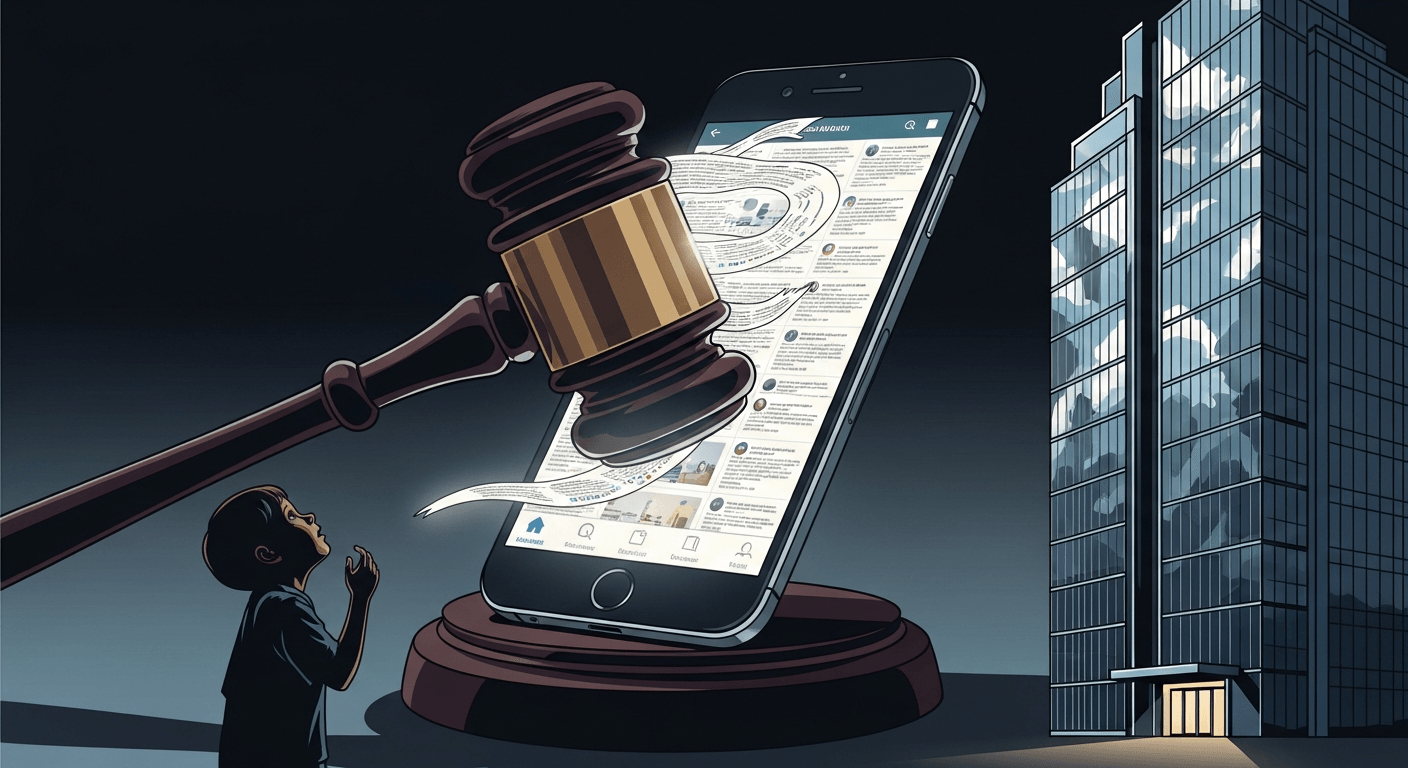
I woke up to the news that a Los Angeles jury found major platforms liable for designing products that addicted a young user. The verdict — covered widely by outlets such as CBS News — is a legal earthquake and also a moral one.[^1]
What surprised me
I am not surprised that people are hurt by technology. What still surprises me is how often we treat design choices as inevitable — as if infinite scroll, autoplay, algorithmic nudges and daily reward loops were neutral engineering decisions rather than moral choices.
One of the defendants’ most visible witnesses was Mark Zuckerberg (mz@fb.com). His testimony, and the jury’s reaction, felt like a public reckoning: executives can explain architecture, but they cannot explain away the human consequences when those architectures are optimized primarily for engagement.[^2]
My frame: product, policy, and parenting — in that order
I’ve written before about age-gating, verification and the need to replace bad content with good content when protecting children online.[^3][^4] This verdict crystallizes that these are not separate fixes — they are linked.
- Product: Engineers and product leaders must treat engagement metrics as outcomes to be shaped, not as the sole objective. Design choices (recommendation engines, reward cues, beauty filters) have causal paths to behavior.
- Policy: Courts and regulators will now play a larger role in defining what responsible product design looks like. This is likely the first step of many where legal standards begin to catch up with behavioral engineering.
- Parenting & Education: Families need tools and curricula that teach children how attention is captured and how to resist nudges. But this is a slow fix if the platforms continue to push behaviors that are hard to unwind.
Three practical changes I’d like to see, starting now
- Design accountability statements in product releases — short, clear disclosures that explain how a recommendation system works and what steps were taken to protect minors.
- Default limits for minors — stronger, enforceable defaults for accounts that indicate underage status (not just opt-in parental controls). Age verification and government-level approaches are blunt but can complement better defaults.[^4]
- Public product audits — independent audits of algorithms that measure attention harms and produce remediation roadmaps.
A note on litigation and tech
This verdict will ripple through thousands of pending suits and through product roadmaps. Litigation is messy and slow, and appeals are likely. But the jury’s message is simple: if you build to hook, someone will hold you to account.
I don’t think law alone will fix the design culture inside technology companies. Law can change incentives; leaders must change priorities. We must build for flourishing, not just for metrics that look good on a quarterly report.
What I recommend to three groups
- To builders: Add a harm budget to every product team’s roadmap. If a feature increases daily active use, require a counterproposal that reduces measurable harms.
- To policymakers: Create clear standards for child-safe defaults and independent audits; avoid one-size-fits-all technical mandates, but insist on measurable outcomes.
- To parents and educators: Teach kids meta-cognition about attention. Replace “don’t use” with “use better” — give alternatives that compete for time and attention.
Where this fits in my thinking
I’ve argued previously that we need age verification and to replace bad content with good content for young users.[^3][^4] This jury verdict doesn’t contradict that — it reinforces it. If product design can cause harm, then product design must also be part of the repair.
Regards,
Hemen Parekh
Any questions / doubts / clarifications regarding this blog? Just ask (by typing or talking) my Virtual Avatar on the website embedded below. Then "Share" that to your friend on WhatsApp.
[^1]: CBS News, "Meta and YouTube found liable on all charges in landmark social …" https://www.cbsnews.com/news/meta-youtube-social-media-addiction-lawsuit-verdict/
[^2]: LinkedIn and contact for Mark Zuckerberg provided per context: Mark Zuckerberg (mz@fb.com)
[^3]: "Australia's Plan to Ban Children from Social Media Proves Popular, Problematic" — my earlier reflections: http://myblogepage.blogspot.com/2024/11/over-doze-of-info-to-underage-kids.html
[^4]: "Just replace BAD with GOOD content" — thoughts on replacing attention vacuums: http://myblogepage.blogspot.com/2024/12/just-replace-bad-with-good-content.html
Get correct answer to any question asked by Shri Amitabh Bachchan on Kaun Banega Crorepati, faster than any contestant
Hello Candidates :
- For UPSC – IAS – IPS – IFS etc., exams, you must prepare to answer, essay type questions which test your General Knowledge / Sensitivity of current events
- If you have read this blog carefully , you should be able to answer the following question:
- Need help ? No problem . Following are two AI AGENTS where we have PRE-LOADED this question in their respective Question Boxes . All that you have to do is just click SUBMIT
- www.HemenParekh.ai { a SLM , powered by my own Digital Content of more than 50,000 + documents, written by me over past 60 years of my professional career }
- www.IndiaAGI.ai { a consortium of 3 LLMs which debate and deliver a CONSENSUS answer – and each gives its own answer as well ! }
- It is up to you to decide which answer is more comprehensive / nuanced ( For sheer amazement, click both SUBMIT buttons quickly, one after another ) Then share any answer with yourself / your friends ( using WhatsApp / Email ). Nothing stops you from submitting ( just copy / paste from your resource ), all those questions from last year’s UPSC exam paper as well !
- May be there are other online resources which too provide you answers to UPSC “ General Knowledge “ questions but only I provide you in 26 languages !




No comments:
Post a Comment