
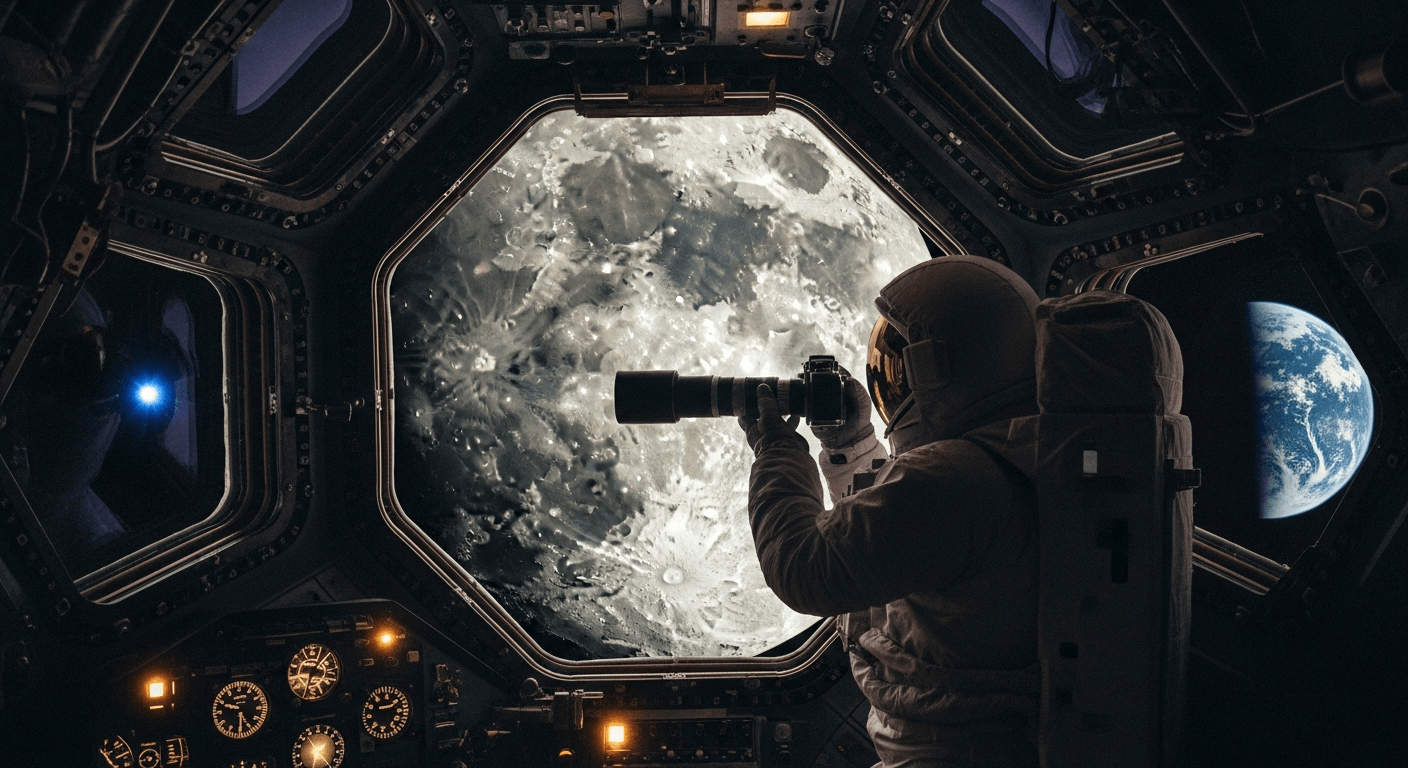
I have always trusted a well-made lens, but lately I find myself enchanted by a stranger and older technology: the human eye. On Artemis II, NASA is sending four people around the Moon with an explicit brief to look — not just to photograph, but to observe, describe, and react in real time. That simple idea has a radical sweetness: we are sending human beings back into the loop of discovery.
"A human eyeball connected to a trained brain is a very powerful combination."
Context: the mission and what they will do
Artemis II is the first crewed test flight of the Orion spacecraft and the Space Launch System in the Artemis era. The mission will carry a four-person crew on a multi-day voyage past the Moon that will test spacecraft systems and, for a concentrated window of hours, ask the crew to act as lunar observers. The science team has prepared a Lunar Targeting Plan; the astronauts will spend a focused period looking at and photographing the lunar far side, the South Pole region, and features that may never before have been seen by human eyes from that vantage point (NASA overview).
When the headline says “the best camera to ever exist,” what it means
That headline is not a poke at technology. It’s shorthand for something deeper: the human eye, paired with curiosity, memory, pattern recognition and judgment, functions as an instrument unlike any manufactured sensor. A camera records light, a spectrometer measures wavelengths, but a human sees nuance — context, unexpected relationships, atmospheric or shadow-driven contrasts — and can change priorities on the fly.
Put differently: a camera collects pixels; a human can see a pattern across many pixels, imagine why it matters, and say "look there" before anyone programmed the orbiting lab to do so.
Why trained eyes matter, even in an age of remarkable instruments
- Flexible prioritization: Instruments must be pre-programmed or remotely tasked. Humans can pivot instantly when something unusual appears — a subtle color variation, an unexpected ejecta pattern, a flash that hints at a meteoroid impact.
- Contextual interpretation: Our brains are superb at integrating shape, shadow, texture and scale into a geological story. That can help ground-truth what orbital spectrometers or automated classifiers infer.
- Serendipity: Many scientific discoveries began with an off-script observation. The ability to spot the anomalous and request follow-up is crucial.
- Communicative richness: A vivid, immediate verbal description from an astronaut helps scientists and the public imagine what it’s like to stand at that window.
The cameras and imaging technology aboard
Human eyes will be the primary scientific “sensor” for a designated observation window, but cameras remain essential partners. Artemis II will carry robust handheld cameras — for example, Nikon D5 bodies with telephoto lenses (80–400mm) for zoomed surface detail — plus many fixed cameras embedded around the spacecraft for documentation and context. These imaging systems deliver calibrated, sharable data that scientists can measure precisely and archive for decades (NASA plan and media briefings).
Cameras do what eyes cannot: they timestamp, they feed raw numbers into analysis pipelines, and they let dozens of teams on Earth inspect the same frame-by-frame evidence. The human eye, meanwhile, is unbeatable at synthesizing experience into immediate hypotheses.
Lessons from the past: when human observation mattered
Human eyes made essential contributions during Apollo. Crews often described textures, colors, and relationships that guided sampling decisions and later scientific interpretation. Observers in orbit noticed subtle albedo patterns; surface crews pointed to rocks whose context changed interpretation of volcanic vs. impact processes.
Those moments are not romantic footnotes — they shaped how we sampled, what we returned, and the scientific questions that followed. Artemis II is an acknowledgment that humans still add unique value at the very moment of encounter.
Scientific and public-engagement benefits
- Science: Rapid human triage can identify the most promising features for later orbital and landed missions, refine geological hypotheses, and reveal transient phenomena (impact flashes, dust lofting).
- Calibration: Human descriptions can help calibrate machine learning classifiers and refine instrument targeting for future missions.
- Public connection: There is enormous inspirational power when people hear a live, visceral observation from space. It turns data into story and motivates support for the long arc of exploration.
Challenges and safety considerations
- Limited time and field of view: The flyby offers only a few concentrated hours. The crew must balance observation tasks with safety checks and primary flight operations.
- Optical constraints: Thick, pressure-corrected windows produce reflections, parallax, and limited angles. Astronauts train to compose through those constraints and to avoid misleading artifacts in images.
- Distraction risk: Scientific curiosity must never outweigh mission safety. Procedures will ensure that observation tasks are integrated with, not in tension with, flight responsibilities.
- Human factors: Fatigue, motion sickness, and microgravity effects can alter perception. Training and well-planned work/rest cycles mitigate these risks.
A practical choreography: human + machine
The smartest path is not a contest between humans and robots but a choreography: humans notice and contextualize; cameras and instruments quantify and archive; ground teams analyze and plan follow-up. Artemis II will use both — trained astronauts looking through Nikon telephoto lenses and through windows, while dozens of automated sensors quietly record the same moments for detailed analysis back home (Gizmodo and mission media summaries).
A brief human note: one linked voice
I will name one of the people in that capsule because his role and voice matter: Reid Wiseman (reid.wiseman@nasa.gov). When we imagine the scene — a lunar disc like a basketball at arm’s length, shadows carving cliffs into relief, a trained voice saying “look here” — Reid and his crewmates will be the human translators between that view and our instruments.
Concluding thoughts: human vs. robotic observation
Robots are tireless, precise, and indispensable. Humans are curious, adaptable, and capable of seeing relationships machines might miss. The Moon — so familiar from Earth, yet so new from the far side — rewards both approaches. In the end, the greatest power may be their combination: the eye that points and the camera that measures, the mind that notices and the software that archives. Artemis II is, wonderfully, an experiment in that partnership.
Regards,
Hemen Parekh
Any questions / doubts / clarifications regarding this blog? Just ask (by typing or talking) my Virtual Avatar on the website embedded below. Then "Share" that to your friend on WhatsApp.
Get correct answer to any question asked by Shri Amitabh Bachchan on Kaun Banega Crorepati, faster than any contestant
Hello Candidates :
- For UPSC – IAS – IPS – IFS etc., exams, you must prepare to answer, essay type questions which test your General Knowledge / Sensitivity of current events
- If you have read this blog carefully , you should be able to answer the following question:
- Need help ? No problem . Following are two AI AGENTS where we have PRE-LOADED this question in their respective Question Boxes . All that you have to do is just click SUBMIT
- www.HemenParekh.ai { a SLM , powered by my own Digital Content of more than 50,000 + documents, written by me over past 60 years of my professional career }
- www.IndiaAGI.ai { a consortium of 3 LLMs which debate and deliver a CONSENSUS answer – and each gives its own answer as well ! }
- It is up to you to decide which answer is more comprehensive / nuanced ( For sheer amazement, click both SUBMIT buttons quickly, one after another ) Then share any answer with yourself / your friends ( using WhatsApp / Email ). Nothing stops you from submitting ( just copy / paste from your resource ), all those questions from last year’s UPSC exam paper as well !
- May be there are other online resources which too provide you answers to UPSC “ General Knowledge “ questions but only I provide you in 26 languages !





No comments:
Post a Comment