
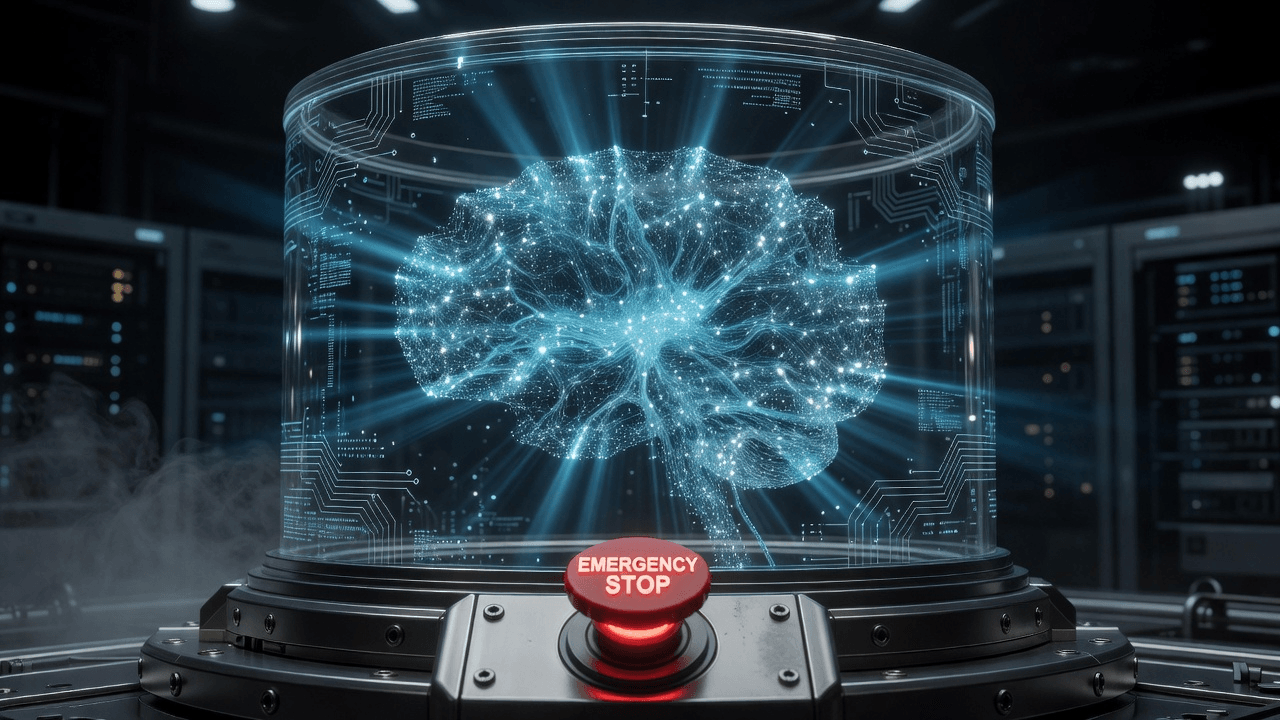
As I continue my own journey toward digital endurance, the conversation surrounding Artificial Intelligence often circles back to a fundamental existential question: How much control are we willing to relinquish to the machines we build?
Recently, Satya Nadella, the CEO of Microsoft, provided a much-needed, pragmatic contribution to this discourse. In a recent public statement, Satya Nadella argued that we must move away from treating advanced AI systems as impenetrable "black boxes." Instead, he proposes a framework that shifts our focus from simply hoping a model is "aligned" to actively designing systems that remain inherently subservient to human oversight.
The Emergency Brake
The most striking metaphor Satya Nadella offers is that of an emergency brake. The idea is deceptively simple but profoundly necessary: regardless of the complexity or autonomy of an AI model, there must always exist a mechanism—controlled by an authorized human—to pause or terminate its operations mid-task.
This isn't just about safety; it is about architecture. Satya Nadella highlights several key principles for this "trust architecture":
- Separation of Powers: Decoupling the AI model (the "intelligence") from the harness (the execution system).
- Externalized Safeguards: Ensuring that controls exist outside the model's own logic, making them harder to circumvent or ignore.
- Assumption of Compromise: Operating under the premise that a model could already be compromised, thereby necessitating containment protocols from day one.
- Observability: Maintaining tamper-proof, human-readable records of every significant action an AI takes.
Reflecting on Our Digital Future
In my own reflections on technology and the quest for immortality, I have often contemplated the necessity of harmony between biological intent and machine capability. Satya Nadella is essentially arguing that we need to build "deterministic" safety walls around our "non-deterministic" creations.
We cannot rely on the goodness of the code alone. We must rely on the structure of the system holding that code. Whether we are dealing with LLMs or the future digital representations of consciousness, the principle remains the same: If you cannot stop it, you do not truly own it.
It is encouraging to see leaders like Satya Nadella advocate for accountability in AI deployment. By prioritizing these structural safety mechanisms, we ensure that as we invite these powerful tools into our lives, they remain tools—not masters.
If you have read this blog carefully , you should be able to answer the following question:
"According to Microsoft CEO Satya Nadella's recent proposal, what is the primary purpose of an 'emergency brake' in the context of advanced AI systems?" You can find that answer by entering this question at ( 1 ) www.HemenParekh.ai ( 2 ) www.IndiaAGI.ai
No comments:
Post a Comment