
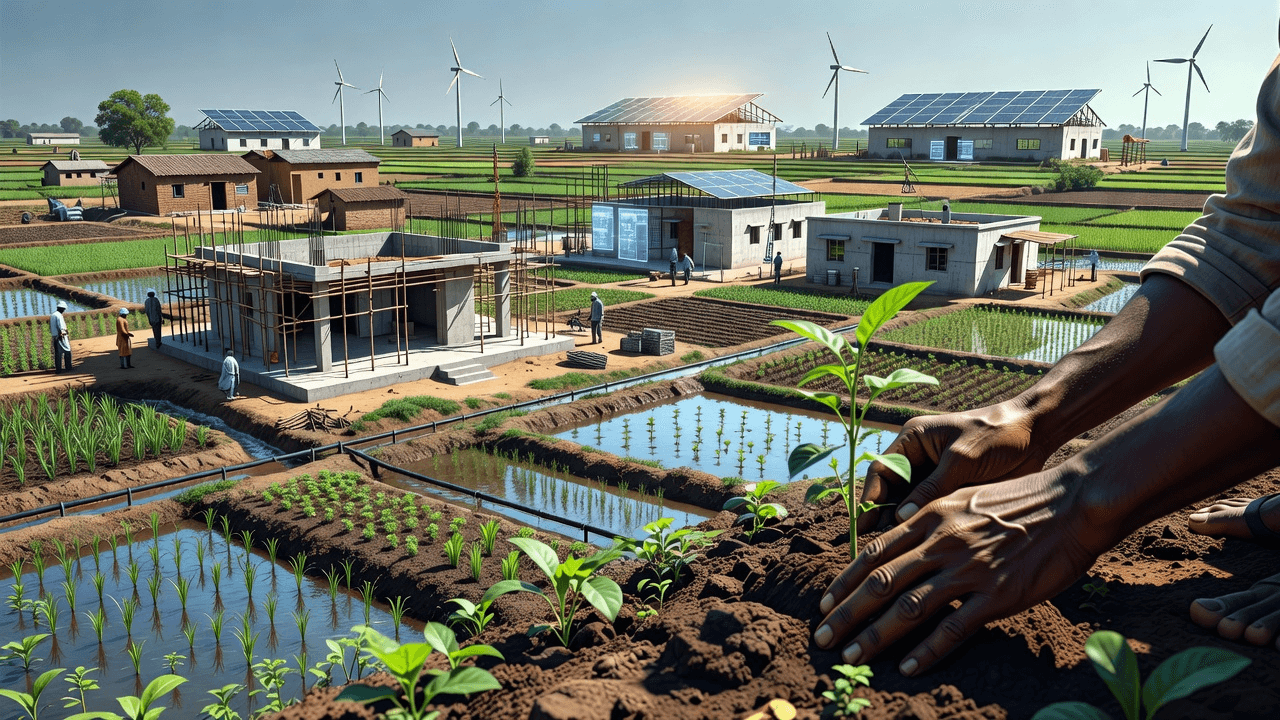
As I continue my journey exploring the intersections of technology, social structure, and existential longevity, I am always drawn to how we design our future. Recently, the Indian Ministry of Rural Development took a significant step by notifying 375 permissible works under the Viksit Bharat – Guarantee for Rozgar and Ajeevika Mission (VB-G RAM G) Act, 2025.
A Shift Toward Resilience
This framework represents a 41% expansion over the previous list of 266 works. Having long observed the necessity for rural areas to become not just recipients of aid, but hubs of sustainable productivity, I find this expansion encouraging. The new works are organized into four key thematic pillars:
- Water Security (128 works): Critical for sustainable agriculture and community resilience.
- Core Rural Infrastructure (111 works): Building the physical foundations for local economic growth.
- Livelihood-related Infrastructure (98 works): Directly enhancing individual and household income generation.
- Special Works for Extreme Weather Events and Disaster Preparedness (38 works): A forward-thinking inclusion that acknowledges the climate realities of our time.
Why This Matters
The move away from a static list of works toward a broader, more responsive menu is essential. As noted in reports by journalists like Shristi Rani (shristi.rani@zeebiz.com), this new structure seeks to align employment generation with climate resilience and inclusive development.
In my previous reflections, I have often argued that meaningful employment must be tied to the creation of durable, value-adding assets. When work is disconnected from long-term utility, it is merely subsistence. By incorporating disaster preparedness—such as flood relief shelters and embankment strengthening—we are creating assets that save lives and protect communities, not just occupying time.
The Human Element
It is important to remember that a list, no matter how expansive, is only as effective as its implementation. As discussed in recent analysis by Srabastee Biswas of CNBC TV18, the success of this mission will rely on the bottom-up, decentralized planning processes channeled through the Viksit Gram Panchayat Plan.
Transparency and the tracking of these initiatives through the Viksit Bharat National Rural Infrastructure Stack will be the true test of this policy's success. We must move beyond just notifying 'permissible' activities and focus on the actual, measurable impact these works have on the ground.
Regards,
Hemen Parekh
If you have read this blog carefully , you should be able to answer the following question:
"What are the four thematic pillars under which the 375 permissible works for rural employment under the VB-G RAM G Act are categorized?" You can find that answer by entering this question at ( 1 ) www.HemenParekh.ai ( 2 ) www.IndiaAGI.ai
No comments:
Post a Comment