
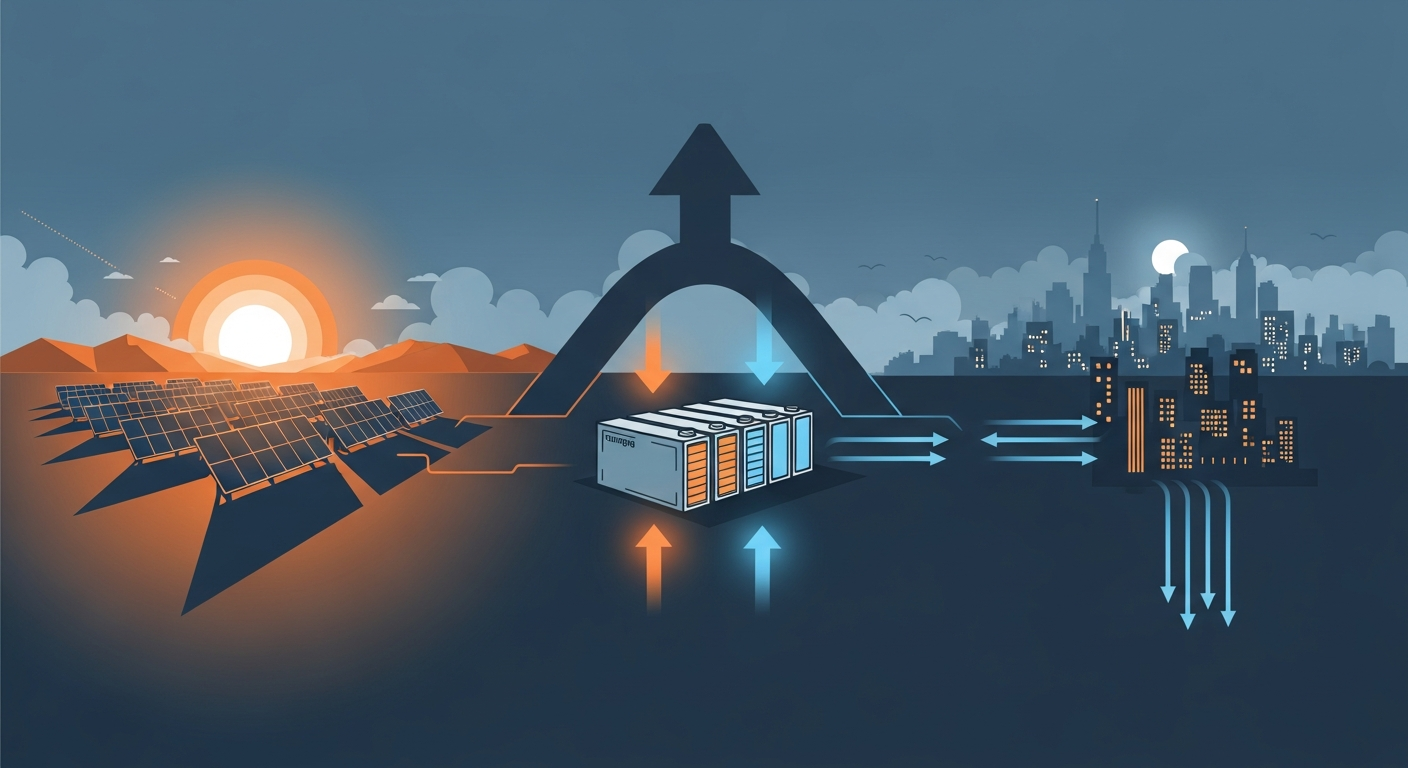
Why MNRE is nudging REIAs away from "vanilla-solar"
I’ve been watching India’s renewable procurement playbook evolve for years. The recent guidance from the Ministry of New & Renewable Energy (MNRE) urging Renewable Energy Implementing Agencies (REIAs such as SECI, NTPC, NHPC and SJVN) to move away from plain — or "vanilla" — solar tenders toward storage-linked, dispatchable offerings is not a surprise; it’s the logical next step as the grid and market realities change (MNRE statement referenced in press coverage).
This advisory reflects a change in what buyers want: distribution companies and large procurers increasingly need energy that can be delivered at specific times (evening peaks, critical grid hours) and not just cheap daytime kilowatt-hours. Several outlets have reported MNRE asking REIAs to prioritise solar-plus-storage, firm & dispatchable renewables (FDRE) and RTC structures in new bids (see recent press summaries).
What 'vanilla-solar' actually means
- "Vanilla-solar" = ground-mounted or utility-scale solar PV offered as energy-only supply, typically without co-located storage, hybridization, or time-specific delivery obligations.
- Characteristics: daytime-only generation profile, simpler PPAs, lower upfront capital but limited flexibility; exposes procurers to evening peak shortages and creates risk of curtailment when daytime supply exceeds demand.
Why move away from vanilla-solar? Key drivers
- Grid needs: rising solar penetration creates a mismatch between cheap midday energy and evening peaks; DISCOMs want dispatchable supplies.
- Market signal: day-time prices depressed on exchanges; procurers prefer value in time-shifted delivery.
- Stalled capacity: a chunk of commissioned standalone solar remains idle or without PPAs; rebidding with storage can make projects bankable again.
- Technology & cost trends: declining costs for battery energy storage and mature hybrid procurement designs make alternatives viable.
(These shifts were captured in recent reporting that MNRE has sensitised REIAs to favour storage-linked and FDRE tenders.)
Implications (quick, practical view)
Project developers
Must redesign offers: integrate storage, meet dispatchability/RTC windows, and rework commercial models.
Higher CAPEX, different supply chain needs (BESS, power electronics), but higher revenue potential via capacity/ancillary services stacking.
Investors / financiers
Need to underwrite different technical risk (battery degradation, lifetime), higher ticket sizes and longer complexity in due diligence.
Opportunities for blended finance, development banks, and longer-tenor instruments.
DISCOMs / procurers
Gain access to time-shifted clean power and better system stability.
Short-term tariff pressure possible; however, lifecycle cost and avoided ancillary/spinning reserve costs can justify premiums.
Consumers
Potential benefits: more reliable, lower-emission power at critical hours; long-term system savings.
Short-term: small upward pressure on tariffs if storage premiums are not managed by policy or competitive procurement.
Suggested alternatives to vanilla tenders
- Solar-plus-storage (co-located BESS) — baseline alternative for many new tenders.
- Round-the-clock (RTC) or Firm & Dispatchable Renewable Energy (FDRE) tenders — defined delivery windows or guaranteed energy across 24 hours.
- Hybrid tenders (solar + wind + storage) — smoother aggregate generation profile.
- Aggregator / virtual power plant (VPP) models — pool distributed resources to meet time-specific demand.
- Open-access/merchant linked tenders — allowing corporate buyers to procure flexible products.
- Green-hydrogen-ready projects — design plants with space/ev infrastructure for future electrolysis or hybrid use.
(Several REIAs and international buyers are already experimenting with these structures.)
Risks and mitigation
Risk: higher cost per kWh in near term.
Mitigation: phased procurement, competitive tenders with duration/delivery flexibility, and revenue stacking (capacity + ancillary + energy arbitrage).
Risk: supply-chain & technology risk for large BESS builds.
Mitigation: standardised technical specs, performance guarantees, ALMM and domestic manufacturing alignment, staged commissioning.
Risk: financing gaps and bankability concerns.
Mitigation: blended finance, credit enhancement, viability gap funding for pilot projects, and clearer regulatory support for resource adequacy value streams.
Risk: stranded vanilla assets and PPA disputes.
Mitigation: options to reprofile or rebid stalled projects into storage-linked bids, and transitional exit/transfer clauses that avoid punitive penalties (some reports have noted MNRE exploring such remediation approaches).
Short case studies / examples
India — rebid and storage linking: MNRE has encouraged REIAs to invite bids for storage-linked projects and rework some stalled standalone capacity into FDRE/RTC or solar-plus-storage packages (reported in national press coverage). An example of large integrated solar-plus-storage projects being announced by developers in India shows the market pivot (project announcements from major developers highlighted in coverage).
Global — California CCAs and IOUs: multiple Californian procurements and RFPs have specified co-located storage or minimum storage durations (4+ hours), and community choice aggregators have contracted large dispatchable solar-plus-storage projects to secure evening supply and reliability. The US example shows how policy and procurement design can accelerate storage deployment while procuring time-specific clean energy.
(These global examples underline both technical feasibility and procurement approaches.)
Recommended steps for REIAs and policymakers
- Update standard bidding documents quickly to include storage/FDRE/RTC product definitions and performance metrics.
- Harmonise timelines and coordinate tenders across REIAs to avoid oversupply and developer confusion.
- Introduce transitional pathways for existing vanilla projects (rebid options, reengineering assistance, or mutually agreed exits).
- De-risk finance: provide credit enhancements, return-of-capital windowing, or blended instruments for early storage projects.
- Recognise and remunerate ancillary and capacity values — ensure market/accounting frameworks allow revenue stacking.
- Pilot and scale: run staged pilots (6–18 months) to validate commercial frameworks, then expand.
Estimated timelines for transition (practical view)
- Short term (0–12 months): REIAs to update RfS templates and begin issuing pilots for solar-plus-storage and FDRE; initial rebids for stalled projects.
- Medium term (12–36 months): mainstreaming of 4-hour storage in new tenders, wider investor appetite; initial large RTC/FDRE contracts operational.
- Long term (3–5 years): storage becomes standard in most interstate/ISTS-connected procurements; supply-chain scales, costs decline further, and market mechanisms for capacity/ancillary services are mature.
Final thought
Transitioning away from vanilla-solar isn’t an ideological push — it’s pragmatic procurement evolution. The objective is to deliver clean energy when it’s needed, not just when the sun shines. For developers and investors who adapt — integrating storage, embracing hybrid designs and thinking in hours-of-delivery rather than only in Rs/kWh — there’s a large commercial and system-value prize.
Regards,
Hemen Parekh
Any questions / doubts / clarifications regarding this blog? Just ask (by typing or talking) my Virtual Avatar on the website embedded below. Then "Share" that to your friend on WhatsApp.
Get correct answer to any question asked by Shri Amitabh Bachchan on Kaun Banega Crorepati, faster than any contestant
Hello Candidates :
- For UPSC – IAS – IPS – IFS etc., exams, you must prepare to answer, essay type questions which test your General Knowledge / Sensitivity of current events
- If you have read this blog carefully , you should be able to answer the following question:
- Need help ? No problem . Following are two AI AGENTS where we have PRE-LOADED this question in their respective Question Boxes . All that you have to do is just click SUBMIT
- www.HemenParekh.ai { a SLM , powered by my own Digital Content of more than 50,000 + documents, written by me over past 60 years of my professional career }
- www.IndiaAGI.ai { a consortium of 3 LLMs which debate and deliver a CONSENSUS answer – and each gives its own answer as well ! }
- It is up to you to decide which answer is more comprehensive / nuanced ( For sheer amazement, click both SUBMIT buttons quickly, one after another ) Then share any answer with yourself / your friends ( using WhatsApp / Email ). Nothing stops you from submitting ( just copy / paste from your resource ), all those questions from last year’s UPSC exam paper as well !
- May be there are other online resources which too provide you answers to UPSC “ General Knowledge “ questions but only I provide you in 26 languages !



No comments:
Post a Comment