
The day the numbers hit home
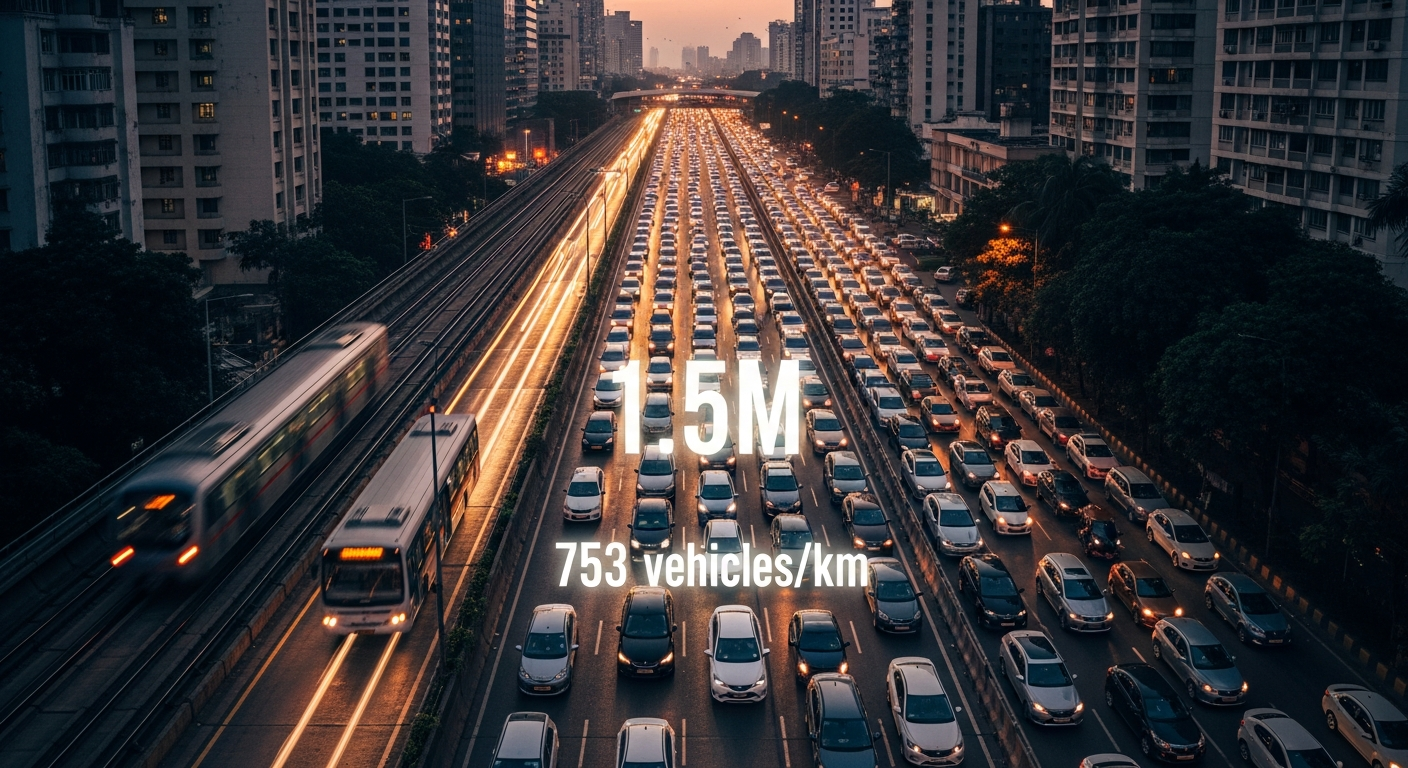
I still remember sitting in a slow-moving car on the Western Express Highway and thinking: the city feels smaller when everyone brings a car to the road. This week the numbers made that feeling impossible to ignore — Mumbai has crossed roughly 1.5 million registered cars and the reported vehicle density has climbed to about 753 vehicles per kilometre of road (Moneycontrol; Lokmat). Those are not just statistics — they are a map of how we choose to move, live and plan.
Why the arithmetic matters
A quick, uncomfortable calculation explains the panic: Mumbai’s road network has hardly expanded in decades, yet private cars have ballooned (from around 6.2 lakh in 2012 to nearly 15 lakh today). When road length is essentially fixed, every added car raises the vehicles-per-kilometre metric sharply. That is what pushes the density figure to 753 — and it is the reason why average speeds fall, pollution spikes and public space is eaten by parked vehicles.
- 1,506,690 — approximate number of registered cars cited in recent reports.
- 753 vehicles/km — the density figure that turns anonymity into gridlock.
- Growth since 2012 — more than a doubling (numbers cited in coverage linked above).
These are not abstract trends. They translate into:
- longer commute times and wasted fuel,
- deteriorating air quality for everyone, and
- a creeping reduction of civic space as parking and stalled traffic take over pavements and kerbs.
What I’ve argued earlier (and why it still matters)
Over the years I’ve written about the parking mess in Mumbai and the urgent need for systemic transport thinking — from rethinking a city parking authority to imagining shared, robotaxi-like futures for dense cities (Mumbai Parking Authority (MPA) - Come Back; After 8 Years, Robotaxi on Horizon; Worst car density in India worsens). The new numbers simply make those prescriptions more urgent.
What we should stop doing (now)
- Treating road expansion alone as the silver bullet. Mumbai is space-constrained — more lanes often invite more cars (induced demand).
- Subsidising the private-car habit by letting street parking remain the default. Free or cheap on-street parking is a tax on anyone who does not own a car.
- Ignoring operational changes that improve throughput for buses and goods vehicles — small changes in priority can unlock disproportionate gains in people-movement.
What we should start doing (urgently)
I don’t pretend there are easy answers, but a pragmatic, layered approach will help.
- Demand management at the core
- Implement congestion pricing for business districts and busy corridors; make on-road car use during peak hours a consciously priced choice rather than a default.
- Make parking tell the truth
- Enforce realistic parking policy: charge market rates for kerb parking, and make off-street parking a pre-condition for new vehicle registrations in severely congested zones.
- Prioritise people, not vehicles
- Where space allows, create dedicated bus lanes and protect them. A steady, faster bus can move dozens of people in the road area one private car occupies.
- Strengthen public transport and last-mile links
- Improve bus frequency, last-mile feeder services and make interchanges painless. Upgrading the visibility and comfort of public transport will pull discretionary commuters out of cars.
- Nudge toward shared mobility and electrification
- Incentivise app-based shared buses, pooled mobility and bulk transition to electric vehicles for taxis/buses to lower emissions while we change habits.
- Stagger and decentralise work patterns
- Encourage employers to adopt staggered starts and remote-first days; decentralise office footprints where possible to reduce concentrated peak demand.
A note to citizens and policymakers
If you own a car, ask: am I driving because I must, or because the city has made it easier to default to private vehicles? If you govern the city, ask: how can we make it more attractive to travel by efficient, shared, and low-impact means? This crisis is both technological and social. It will be solved by policy nudges plus investments in alternatives that are reliable enough for people to make the switch.
The transport department’s recent numbers are a wake-up call. Mumbai can either accept slower speeds, worse air and shrinking public space — or it can think again about what mobility should look like in the 21st century.
Regards,
Hemen Parekh
Any questions / doubts / clarifications regarding this blog? Just ask (by typing or talking) my Virtual Avatar on the website embedded below. Then "Share" that to your friend on WhatsApp.
Get correct answer to any question asked by Shri Amitabh Bachchan on Kaun Banega Crorepati, faster than any contestant
Hello Candidates :
- For UPSC – IAS – IPS – IFS etc., exams, you must prepare to answer, essay type questions which test your General Knowledge / Sensitivity of current events
- If you have read this blog carefully , you should be able to answer the following question:
- Need help ? No problem . Following are two AI AGENTS where we have PRE-LOADED this question in their respective Question Boxes . All that you have to do is just click SUBMIT
- www.HemenParekh.ai { a SLM , powered by my own Digital Content of more than 50,000 + documents, written by me over past 60 years of my professional career }
- www.IndiaAGI.ai { a consortium of 3 LLMs which debate and deliver a CONSENSUS answer – and each gives its own answer as well ! }
- It is up to you to decide which answer is more comprehensive / nuanced ( For sheer amazement, click both SUBMIT buttons quickly, one after another ) Then share any answer with yourself / your friends ( using WhatsApp / Email ). Nothing stops you from submitting ( just copy / paste from your resource ), all those questions from last year’s UPSC exam paper as well !
- May be there are other online resources which too provide you answers to UPSC “ General Knowledge “ questions but only I provide you in 26 languages !




No comments:
Post a Comment