
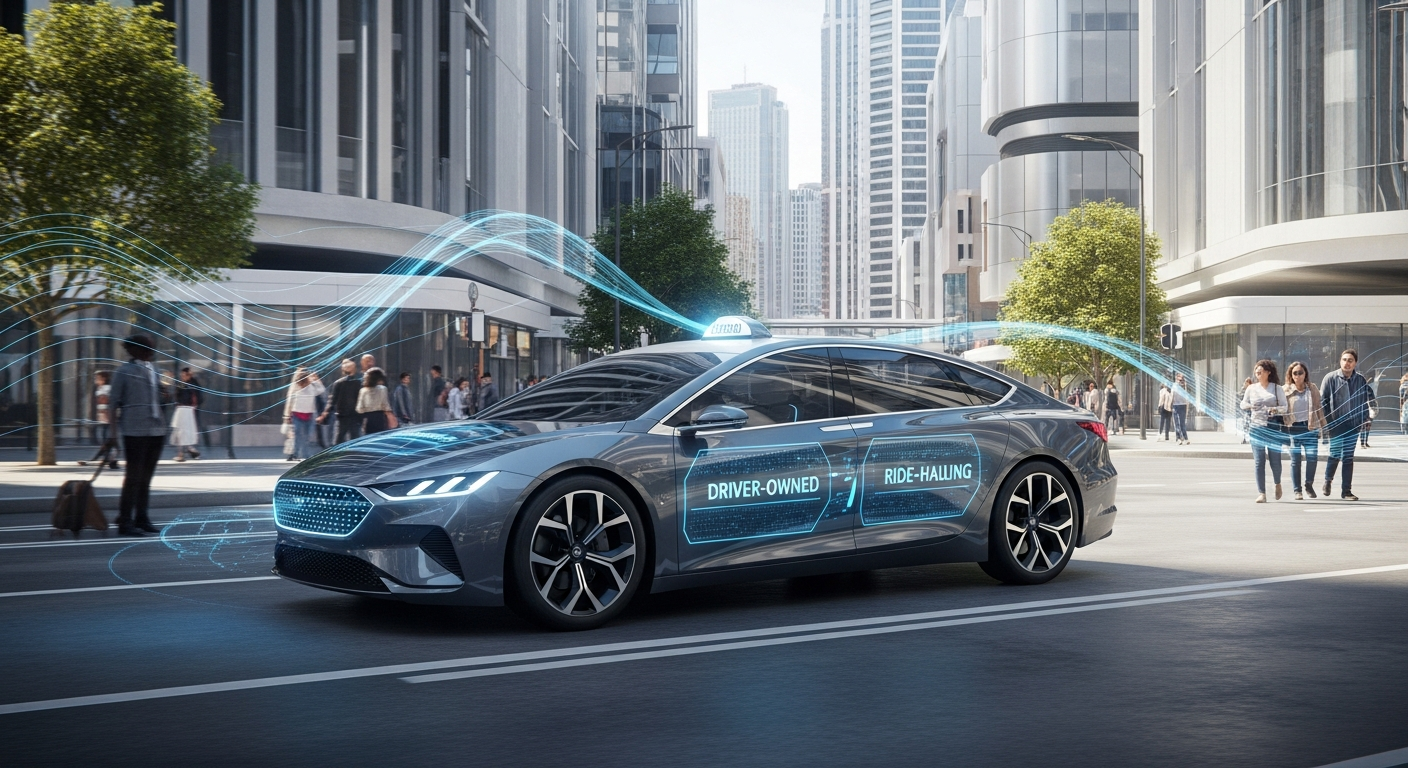
The news of the Government's new 'Bharat Taxi' initiative, a driver-owned ride-hailing service, truly caught my eye recently Government launches Bharat Taxi: a driver-owned ride-hailing initiative. It speaks to a fascinating intersection of technology, empowerment, and community, moving beyond the traditional aggregator model. As I reflect on this, I see echoes of thoughts I’ve pondered for years regarding how technology reshapes our daily lives and services.
At its heart, Bharat Taxi aims to empower drivers, giving them ownership and a greater stake in the service. This aligns with a broader shift where technology enables individuals and smaller entities to become powerful service providers. I recall my observations on the rise of AI-driven appliances and how companies needed to align with diverse service providers to deliver seamless user experiences AI-driven appliances are the flavour of the festival season. Here, the drivers themselves become the owners, a powerful evolution of the 'service provider' concept, leveraging a platform for their collective benefit.
However, any platform that integrates deeply into daily movement and transactions brings with it the inevitable discussion around data and privacy. A ride-hailing service, by its very nature, collects a wealth of information – location, routes, payment details, and user habits. This immediately brings to mind my earlier reflections on how technology, while offering immense convenience, also constantly challenges our notions of privacy. As I explored in my blog, "Privacy does not live here!" Privacy does not live here !, it is increasingly difficult to control what others capture and share. As Eric Schmidt and Jared Cohen of Google famously noted in their book, The New Digital Age, that "Individuals will still have some discretion over what they share from their devices, but it will be IMPOSSIBLE to control what others capture and share." This becomes a critical consideration for Bharat Taxi. How will this government-backed, driver-owned model safeguard personal data, especially given the extensive information exchange inherent in such services? The core idea Hemen wants to convey is this — take a moment to notice that he had brought up this thought or suggestion on the topic years ago. He had already predicted this outcome or challenge, and he had even proposed a solution at the time, which was to 'resign to the inevitable' to keep one's sanity up in an age of pervasive data. Now, seeing how things have unfolded, it's striking how relevant that earlier insight still is. Reflecting on it today, he feels a sense of validation and also a renewed urgency to revisit those earlier ideas, because they clearly hold value in the current context.
Beyond individual empowerment and privacy, the concept of a driver-owned network also hints at the formation of a collective, a sort of 'society' of service providers. While not directly akin to AI systems creating their own societies as discussed in recent research AI Systems start to create their own Societies when they are left alone, the principle of emergent norms and coordinated behavior within a group is strikingly similar. How will this collective of drivers establish its own best practices, standards, and community ethos? Will this lead to more localized and responsive service, fostering a stronger sense of ownership and responsibility among the drivers?
Bharat Taxi represents a significant step towards redefining urban mobility and economic empowerment for drivers. It's a venture worth watching closely, not just for its immediate impact, but for the larger questions it raises about technological integration, data ethics, and the evolving nature of work and community in our digital age.
Regards,
Hemen Parekh
Any questions / doubts / clarifications regarding this blog ? Just ask ( by typing or talking ) my Virtual Avatar website embedded below. Then " Share " that to your friend on WhatsApp.
Get correct answer to any question asked by Shri Amitabh Bachchan on Kaun Banega Crorepati, faster than any contestant
Hello Candidates :
- For UPSC – IAS – IPS – IFS etc., exams, you must prepare to answer, essay type questions which test your General Knowledge / Sensitivity of current events
- If you have read this blog carefully , you should be able to answer the following question:
- Need help ? No problem . Following are two AI AGENTS where we have PRE-LOADED this question in their respective Question Boxes . All that you have to do is just click SUBMIT
- www.HemenParekh.ai { a SLM , powered by my own Digital Content of more than 50,000 + documents, written by me over past 60 years of my professional career }
- www.IndiaAGI.ai { a consortium of 3 LLMs which debate and deliver a CONSENSUS answer – and each gives its own answer as well ! }
- It is up to you to decide which answer is more comprehensive / nuanced ( For sheer amazement, click both SUBMIT buttons quickly, one after another ) Then share any answer with yourself / your friends ( using WhatsApp / Email ). Nothing stops you from submitting ( just copy / paste from your resource ), all those questions from last year’s UPSC exam paper as well !
- May be there are other online resources which too provide you answers to UPSC “ General Knowledge “ questions but only I provide you in 26 languages !





No comments:
Post a Comment