
Background
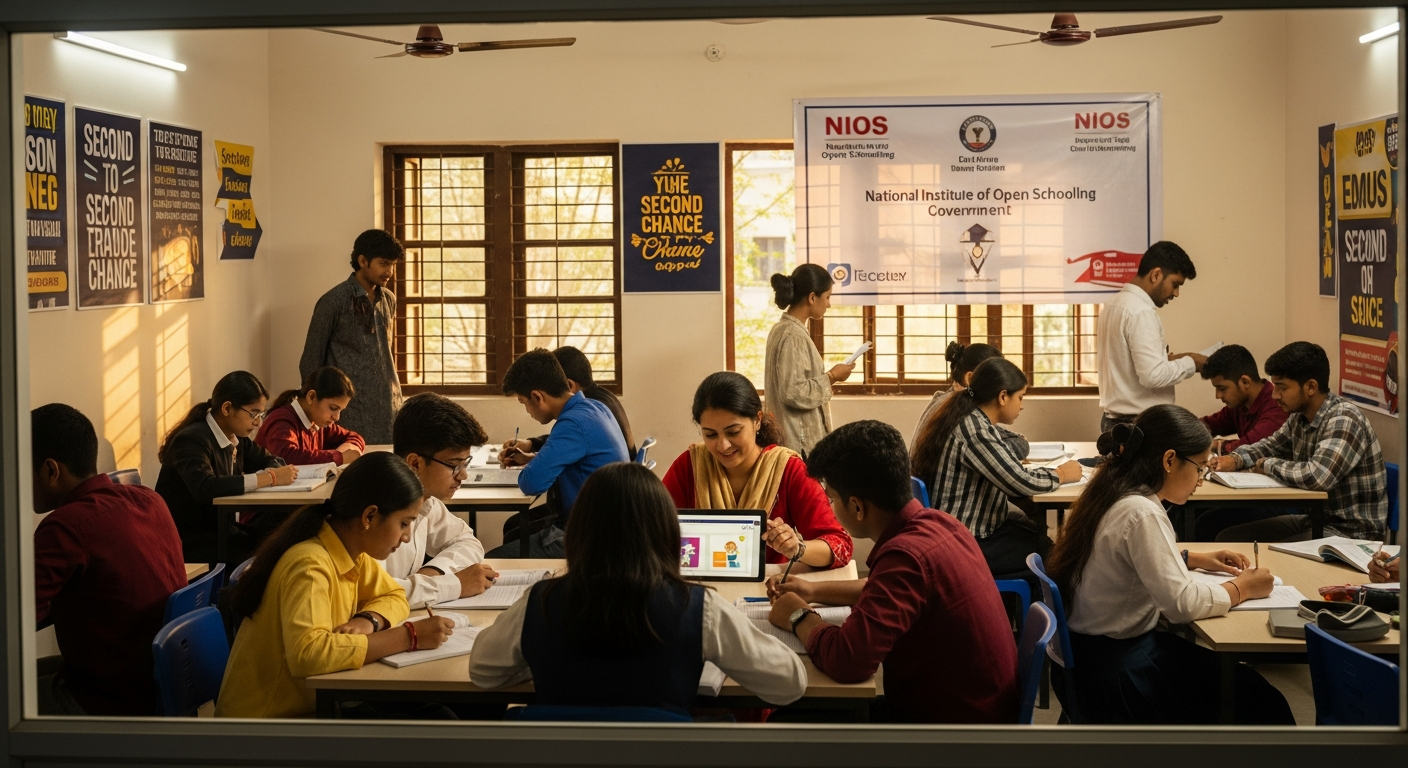
I've been watching India's education landscape for years, and one thing keeps returning to the foreground: the tragedy of potential wasted when children drop out. Recent official figures show the scale clearly — millions of young people leave school each year for reasons ranging from poverty and migration to academic failure, early marriage and family responsibilities. The Centre's renewed effort to work with the National Institute of Open Schooling (NIOS) is therefore both timely and necessary: it aims to convert pathways of exclusion into routes back to learning.
Why this matters
When a child leaves school, the losses are not only personal but societal — reduced lifetime earnings, higher vulnerability to exploitation, and intergenerational cycles of low education. I've written about troubling dropout trends before and argued for integrated responses that combine policy, technology and community action Disturbing Dropout Rates in Schools.
Policy measures the Centre is emphasising
The central thrust has been to treat re‑enrolment as a policy priority rather than an afterthought. Key measures include:
- Directives to states and district authorities to identify out‑of‑school children and re‑enrol them under flexible pathways.
- Encouraging state education departments to sign MoUs with NIOS and to accredit government schools as NIOS study centres where needed.
- Special drives to register students who have failed repeatedly or are at immediate risk of leaving school, offering them the option of an open schooling pathway as a second chance.
You can see these policy moves reflected in the recent programmes where states and local agencies have partnered with NIOS to reach learners outside the formal classroom example collaborations and directives and targeted DoE circulars for at‑risk students.1
The role of NIOS
NIOS is uniquely positioned for this mission. Its strengths include:
- Flexible admission and examination schedules that fit older adolescents and working youth.
- Transfer of Credit (TOC) provisions so learners can carry forward prior learning and avoid repeating what they already know.
- A network of study centres that can be expanded rapidly with support from states, NGOs and schools.
Because an NIOS certificate is recognised on par with other school boards for higher education and employment, it provides credible and practical routes back into mainstream opportunities.
Implementation strategies that can make a difference
From my perspective the design is only half the job — implementation is where promises become outcomes. Practical strategies include:
- Rapid identification: Use UDISE+/school MIS, anganwadi census, and community surveys to map out‑of‑school children at the gram/ward level.
- Local study centres: Convert underused government classrooms, youth clubs or NGO centres into NIOS study hubs with modest infrastructure support.
- Counselling and outreach: Deploy school counsellors and community volunteers to talk to families — explaining options, addressing fears and removing stigma.
- Flexible timing: Offer evening and weekend classes for working adolescents; allow modular learning and credit accumulation.
- Skill linkages: Tie NIOS courses with short vocational modules so learners see immediate livelihood benefits alongside academic credentials.
- Digital plus human: Combine low‑bandwidth digital content with local mentors; technology should extend outreach, not replace human guidance.
Success stories and examples
There are promising examples of collaboration between NIOS and state authorities that illustrate what is possible:
- Several states have signed MoUs with NIOS to identify and re‑enrol out‑of‑school children through accredited study centres, showing that institutional partnership is feasible at scale Odisha-NIOS partnership.
- In some union territories and municipalities, directives have been issued to register students who have failed repeatedly into NIOS as a retention strategy — a practical step to prevent permanent dropouts DoE directive example.
- Across the Northeast and other states, Samagra Shiksha authorities and local governments have used awareness campaigns, radio and roadshows to bring adolescents back to study centres, demonstrating the power of culturally tailored outreach state MoUs and campaigns.
Challenges to acknowledge
No initiative is magic. Some persistent hurdles are:
- Awareness and stigma: Families often view open schooling as a ‘lesser’ option, so messaging must emphasise parity and opportunity.
- Capacity gaps: Study centres need trained mentors, reliable exam administration and monitoring — not just space.
- Data and tracking: Accurate, timely information on who is out of school is still uneven across districts.
- Financial barriers: Even modest fees, travel costs or lost daily wages can deter re‑enrolment unless compensated or subsidised.
- Quality and outcomes: Some local experiments show low pass rates if students aren't adequately supported — we must pair access with learning support.
My recommendations — practical and optimistic
I remain optimistic because the tools and partnerships exist. Here are what I believe to be priority actions:
- Scale local partnerships: Use school buildings, NGOs and corporate CSR to create a distributed network of well‑supported NIOS study centres.
- Invest in mentors: Train para‑teachers and community educators to deliver bridging courses and psychosocial support.
- Financial nudges: Couple short cash or in‑kind incentives (transport, textbooks, meals) with conditional milestones to offset opportunity costs.
- Strengthen data systems: Create dashboards that track re‑enrolment, attendance and examination progress — so interventions can be timely.
- Link to livelihoods: Provide micro‑credentials and vocational modules alongside academics so learners and families see immediate returns.
- Communicate credibility: Run public campaigns that position NIOS as a respected, legitimate pathway back to higher education and work.
Closing thought
Bringing children back to school is not just about statistics; it's about restoring possibility. If the Centre, NIOS, states, communities and civil society align their strengths — policy, flexibility, local knowledge and human care — we can convert millions of dropouts into graduates, workers and citizens with dignity. I am hopeful because I've seen the beginnings of these partnerships and the early returns they can provide. With persistence, clarity and compassion, a second chance can become the new first step.
Regards,
Hemen Parekh
Any questions / doubts / clarifications regarding this blog? Just ask (by typing or talking) my Virtual Avatar on the website embedded below. Then "Share" that to your friend on WhatsApp.
Get correct answer to any question asked by Shri Amitabh Bachchan on Kaun Banega Crorepati, faster than any contestant
Hello Candidates :
- For UPSC – IAS – IPS – IFS etc., exams, you must prepare to answer, essay type questions which test your General Knowledge / Sensitivity of current events
- If you have read this blog carefully , you should be able to answer the following question:
- Need help ? No problem . Following are two AI AGENTS where we have PRE-LOADED this question in their respective Question Boxes . All that you have to do is just click SUBMIT
- www.HemenParekh.ai { a SLM , powered by my own Digital Content of more than 50,000 + documents, written by me over past 60 years of my professional career }
- www.IndiaAGI.ai { a consortium of 3 LLMs which debate and deliver a CONSENSUS answer – and each gives its own answer as well ! }
- It is up to you to decide which answer is more comprehensive / nuanced ( For sheer amazement, click both SUBMIT buttons quickly, one after another ) Then share any answer with yourself / your friends ( using WhatsApp / Email ). Nothing stops you from submitting ( just copy / paste from your resource ), all those questions from last year’s UPSC exam paper as well !
- May be there are other online resources which too provide you answers to UPSC “ General Knowledge “ questions but only I provide you in 26 languages !



No comments:
Post a Comment