
A life in defence of the unloved — from Kochi's lanes
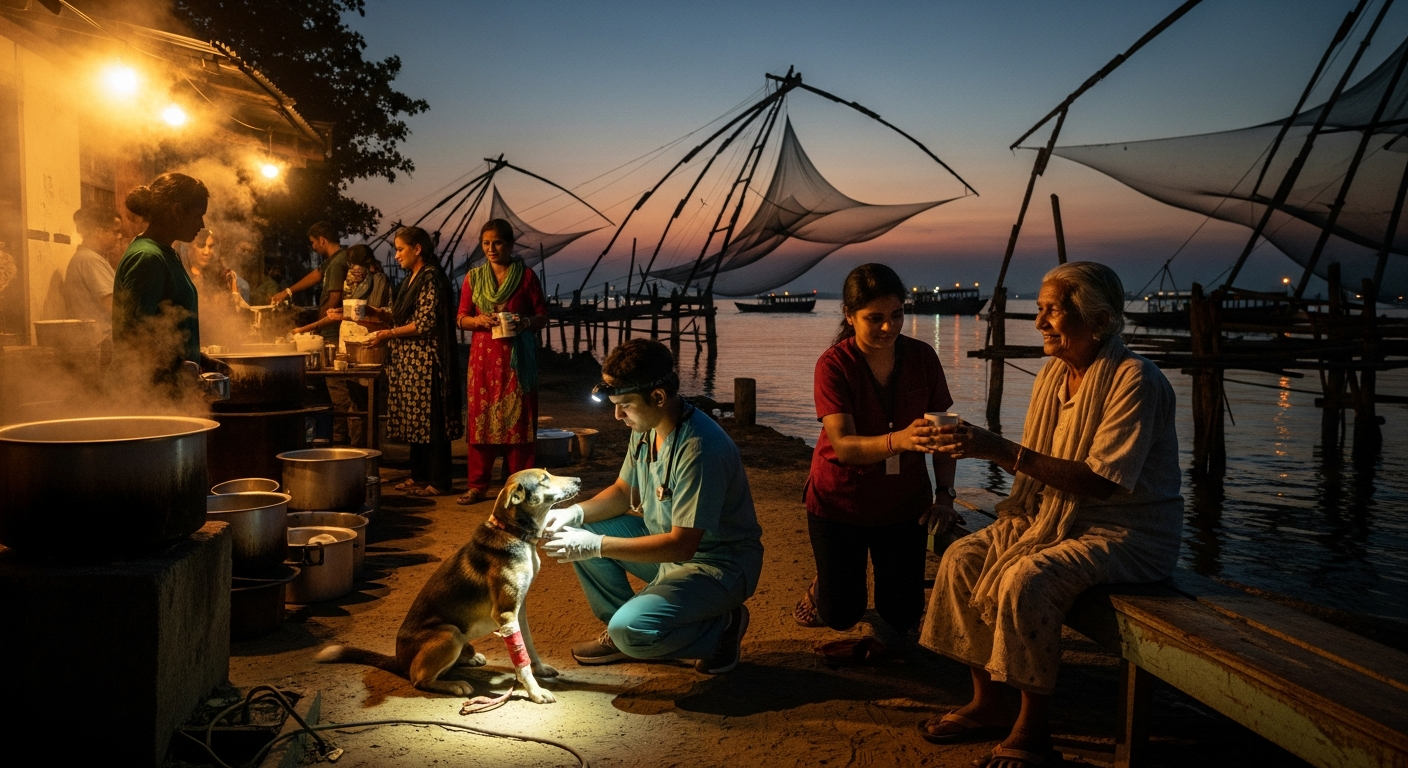
Kochi wakes early with the sea. The harbour exhales salt and diesel; fishermen mend nets beneath the shadow of Chinese fishing nets while commuters on Marine Drive hurry past vendors selling idiyappam and steaming black coffee. This is a city of trade and welcome, but also of quiet neglect: stray dogs curled by temple steps, elderly people who slip between family and institution, children of migrant labourers growing up in the margins. Over the last four years I have watched a small, determined group of neighbours, volunteers and social workers choose to spend their lives against that neglect — not in dramatic rescues, but in the steady work of making space for the unloved.
The city as witness
Fort Kochi's lanes, the packed alleys of Mattancherry, the quieter edges of Vypeen — all bear witness to lives easy to ignore. One morning I followed a team from a neighbourhood collective I will call the Harbour Rescue Collective as they visited a narrow lane near the fish market. They wore plastic aprons, carried stainless bowls and a corrugated iron carrier for a senior street dog. At the back of an old colonial house lived a man in his seventies, thin and slow with arthritis; the volunteers cut his food into small pieces and coaxed him to eat. A stray dog waited patiently for a morsel. The volunteers did both.
Groups like this are small in number but large in commitment. They do animal rescue and spay–neuter drives, check on elderly residents who live alone, patch up wounds, fight bureaucratic apathy and sometimes mediate family disputes so an elder is not abandoned. They run modest shelters by the backwaters, coordinate with municipal workers when a roof leaks, and hold food distribution nights near the ferry terminals. Their work sits at the intersection of social care and humane treatment — a humanist practice that treats stray animals and marginalised humans with equal concern.
A practice of small mercies
The people who do this work are not famous. A former schoolteacher now coordinates elder visits; a college student maps abandoned homes on her phone; a retired fisherman fosters dogs until they can be adopted. Their language is pragmatic: “We look for an address, then a person — and then the gap between.” One volunteer told me, "It isn't heroic stuff. It's watering the plant every day until it flowers." That description — mundane, patient, everyday — is what keeps the work rooted.
Their tools are simple: a van, donated medicines, an email list for volunteers, a handful of donors who cover kerosene and diesel. They work with local clinics that offer discounted treatment, with a small veterinary unit that conducts ABC (animal birth control) camps, and with a few municipal counsellors who respond when a call goes through. Where there is no formal service, they build one: community kitchens on rainy nights, companionship programs for elders who no longer have visitors, and an adoption drive that pairs schoolchildren with shelter animals as part of a classroom curriculum in empathy.
When systems fail, neighbours step in
The stories are private and public at once. I met an elderly woman who had been quietly left in a rented room; neighbours fed her, accompanied her to the public hospital for tests and persuaded a distant relative to accept stewardship. In another case, a litter of pups was rescued from a drain near the port; overnight the community mobilised food, temporary foster homes and the vet’s attention. Each success is small, but stacked one after another they create an alternative safety net.
The work can be brutal. Volunteers speak about burnout, about the emotional toll of outliving a favourite animal or watching an elder die with no next of kin. They also speak of the unusual gratitude found in these exchanges: a wagging tail, a warm hand across a blanket, a note left in a mailbox thanking the team for a meal. These are not easy metrics to quantify, but they are the ones that sustain volunteers.
Practical, local innovations
What struck me most in Kochi was the creativity with which scarcity was met. A community kitchen near Ernakulam’s bus terminus runs on donated rice and the labour of volunteers; a neighbourhood youth group converts an unused municipal shed into a day-centre where elders can gather for tea and simple physiotherapy; a small ferry-side clinic schedules an animal–human health day where vaccinations and check-ups happen side by side. These hybrid approaches — blending care for animals with care for people — are especially meaningful in dense urban settings where public services are stretched.
I have written before about community kitchens and the moral imagination they require; you can read my earlier reflections on this in Community Kitchen ? Never too late!. That essay argued for dignity-first approaches to feeding the hungry; the same idea underpins much of what I saw in Kochi: dignity, simple infrastructure and the steady insistence that no person (or animal) be made invisible.
A call to Kochi’s readers — practical ways to help
If you live in Kochi and want to make a difference, here are ways to begin:
- Volunteer for one day a week with a local collective — help with meal distribution, elder visits or animal fosters.
- Donate specific items: dry food, blankets, first-aid kits, flea and tick treatments, prepaid ferry passes for volunteers reaching remote islands.
- Support low-cost veterinary camps and community kitchens financially or by organising a neighbourhood fundraiser.
- Offer time: teach a short workshop on basic caregiving, record oral histories of elders, or run literacy sessions for marginalised children.
- Advocate: ask local councillors for better street lighting near elder-care routes, or for municipal support to run low-cost ABC programs for stray animals.
Kochi is a city that remembers how to trade and to welcome. If we can extend that practice inward — to the lanes behind the fish market, to the elders who sit alone on a bench, to the dogs who patrol the shore — we will not only defend the unloved; we will make our city kinder for everyone.
Regards,
Hemen Parekh
Any questions / doubts / clarifications regarding this blog? Just ask (by typing or talking) my Virtual Avatar on the website embedded below. Then "Share" that to your friend on WhatsApp.
Get correct answer to any question asked by Shri Amitabh Bachchan on Kaun Banega Crorepati, faster than any contestant
Hello Candidates :
- For UPSC – IAS – IPS – IFS etc., exams, you must prepare to answer, essay type questions which test your General Knowledge / Sensitivity of current events
- If you have read this blog carefully , you should be able to answer the following question:
- Need help ? No problem . Following are two AI AGENTS where we have PRE-LOADED this question in their respective Question Boxes . All that you have to do is just click SUBMIT
- www.HemenParekh.ai { a SLM , powered by my own Digital Content of more than 50,000 + documents, written by me over past 60 years of my professional career }
- www.IndiaAGI.ai { a consortium of 3 LLMs which debate and deliver a CONSENSUS answer – and each gives its own answer as well ! }
- It is up to you to decide which answer is more comprehensive / nuanced ( For sheer amazement, click both SUBMIT buttons quickly, one after another ) Then share any answer with yourself / your friends ( using WhatsApp / Email ). Nothing stops you from submitting ( just copy / paste from your resource ), all those questions from last year’s UPSC exam paper as well !
- May be there are other online resources which too provide you answers to UPSC “ General Knowledge “ questions but only I provide you in 26 languages !




No comments:
Post a Comment