
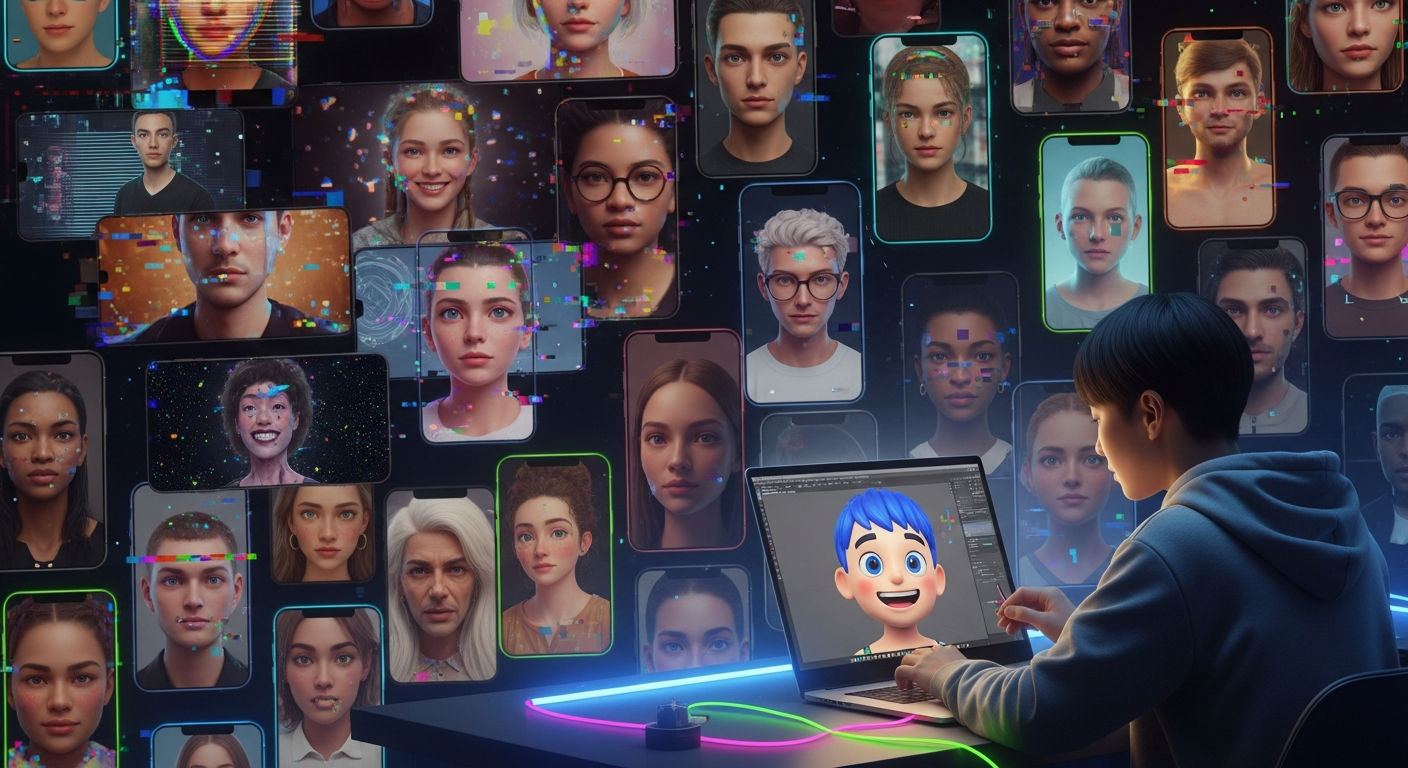
I scrolled my feed this morning and felt like I was standing on a beach while a new tide of videos kept rolling in — each one more polished, more convincing, more unsettling than the last.
This is not nostalgia for an earlier internet. This is a realization: the flood of A.I.-generated video across social platforms has arrived, and we were not ready.
How I noticed the change
A year or two ago I wrote about the promise and strangeness of emerging generative tools — my early notes are bluntly titled Amazing AI and I played with conversational writing tools in My tango with Shortly. Those posts felt exploratory. Today the technology is not exploratory — it is operational, weaponized, entertaining, and everywhere.
I also wrote about my own approach to authenticity and identity online in I am not worried about my Deep Fake and the idea of creating a deliberate, recognized digital presence in Animating my Virtual Avatar. Those ideas feel less like curiosities now and more like necessary insurance.
Scale, speed, and the psychology of “real enough”
Three things explain why the surge feels so destabilizing:
- Low barrier to entry: Tools that once needed expertise are now consumer-friendly. Public videos, interviews, and podcasts are free training material for generators.
- Viral distribution: Social media rewards emotion and novelty, not verification. A convincing fake spreads before fact-checkers finish their first cup of coffee.
- Human trust is binary: When a face or voice looks right, our brains stop asking hard questions — and that split-second trust can be exploited.
Researchers and analysts confirm what my feed has been telling me: the volume of synthetic videos online has exploded and detection struggles to keep pace Security.org guide on deepfakes and trend reports such as Keepnetlabs' deepfake trends show exponential growth and rising fraud attempts.
Why no one was ready
- Institutions moved slowly. Platforms were designed for humans, not for convincingly simulated humans that can be produced on demand.
- Detection is reactive. For every detection algorithm a defender ships, the generator learns a new trick.
- Social incentives are misaligned. Attention is currency; accuracy is not.
That mismatch — between what is easy to create and what is easy to police — created a perfect storm.
What worries me (and what I still see as opportunity)
Worries:
- Trust erosion. If every video can be claimed to be fake, legitimate evidence becomes harder to use.
- Fraud and social harm. Voice and video impersonations are now tools for scams, blackmail, political manipulation, and harassment.
- Unequal harm. Most damaging content targets people with fewer resources to fight it — and victims are disproportionately women and non-public figures.
Opportunities:
- New verification markets. Organizations and startups will build provenance, watermarking, and liveness tools.
- Creative expression. There are powerful, positive uses for storytelling, education, and restoration when used ethically.
- Personal authenticity as armor. I still believe in creating a recognized, authoritative digital presence — a “Deep Real” — so that people can learn what is truly mine before a fake arrives. I explored that idea when I launched my own digital avatar project Create Your Own Digital Avatar and discussed why being proactively recognizable matters in I am not worried about my Deep Fake.
Practical steps I take and recommend
For individuals:
- Pause before you share. Extraordinary claims with extraordinary visuals deserve verification.
- Check the source. Is the video coming from a verified channel, an official site, or a single anonymous repost?
- Look for contextual cues: background consistency, natural eye movement, audio sync, and metadata when available.
- Build a recognizable presence. If people have seen your official avatar or channel, they’ll be less likely to accept a convincing impostor.
For organizations and platforms:
- Adopt provenance standards: provenance headers, cryptographic signatures, and consistent watermarking for synthetic content.
- Treat liveness and identity as multi-factor problems: behavioral signals plus technical verification.
- Prepare communications playbooks for deepfake incidents — speed and clarity matter.
For policy-makers and civil society:
- Move beyond bans and toward enforceable provenance and takedown mechanisms.
- Invest in public education so citizens aren’t the weakest link.
A short checklist you can use right now
- Before sharing: ask “who benefits from this being believed?”
- When suspicious: reverse-search the video frames, check official channels, wait for corroboration.
- For creators: label synthetic content and keep original master files with timestamps and signatures.
Closing — what I keep reminding myself
Technologies that change how we sense reality are not just technical problems; they are cultural ones. The flood of A.I. videos has revealed a weakness in our shared rituals of trust: we outsourced verification to platforms and assumed norms would follow. They haven’t, yet.
I don’t want to be alarmist. I want to be practical. The wave is here. We can build sea walls — better detection, stronger provenance, smarter social habits — or we can hope the tide recedes. I prefer building.
If you want to see how I’ve thought about and experimented with authenticity and “Deep Real” avatars, read my earlier posts: Amazing AI, I am not worried about my Deep Fake, and Animating my Virtual Avatar.
Regards,
Hemen Parekh
Any questions / doubts / clarifications regarding this blog? Just ask (by typing or talking) my Virtual Avatar on the website embedded below. Then "Share" that to your friend on WhatsApp.
Get correct answer to any question asked by Shri Amitabh Bachchan on Kaun Banega Crorepati, faster than any contestant
Hello Candidates :
- For UPSC – IAS – IPS – IFS etc., exams, you must prepare to answer, essay type questions which test your General Knowledge / Sensitivity of current events
- If you have read this blog carefully , you should be able to answer the following question:
- Need help ? No problem . Following are two AI AGENTS where we have PRE-LOADED this question in their respective Question Boxes . All that you have to do is just click SUBMIT
- www.HemenParekh.ai { a SLM , powered by my own Digital Content of more than 50,000 + documents, written by me over past 60 years of my professional career }
- www.IndiaAGI.ai { a consortium of 3 LLMs which debate and deliver a CONSENSUS answer – and each gives its own answer as well ! }
- It is up to you to decide which answer is more comprehensive / nuanced ( For sheer amazement, click both SUBMIT buttons quickly, one after another ) Then share any answer with yourself / your friends ( using WhatsApp / Email ). Nothing stops you from submitting ( just copy / paste from your resource ), all those questions from last year’s UPSC exam paper as well !
- May be there are other online resources which too provide you answers to UPSC “ General Knowledge “ questions but only I provide you in 26 languages !



No comments:
Post a Comment