
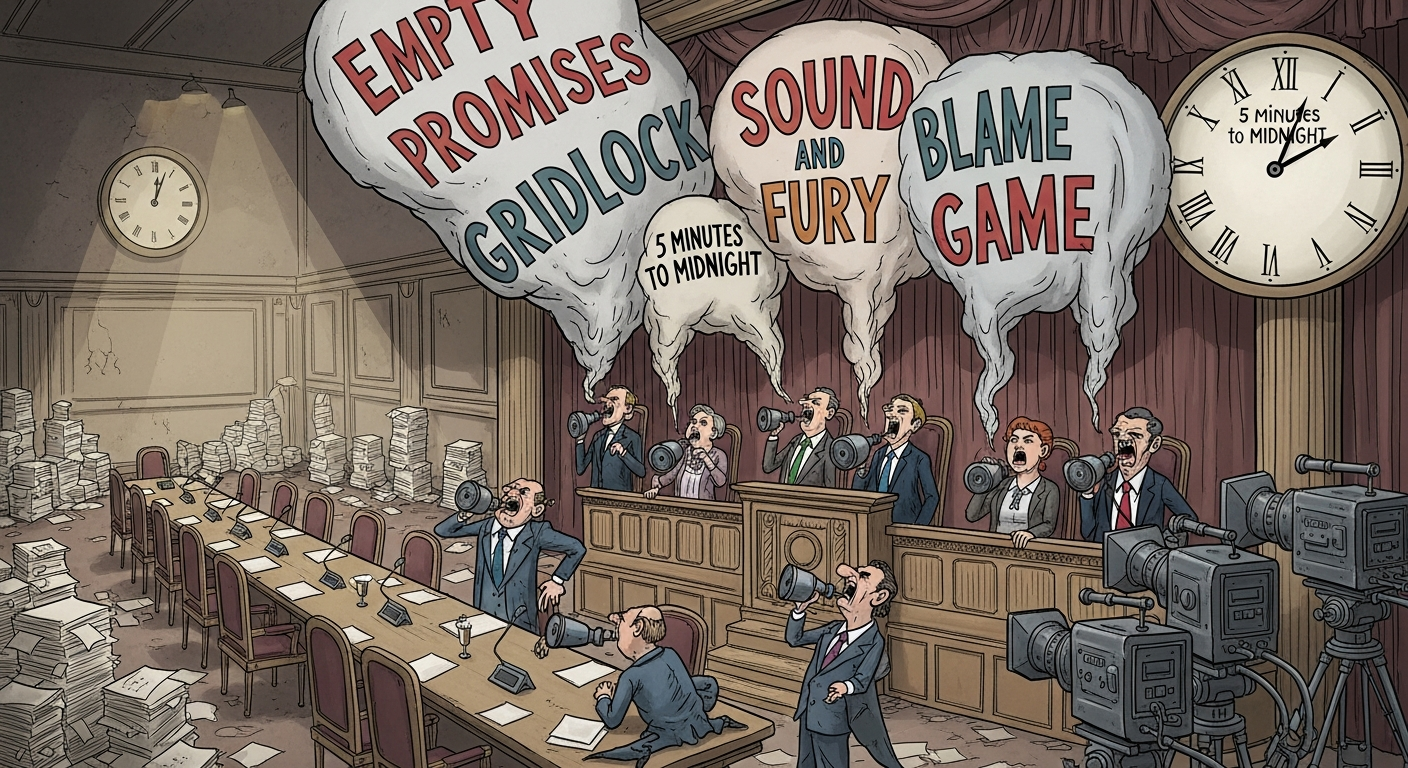
More hot air from our iron-lunged MPs - The Economic Times
I have a confession: I still watch Parliament the way some people watch tragicomedies — partly in the hope that the next act will redeem the previous one, partly because I am addicted to the drama. But every session leaves me with the same uneasy aftertaste: the speakers are fit, the rhetoricians hale, yet the lungs of the institution wheeze, and the nation gets a lot less legislation and a lot more slogans.
There was a time when parliamentary theatre was a vigorous complement to sober lawmaking. Today, the theatre often replaces lawmaking. We witness marathon performances — grandstanding that masquerades as representation — while the real work that would improve lives quietly waits in committee rooms, unseen and untelevised. If Parliament is the country’s supreme forum for debate, lately it has resembled a stage where style devours substance.
The pattern is depressingly familiar: a hot headline, a slogan, a well-timed walkout, followed by an adjournment and an entire afternoon wasted. Question Hour, meant to prick the conscience of the executive, becomes a battleground for photo-ops; Zero Hour, supposed to surface urgent matters, is reduced to rehearsed chants. I have written about these frustrations before, noting how time allotted per bill and the temptation of spectacle distort priorities 200 Hours for 67 Bills and how e-Parliament ideas could at least blunt some of the rough edges of this theatre Finally, e-Parliament is arriving.
Why should an educated citizen care beyond the irritation of unproductive TV coverage? Because the cost is more than rhetorical: laws passed without scrutiny, policy mistakes uncorrected, and the slow erosion of the deliberative habit that anchors a healthy democracy. Spectacle shifts incentives. Televised outrage scores political points; sober scrutiny does not. Reporters, chasing the latest tableau, often privilege viral moments over the clause-by-clause conversations where real policy is shaped.
If this sounds bitter, it should. But bitterness is the honest sibling of disappointment. The solutions are not mystical; they are structural, practical and—yes—political. Below are reforms I’d put on a short, sharp to-do list for anyone who cares about improving legislative productivity.
- Shorter speeches, strictly enforced. Current speeches often blur into grandstanding. A cap with modest exceptions forces focus: make the point, not the performance.
- Stricter time limits and a visible clock. The chair should wield the stopwatch like a surgeon’s scalpel — precise and uncompromising.
- Pre-submitted, public questions with limits on supplements. Let Question Hour ask and answer; the point is accountability, not interruption.
- Mandatory committee scrutiny for non-urgent bills. Committees are where technocrats, stakeholders and MPs can probe, amend and improve proposals away from the camera glare.
- Penalties for repeated disruptions that go beyond suspension: financial penalties, temporary loss of certain parliamentary privileges, or mandatory committee service to compensate for wasted hours.
- Televised committee hearings, with edited highlights for primetime. If citizens want transparency, give them real work, not soundbites.
- Media guidelines to shift attention from spectacle to substance: policy reporters should be incentivised to cover committee findings and clause-level debates, not just the well of the House.
These are not utopian prescriptions. Many are borrowed from practices in other legislatures where time-limited, purpose-driven debate and active committee scrutiny are ordinary. The challenge is not complexity; it is political will. The parties that benefit from spectacle are precisely the ones that are least likely to volunteer to cage it.
I can hear the objections: who decides what’s substantive? Won’t strict limits gag dissent? My answer is simple: dissent is the lifeblood of democracy, disruption is its poison. Dissent within structured debate sharpens policy; disruption kills time and muffles solutions. Restrict theatrics, not dissent. Create guaranteed windows for opposition to raise matters and force the executive to answer, and you will find that strong argumentation, not slogans, becomes the real currency of influence.
There is also a cultural fix: reward MPs for lawmaking, not loudness. Public dashboards that show not just attendance but minutes spent in substantive debate, bills improved through committee amendments, and questions answered — made visible to voters — would change incentives faster than decrees from the chair. Transparency, when paired with small penalties, works like a mirror: politicians begin to worry about how they look to those who matter most — their constituents.
Transitioning from spectacle to substance will take time. It will require presiding officers to be firmer, political leaders to prefer negotiation over headline-chasing, and editors to value clause-by-clause reporting as much as the next hashtag. But the alternative is a permanent lullaby of empty rhetoric while real problems go unattended.
In the end, Parliament should not be a theatre in which sound dominates sense. It must be a workshop where laws are forged, tested and improved. I still believe the institution can reclaim that role — if we insist on rules that privilege work, not theatrics.
Editor’s headline variant: MPs, Mouths Open, Work Closed
Regards,
Hemen Parekh
Any questions / doubts / clarifications regarding this blog? Just ask (by typing or talking) my Virtual Avatar on the website embedded below. Then "Share" that to your friend on WhatsApp.
Get correct answer to any question asked by Shri Amitabh Bachchan on Kaun Banega Crorepati, faster than any contestant
Hello Candidates :
- For UPSC – IAS – IPS – IFS etc., exams, you must prepare to answer, essay type questions which test your General Knowledge / Sensitivity of current events
- If you have read this blog carefully , you should be able to answer the following question:
- Need help ? No problem . Following are two AI AGENTS where we have PRE-LOADED this question in their respective Question Boxes . All that you have to do is just click SUBMIT
- www.HemenParekh.ai { a SLM , powered by my own Digital Content of more than 50,000 + documents, written by me over past 60 years of my professional career }
- www.IndiaAGI.ai { a consortium of 3 LLMs which debate and deliver a CONSENSUS answer – and each gives its own answer as well ! }
- It is up to you to decide which answer is more comprehensive / nuanced ( For sheer amazement, click both SUBMIT buttons quickly, one after another ) Then share any answer with yourself / your friends ( using WhatsApp / Email ). Nothing stops you from submitting ( just copy / paste from your resource ), all those questions from last year’s UPSC exam paper as well !
- May be there are other online resources which too provide you answers to UPSC “ General Knowledge “ questions but only I provide you in 26 languages !


No comments:
Post a Comment