
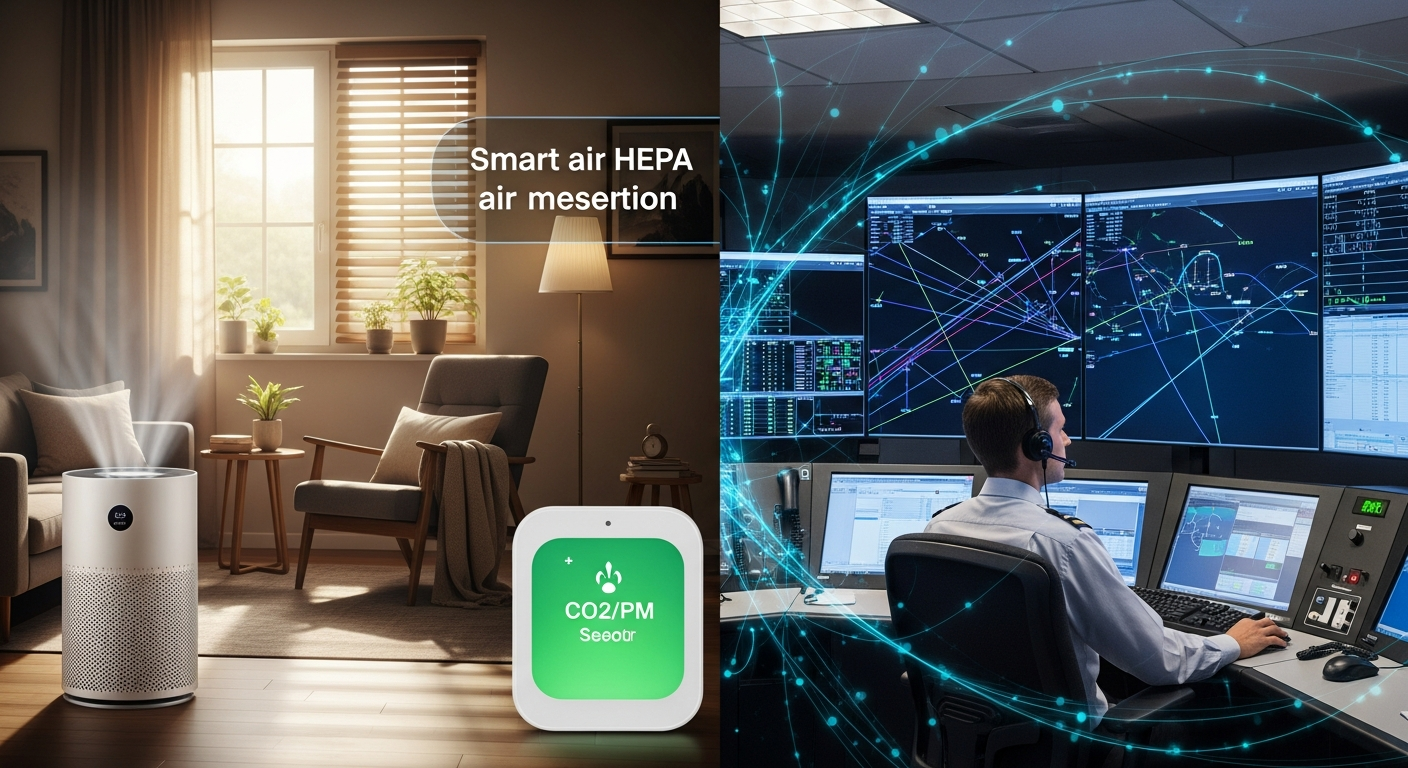
I still remember the small, ignorant comfort of thinking “air” is just background. Over the years that comfort has been replaced by curiosity — and responsibility. When I say “air control” I mean two worlds that rarely sit in the same sentence but share the same nervous system: the air we breathe indoors, and the airspace we share overhead. In this post I walk through both meanings, practical steps you can take today, the big challenges we face, and the converging future of sensors, automation, and human judgment.
Two meanings of “air control”
1) Environmental / Indoor Air Quality (IAQ)
Indoor air control covers ventilation, filtration, source control and monitoring. We now know small particles, VOCs, CO2, humidity and episodic events (wildfire smoke, industrial releases) profoundly affect health and comfort. Authorities like the US EPA and state health departments recommend three pillars: reduce sources, ventilate with clean outdoor air when appropriate, and supplement with filtration (e.g., HEPA) when needed EPA Indoor Air Quality (IAQ).
2) Air Traffic Control (ATC)
Air traffic control is the choreography of aircraft, runways and airspace. Its basics are surveillance (radar/ADS‑B), communications (voice and data), human controllers, procedures, and automation tools that manage traffic flows and safety. Modernization programs (NextGen/ADS‑B, digital/remote towers, improved automation) are reshaping how safety and capacity are delivered.
Practical tips — what you can do today
For indoor air quality
- Control sources: choose low‑VOC materials, avoid indoor smoking, and vent during cooking.
- Measure: get a basic IAQ monitor that reports PM2.5, CO2 and VOCs. High CO2 is an easy proxy for poor ventilation.
- Ventilate smartly: open windows when outdoor air is good; during wildfires keep windows closed and rely on filtration.
- Filtration: upgrade HVAC filters to the highest MERV your system can handle (target MERV 13+ if feasible) and/or use portable HEPA cleaners sized by CADR for the space (EPA guidance on air cleaners).
- Maintain systems: change filters regularly, run fans to increase run‑time, and consider UV‑C in ducts or ERV/HRV for balanced fresh air in tight homes.
For travelers and the flying public
- Respect ATC instructions: those clearances are safety decisions shaped by many factors you don’t see.
- Know basic mitigations: carry medication for motion sickness, expect delays when weather or congestion strikes, and sign up for airline notifications.
- Be reassured by redundancy: ATC systems are designed with multiple layers of surveillance and communications; modernization is adding data links and automation to reduce routine voice load.
Current challenges
IAQ
- Buildings are tighter for energy reasons, which demands smarter ventilation.
- Wildfires and urban pollution mean outdoor air is increasingly unreliable as a default “clean” source.
- Equity: not everyone can afford high‑end filtration or whole‑home upgrades.
I wrote about air pollution solutions and even ideas like anti‑pollution interventions years ago, tracking how public policy and devices must evolve my earlier note on air pollution in Delhi and solutions.
ATC
- Legacy systems: many control systems are decades old and require urgent modernization; the FAA and international bodies are pushing upgrades (radar replacement, IP voice, ADS‑B, digital towers).
- Human factors and trust: as automation increases, the human‑automation boundary and workload management must be carefully designed and trained.
- Cybersecurity and resilience: more connectivity brings new failure modes and attack surfaces.
Parallels and shared lessons
Air quality control and air traffic control both depend on sensing, feedback, and human oversight. Common themes:
- Sensors first: you cannot control what you cannot measure (CO2 and PM sensors for IAQ; ADS‑B/radar for ATC).
- Effective automation augments, not replaces, human judgment. Both fields require careful human factors design to avoid complacency or overload.
- Redundancy and fail‑safe design matter: filtered recirculation when outside air is unsafe; multiple radios and data paths in ATC.
- Visible cues build trust: in buildings a green light on an air purifier reassures occupants; in towers, clear displays and alerts reassure controllers and operators.
Future trends to watch
- Smarter IAQ: integrated sensor networks, demand‑controlled ventilation, and room‑level purification will become normal. Expect standards to push buildings toward measurable health outcomes (eACH targets, continuous monitoring).
- Distributed vs centralized strategies: “seal and scrub” approaches (tight envelopes plus local purifiers) will compete and combine with whole‑building HVAC upgrades.
- ATC modernization: remote/digital towers, AI‑enabled decision support, and satellite surveillance (ADS‑B) will expand capacity — but regulators will need to address human workload and contingency planning.
- Convergence: both domains will use similar stacks — higher‑fidelity sensors, secure IP networks, edge computing, and AI assistance — requiring attention to privacy, security and human trust.
Closing thought
Air control, whether at the scale of a room or an entire national airspace, is about stewarding invisible systems so people can live and travel safely. Technology gives us extraordinary tools, but the human elements — design, maintenance, policy and humility — decide whether those tools help or harm. I’ve been writing about air problems for some years and I believe the most effective next step is better measurement, smarter local actions, and public policies that make healthy air accessible to everyone earlier reflections and proposals.
Regards,
Hemen Parekh
Any questions / doubts / clarifications regarding this blog? Just ask (by typing or talking) my Virtual Avatar on the website embedded below. Then "Share" that to your friend on WhatsApp.
Get correct answer to any question asked by Shri Amitabh Bachchan on Kaun Banega Crorepati, faster than any contestant
Hello Candidates :
- For UPSC – IAS – IPS – IFS etc., exams, you must prepare to answer, essay type questions which test your General Knowledge / Sensitivity of current events
- If you have read this blog carefully , you should be able to answer the following question:
- Need help ? No problem . Following are two AI AGENTS where we have PRE-LOADED this question in their respective Question Boxes . All that you have to do is just click SUBMIT
- www.HemenParekh.ai { a SLM , powered by my own Digital Content of more than 50,000 + documents, written by me over past 60 years of my professional career }
- www.IndiaAGI.ai { a consortium of 3 LLMs which debate and deliver a CONSENSUS answer – and each gives its own answer as well ! }
- It is up to you to decide which answer is more comprehensive / nuanced ( For sheer amazement, click both SUBMIT buttons quickly, one after another ) Then share any answer with yourself / your friends ( using WhatsApp / Email ). Nothing stops you from submitting ( just copy / paste from your resource ), all those questions from last year’s UPSC exam paper as well !
- May be there are other online resources which too provide you answers to UPSC “ General Knowledge “ questions but only I provide you in 26 languages !



No comments:
Post a Comment