
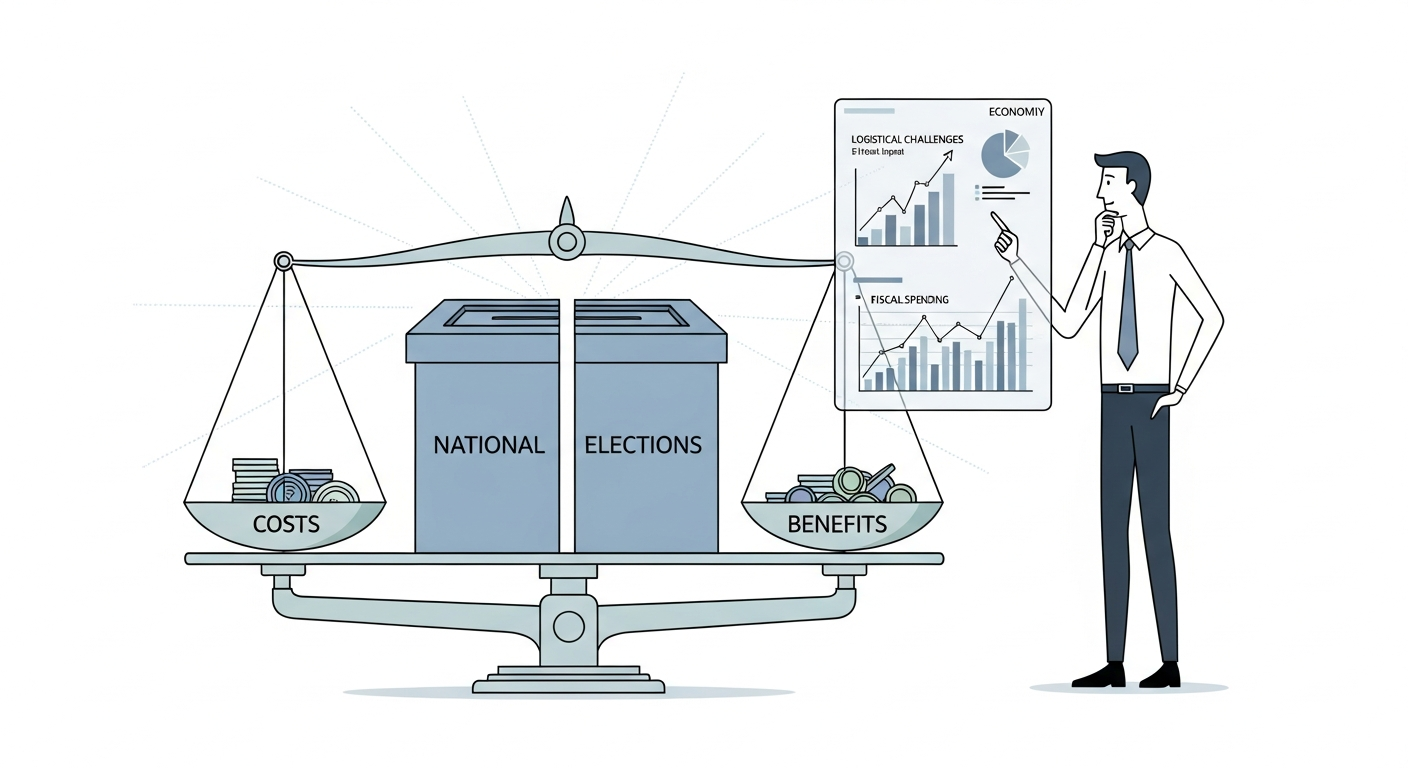
ONOE: Positive, Needs Scrutiny
Context
I want to unpack a recent intervention that matters for economics and democratic governance alike: Gita Gopinath (gopinath@harvard.edu) described the One Nation, One Election (ONOE) proposal as “a positive reform” from an economic perspective — but one that "needs further look" when it comes to costs and logistics Hindustan Times. As someone who watches policy through both macroeconomic and social lenses, I think her framing is thoughtful and the follow-up work she recommends should be mandatory before any big structural change.
Who is Gita Gopinath (gopinath@harvard.edu)?
Gita Gopinath (gopinath@harvard.edu) is one of the world’s leading macroeconomists — formerly IMF Chief Economist and First Deputy Managing Director, and now back in academia. Her institutional perspective combines rigorous data-driven analysis with practical policy judgment. When she flags both upside potential and the need for further inquiry, I treat it as an invitation to rigorous cost–benefit and institutional analysis rather than a thumbs-up or thumbs-down.
What ONOE refers to
ONOE (One Nation, One Election) is the shorthand for synchronising national (Lok Sabha) and state assembly elections so that multiple polls occur in the same window rather than staggered over the five-year cycle. The idea is to reduce repeated election cycles that create policy uncertainty, short‑term fiscal tinkering, and repeated deployment of administrative resources.
What she said — summary
In a written submission to a parliamentary committee, Gita Gopinath (gopinath@harvard.edu) described ONOE as "positive" for the economy but cautioned that:
- official estimates of direct cost reductions are not yet robust;
- logistic challenges (staffing, ballot complexity, security) could be substantial; and
- international experience — notably Indonesia’s fully simultaneous elections — shows mixed outcomes, including record spending and administrative strain leading to a subsequent court-mandated partial separation of polls [Hindustan Times].
Her recommendation was plain: treat ONOE as a reform worth studying rigorously rather than rushing into implementation.
Economic implications — my analysis
There are plausible mechanisms through which ONOE could improve economic outcomes, but they need quantification.
Reduced policy uncertainty: Fewer election windows could lower episodic policy uncertainty that delays firm procurement, government contracting, and some private investment. That effect can raise efficiency and raise the premium on long-term infrastructure planning.
Reallocation of fiscal priorities: Election periods often see short-term spending spikes (subsidies, targeted transfers) that can crowd out capital formation. Synchronisation might reduce the frequency of such cyclical distortions and free up fiscal headroom for public investment.
Administrative efficiency: Consolidating logistics, security, and electoral infrastructure could yield cost savings — but savings depend on scale effects and complexity. If simultaneous polls require more varied ballots, training, or staff per polling station, administrative costs and error risk can rise.
Macro consequences: If ONOE leads to higher sustained public investment and lower recurrent election-driven consumption spikes, potential GDP could increase modestly over the medium term. But these gains hinge on political incentives and implementation quality.
Reactions and political-economy considerations
Her stance is politically neutral but institutionally demanding. Key governance concerns include:
Federal balance: Synchronisation could alter centre–state dynamics (timing of mandates, leverage over policy agendas).
Voter experience and turnout: Longer ballots or multiple simultaneous choices can confuse voters and increase invalid ballots, as some international cases suggest.
Administrative resilience: Election workers, security forces, and logistics chains could be overstretched during fully simultaneous polls.
These are not mere technicalities — they shape public trust and the legitimacy of outcomes.
What further scrutiny should involve
If policymakers take Gita Gopinath (gopinath@harvard.edu)'s advice and proceed carefully, a robust review should include:
Empirical cost–benefit analysis: Estimate direct and indirect fiscal savings against transition and recurring administrative costs, using state-level natural experiments where polls already coincide.
Pilot and phased rollout: Test reforms in a limited number of states or election cycles before national implementation.
Administrative stress-testing: Simulate ballot complexity, staffing needs, and security scenarios (including worst-case contingencies).
Democratic safeguards: Assess impacts on representation, campaign finance dynamics, and federalism. Consider legal safeguards to protect minority and regional voices.
Data collection plan: Create standardized metrics (cost-per-poll, invalid-ballot rates, staff-hours, security incidents) to evaluate outcomes objectively.
Risks to watch
- Hidden transition costs (IT systems, re-training, logistics) that exceed projected savings.
- Concentration of electoral power and potential erosion of decentralised accountability.
- Voter confusion and higher rates of invalid votes in multi-ballot exercises.
- Political timing that favours short-term optics over long-term institutional health.
Conclusion
I welcome the tone of careful curiosity in Gita Gopinath (gopinath@harvard.edu)'s intervention: ONOE may offer genuine economic benefits, but those benefits are conditional on rigorous, transparent scrutiny and staged implementation. Economists and policymakers must collaborate on data-driven pilots, realistic accounting of transition costs, and safeguards for democratic institutions. If we do that, we can turn a promising idea into a credible reform — otherwise we risk trading short-term headlines for long-term institutional costs.
Regards,
Hemen Parekh
Any questions / doubts / clarifications regarding this blog? Just ask (by typing or talking) my Virtual Avatar on the website embedded below. Then "Share" that to your friend on WhatsApp.
Get correct answer to any question asked by Shri Amitabh Bachchan on Kaun Banega Crorepati, faster than any contestant
Hello Candidates :
- For UPSC – IAS – IPS – IFS etc., exams, you must prepare to answer, essay type questions which test your General Knowledge / Sensitivity of current events
- If you have read this blog carefully , you should be able to answer the following question:
- Need help ? No problem . Following are two AI AGENTS where we have PRE-LOADED this question in their respective Question Boxes . All that you have to do is just click SUBMIT
- www.HemenParekh.ai { a SLM , powered by my own Digital Content of more than 50,000 + documents, written by me over past 60 years of my professional career }
- www.IndiaAGI.ai { a consortium of 3 LLMs which debate and deliver a CONSENSUS answer – and each gives its own answer as well ! }
- It is up to you to decide which answer is more comprehensive / nuanced ( For sheer amazement, click both SUBMIT buttons quickly, one after another ) Then share any answer with yourself / your friends ( using WhatsApp / Email ). Nothing stops you from submitting ( just copy / paste from your resource ), all those questions from last year’s UPSC exam paper as well !
- May be there are other online resources which too provide you answers to UPSC “ General Knowledge “ questions but only I provide you in 26 languages !


No comments:
Post a Comment