
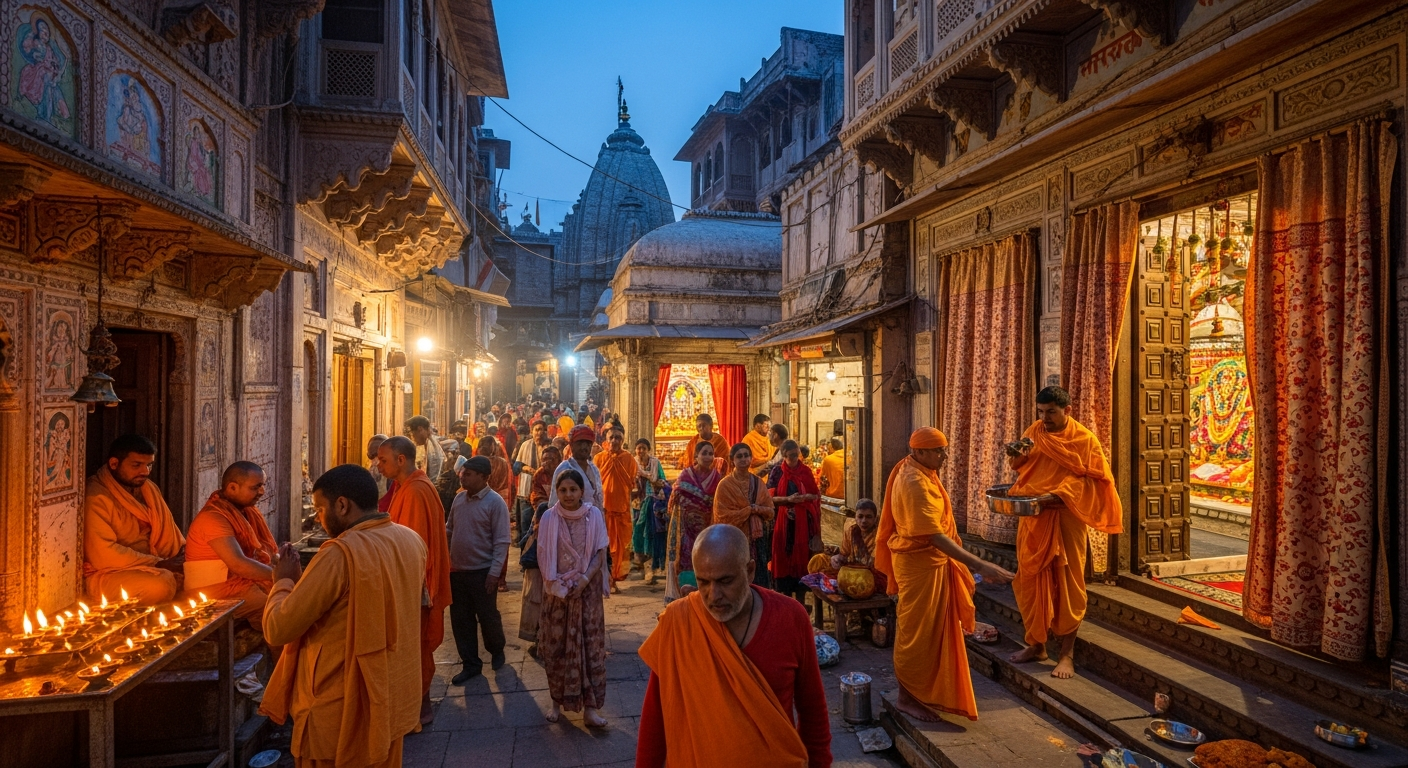
I write this as someone who watches public life in India closely: the dispute over darshan timings at Vrindavan’s Banke Bihari temple — now before the Supreme Court — is about more than a schedule. It touches ritual authority, crowd safety, governance and the way ordinary devotees experience the sacred. The reporting that prompted the legal notice is visible in coverage such as The Times of India’s recent reporting on the matter “What was the tearing hurry?” and contemporaneous accounts by national outlets India Today and News18.
What is the issue now?
A petition has reached the Supreme Court challenging recent administrative changes to the Banke Bihari temple’s public darshan timings and the suspension of certain internal rituals performed when the shrine is formally closed. The court has issued notices to the relevant authorities and the committee currently managing the temple and has asked for responses, listing the matter for further hearing.
The central legal questions are straightforward on paper, but intricate in practice:
- Were long-standing ritual timings and internal practices lawfully altered?
- Did the committee managing the temple overstep into "internal" religious functions?
- Do extended or shifted darshan windows allow paid or privileged rituals that disturb the deity’s resting period and hurt the traditional ritual order?
A brief background on the temple and the practice of ‘‘deity sleep’’
Banke Bihari in Vrindavan is one of north India’s most visited Krishna shrines. Over generations the temple developed not just public aarti and bhog schedules but internal, time-bound rituals — moments when the sanctum is closed to the public so priests and hereditary servitors can perform rites, offer bhog (food), and maintain a pattern of waking and resting for the deity.
The term often used in public debate — the deity’s "sleep" or "resting time" — refers to these ritual pauses. In Hindu worship traditions, such pauses have theological and symbolic meaning: treating the murti (icon) as a living presence that requires care, food and repose. These intervals also structure who can access the sanctum and when, and are often linked to guru–shishya (teacher–disciple) practices and hereditary privileges.
What the Supreme Court is being asked to decide
The court must balance constitutional and administrative questions with religious sensibilities. Petitioners argue the changes:
- Violate the temple’s established ritual rhythm and thereby infringe Article 25/26 religious freedoms; and
- Contrary to prior court directions that the High-Powered Committee should not interfere in internal puja/seva arrangements.
Respondents and managing authorities counter that timing adjustments are aimed at crowd control, safety and ensuring wider access — especially after stampede-like incidents at festivals — and that administrative oversight is necessary while governance structures are in legal flux.
Why the issue matters beyond ritual language
There are practical and symbolic stakes:
- Devotees: For many, the timing and manner of darshan is an emotional and devotional matter. Changes can feel like an erosion of intimacy with the deity.
- Temple management and the state: The dispute sits atop a wider row on governance — including a government ordinance and a court-appointed management committee created to oversee day-to-day functioning and safety upgrades. Infrastructure projects (a temple corridor) and use of temple funds feature in the background.
- Equity and access: Allegations that paid, ‘‘special pujas’’ were being allowed during closed hours raise questions about privilege, transparency and whether the shrine’s public character is being preserved.
Voices on the ground (plausible, representative quotes)
A temple-management spokesperson said: "We aim to make darshan safer and more orderly; small timing changes help manage crowds without changing the heart of worship."
A member of the committee appointed to manage the temple observed: "Our mandate is public safety and basic amenities for lakhs of devotees; we must ensure no repeat of past tragedies. Timing is part of that equation."
A devotee I spoke with reflected the emotional tenor: "It’s not just minutes on a clock. The time when Thakurji rests is sacred. Disturbing it feels wrong to many of us."
A legal expert (on background) offered the balance: "Courts will look at whether the committee’s choices are administrative and safety-driven or whether they alter the core rite — if the latter, constitutional protections for religious practice will be engaged."
Possible outcomes and implications
- If the court finds the committee exceeded its remit, some ritual practices (including the Dehri puja) could be reinstated and stricter limits placed on paid/closed-hour rituals.
- If the court upholds timing changes for safety reasons, the precedent may empower administrative bodies to make similar interventions — but likely with guidelines to protect internal rites where constitutionally required.
- Longer-term, a negotiated settlement that codifies transparent timing rules, public booking and safeguards against private, paid darshan during closed hours could reduce friction.
My take — a balanced view
I believe the instinct to protect safety and prevent stampedes is legitimate — no one wants congregational tragedies. But faith traditions are lived in ritual time; any change must be consultative, transparent and minimally intrusive on core worship practices. The Supreme Court’s role should be to ensure that administrative steps aimed at safety do not become cover for privileging a few or eroding centuries-old religious practices without genuine necessity.
This is about how modern governance and ancient ritual memory coexist. I hope the resolution honours both the devotees’ faith and the practical need to keep crowds safe.
Regards,
Hemen Parekh
Any questions / doubts / clarifications regarding this blog? Just ask (by typing or talking) my Virtual Avatar on the website embedded below. Then "Share" that to your friend on WhatsApp.
Get correct answer to any question asked by Shri Amitabh Bachchan on Kaun Banega Crorepati, faster than any contestant
Hello Candidates :
- For UPSC – IAS – IPS – IFS etc., exams, you must prepare to answer, essay type questions which test your General Knowledge / Sensitivity of current events
- If you have read this blog carefully , you should be able to answer the following question:
- Need help ? No problem . Following are two AI AGENTS where we have PRE-LOADED this question in their respective Question Boxes . All that you have to do is just click SUBMIT
- www.HemenParekh.ai { a SLM , powered by my own Digital Content of more than 50,000 + documents, written by me over past 60 years of my professional career }
- www.IndiaAGI.ai { a consortium of 3 LLMs which debate and deliver a CONSENSUS answer – and each gives its own answer as well ! }
- It is up to you to decide which answer is more comprehensive / nuanced ( For sheer amazement, click both SUBMIT buttons quickly, one after another ) Then share any answer with yourself / your friends ( using WhatsApp / Email ). Nothing stops you from submitting ( just copy / paste from your resource ), all those questions from last year’s UPSC exam paper as well !
- May be there are other online resources which too provide you answers to UPSC “ General Knowledge “ questions but only I provide you in 26 languages !




No comments:
Post a Comment