
Introduction
I write this as someone who has watched India’s energy story unfold for decades — with curiosity, a little worry, and a constant sense of possibility. News that India’s petrol pump network has crossed the 100,000 mark is not just a milestone of infrastructure; it is a mirror of our mobility, policy choices, industrial strategy, and the contradictions of a country moving quickly but unevenly.
Data and quick snapshot
- The Petroleum Planning & Analysis Cell (PPAC) and contemporaneous news reports put the number at about 100,266 petrol pumps in India as of the end of November 2025 — placing India third globally after the United States and China PPAC.
- Over the past decade the retail network has nearly doubled from roughly 50,000 outlets in 2015 to the 100k level today. Several news summaries and industry analyses have highlighted this rapid expansion (Business Standard, Rediff/Money).
- Ownership mix: more than 90% of outlets remain with state-owned oil marketing companies (IOCL, BPCL, HPCL), while private players account for a single-digit share (~9% in recent tallies) [Rediff/Money].
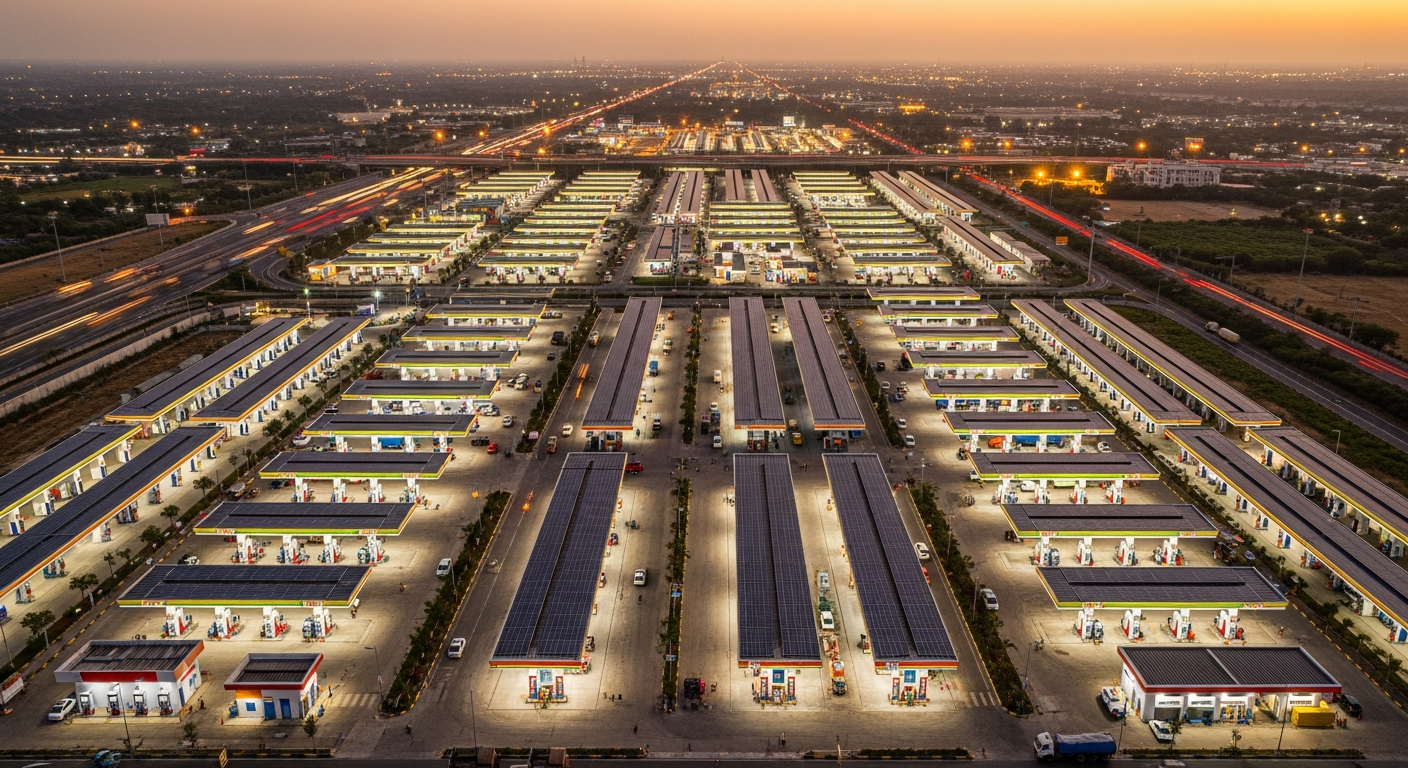
- Geography and services: rural outlets now account for close to 29% of the total, up from ~22% a decade ago, and a growing share of stations are adding non-traditional services such as CNG, biofuel blends and early-stage EV charging infrastructure [Business Standard].
Why did the network grow so fast?
Several forces combined:
- Vehicle growth and highways: Rising vehicle ownership — cars, two-wheelers and freight — plus investments in highways and logistics corridors created demand for more refuelling points.
- PSU expansion strategy: Public sector oil companies have actively expanded to defend market share, meet social/access objectives and serve rural and remote markets where private operators are cautious.
- Policy and business model: A regulated environment with government influence in pricing (and the comfort of predictable PSU balance sheets) encouraged steady outlet additions rather than consolidation driven purely by market economics.
- Township and retail play: Many outlets became multi-service retail nodes — convenience stores, quick-serve food, and alternate fuels — making new sites commercially attractive beyond fuel margins.
Implications for the economy and consumers
Positive:
- Better access: For many rural and peri-urban Indians the nearer pump means improved last-mile connectivity for goods and mobility.
- Employment and micro-enterprise: Thousands of dealers, attendants and ancillary workers gained livelihoods; local vendors and logistics players benefitted.
- Competitive service: Denser networks and multiple operators in urban corridors have pushed improvements in service quality, loyalty programs, and digital payments.
Tension points:
- Throughput squeeze: As outlets proliferate, average daily volume per pump can fall on less-busy routes, pressuring the economics of small dealers.
- Investment burden: The installed capital in the network is large; adding more outlets raises questions of long-term utilisation and return on investment.
Challenges and concerns
Environmental
- Continued fossil dependence: A large petrol/diesel retail network entrenches liquid-fuel dependence, complicating a faster transition to low-carbon mobility.
- Local pollution and risk: Stations bring risks of soil contamination, accidental spills, and local air quality impacts if vapour recovery & safety standards are inconsistent.
- Land and water: Expanding stations — especially informal or marginally regulated ones — can stress local land use and groundwater if containment is weak.
Regulatory and market
- Pricing signals and distortions: State influence and subsidy legacies have at times distorted commercial incentives, discouraging private entrants and efficiency-driven consolidation.
- Uneven private participation: The low presence of private retailers suggests market barriers that limit competition; industry observers note that identical pump pricing across PSUs reduces price competition as a tool to attract customers.
- Safety & compliance: Rapid expansion requires equally rapid strengthening of safety inspections, environmental clearances and training for operators.
Operational and strategic
- The EV challenge: Petrol pumps are not automatically the right sites for heavy investment in EV charging. Urban pumps are often space-limited; waiting-line dynamics differ between fast refuelling and battery charging. This was a theme I raised earlier when I wondered how petrol infrastructure would adapt to fast electrification and solarized charging concepts (my earlier notes on solarized charging and the challenge of charging infrastructure).
- Overcapacity risk: Some industry voices have warned that India may be approaching a plateau where adding more pumps yields diminishing returns and forces uneconomic closures.
Future outlook — what happens next?
I see several plausible pathways over the next decade:
- Plateau and consolidation: The network could stabilise as high-cost, low-throughput outlets exit and surviving sites diversify services.
- Multi-fuel retail hubs: Leading outlets will evolve into energy-retail hubs offering petrol/diesel, CNG, biofuel blends, hydrogen pilot dispensing, and multiple grades of EV fast-charging — transforming pumps into energy-and-mobility service centers.
- Solar and digital upgrade: Solarization of canopy roofs, battery-buffered microgrids, digital payments, telemetry, and customer apps will become standard for the most competitive sites. This echoes my earlier thoughts about rooftop solar and the economics of charging stations (see my analysis on rooftop solar and EV charging economics).
- Policy pivot: If India accelerates EV adoption through stronger incentives, or mandates faster blends of biofuels and e-fuels, the long-term role and revenue mix of petrol pumps will change significantly.
Voices from the field (hypothetical but plausible)
“We added outlets to be closer to our customer base — but now we’re redesigning stations to add convenience retail and fast-charge pilots. The future is multi-energy retailing.” — a senior industry executive at a major OMC.
“Rural access improved markedly; but dealers on low-traffic roads struggle to cover fixed costs. Policy must balance access with dealer viability.” — a veteran dealer association representative.
These sentiments are consistent with multiple industry analyses and on-the-ground reports: expansion delivered accessibility but also unveiled structural sustainability questions.
What I wrote before and why it matters now
I have long argued that adding physical refuelling infrastructure without an eye on future fuels and the energy transition risks stranded assets. In 2018 I raised questions about investments in new petrol pumps versus the economics of scaled EV charging and solarized stations (see: "25,000 New Petrol Pumps? Why?" and related posts). That thread of thought matters now: the 100k milestone is a success for access, but also a call to rethink how those sites will adapt to cleaner fuels, digital services, and climate resilience.
Policy and industry actions I would recommend
- Rationalise expansion plans: Prioritise corridors and underserved pockets, and avoid blanket outlet additions without throughput-based business tests.
- Incentivise diversification: Offer targeted support for solarization, EV fastchargers, vapour recovery units and safe waste handling at retail sites.
- Strengthen dealer support: Credit lines, safety training, and technology grants can help marginal outlets transition rather than collapse.
- Set clear transition roadmaps: A predictable fuel-and-technology roadmap (EV targets, hydrogen pilots, biofuel blending schedules) will allow retailers to plan capex and diversify.
Conclusion
The crossing of 100,000 petrol pumps in India is both an achievement and a juncture. It speaks of remarkable distributional reach and of public-sector intent to serve. But it also raises tough questions about efficiency, environmental responsibility, and future-readiness. My view is this: celebrate the access milestone, but treat it as the starting line for a deliberate, tech-enabled, and sustainable transformation of fuel retailing in India.
Regards,
Hemen Parekh
Any questions / doubts / clarifications regarding this blog? Just ask (by typing or talking) my Virtual Avatar on the website embedded below. Then "Share" that to your friend on WhatsApp.
Get correct answer to any question asked by Shri Amitabh Bachchan on Kaun Banega Crorepati, faster than any contestant
Hello Candidates :
- For UPSC – IAS – IPS – IFS etc., exams, you must prepare to answer, essay type questions which test your General Knowledge / Sensitivity of current events
- If you have read this blog carefully , you should be able to answer the following question:
- Need help ? No problem . Following are two AI AGENTS where we have PRE-LOADED this question in their respective Question Boxes . All that you have to do is just click SUBMIT
- www.HemenParekh.ai { a SLM , powered by my own Digital Content of more than 50,000 + documents, written by me over past 60 years of my professional career }
- www.IndiaAGI.ai { a consortium of 3 LLMs which debate and deliver a CONSENSUS answer – and each gives its own answer as well ! }
- It is up to you to decide which answer is more comprehensive / nuanced ( For sheer amazement, click both SUBMIT buttons quickly, one after another ) Then share any answer with yourself / your friends ( using WhatsApp / Email ). Nothing stops you from submitting ( just copy / paste from your resource ), all those questions from last year’s UPSC exam paper as well !
- May be there are other online resources which too provide you answers to UPSC “ General Knowledge “ questions but only I provide you in 26 languages !



No comments:
Post a Comment