
Lead / Lede
India has made remarkable strides in renewable energy deployment, but the Ministry of New and Renewable Energy (MNRE) has told Parliament that much more capital is needed—particularly for battery storage, green hydrogen and offshore wind—to meet the country’s 500 GW non-fossil capacity goals. Recent reporting in BioEnergy Times synthesises MNRE’s parliamentary update and highlights an estimated funding requirement running into tens of lakh crore rupees for the coming six years BioEnergy Times. In this post I pull those signals together, describe the core challenges, and offer practical policy and investment recommendations for policymakers, energy professionals and the informed public.
Background / Context
India’s renewables journey has been impressive: solar and wind capacity additions have accelerated, public and private capital have flowed in, and policy instruments (PLI schemes, sovereign green bonds, priority-sector lending limits) have been introduced to support growth. Yet the next phase of the transition requires technologies and infrastructure that are capital‑intensive and nascent in domestic markets—shared storage systems, large‑scale offshore wind farms, and a green hydrogen ecosystem that depends on abundant firm renewable power and new value chains.
Current challenges and data points
- MNRE’s summary to Parliament (as reported by BioEnergy Times) notes that cumulative investments in recent years have risen sharply, but that the country will need substantially more funding to reach its 500 GW non-fossil target.
- Estimates cited by MNRE indicate an overall financing requirement on the order of ₹30.5 lakh crore between FY2023–24 and FY2029–30 to achieve the target reported in parliamentary documents [BioEnergy Times].
- Capital intensity is concentrated in three areas:
- Energy storage (battery and pumped hydro) for grid stability and RTC renewables.
- Green hydrogen production (electrolysers, renewables dedicated capacity, storage and transport infrastructure).
- Offshore wind (site development, transmission corridors, ports and vessels).
- Public banks and finance institutions have been active, but private and global institutional investors will need clear, long-term policy signals and de‑risking instruments to commit at scale.
Policy and funding needs
The funding gap is both quantitative and qualitative. That means we need more money and smarter instruments to mobilise it:
- Scale up concessional finance and blended instruments (sovereign guarantees, subordinated debt, concessional loans) to reduce early‑stage risk.
- Expand and clarify market‑making mechanisms: long‑term contracts, demand aggregation for hydrogen, and revenue support (VGF, tax credits or production incentives) for early offshore wind projects.
- Faster and clearer transmission planning and cost‑allocation mechanisms for offshore wind and large renewables+storage projects.
- Strengthen public R&D and domestic manufacturing support for electrolysers and storage components to shorten lead times and lower costs.
Potential solutions and investment opportunities
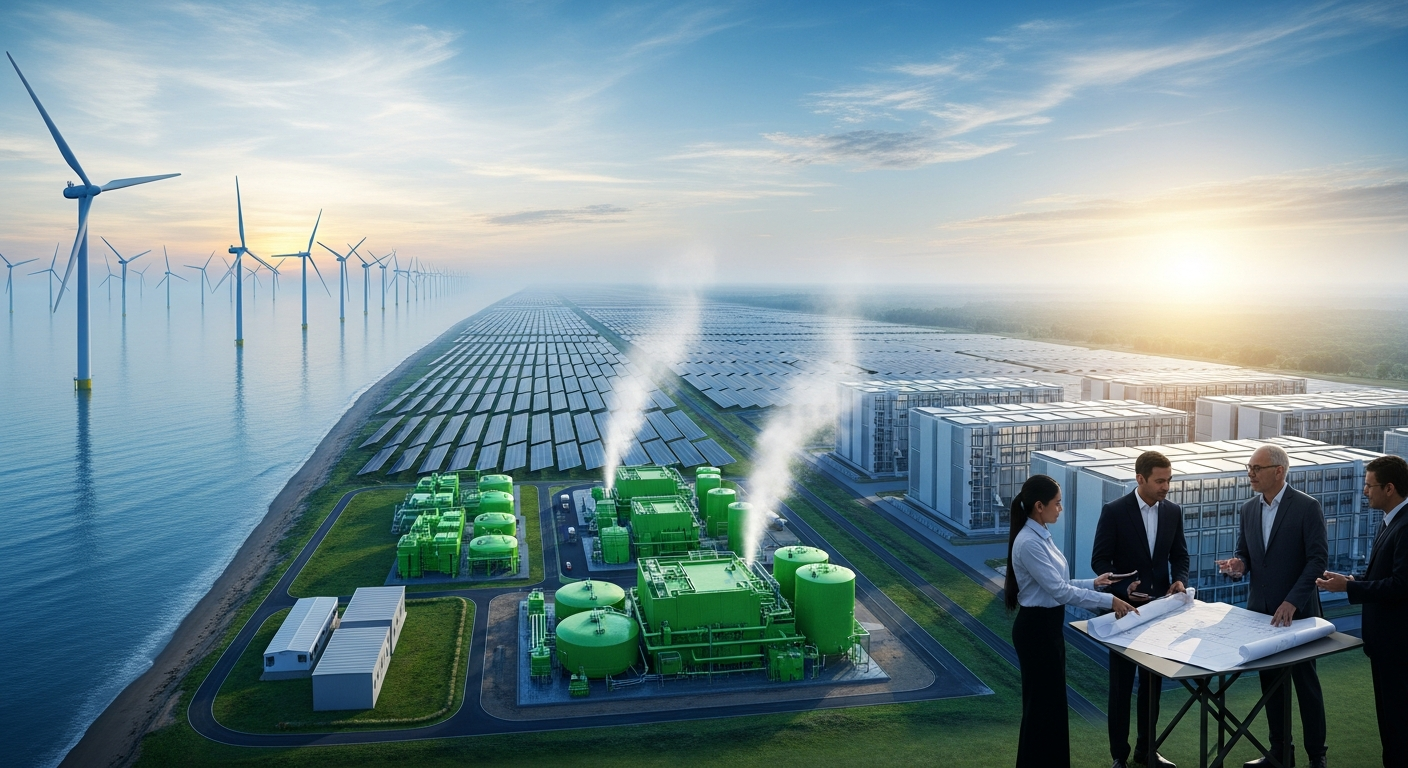
- Green hydrogen hubs: Co‑locate electrolyser plants with dedicated renewable capacity, shared storage and industrial off‑takers to create clustered demand and lower logistics costs.
- Shared grid‑scale storage facilities: Instead of only project‑tied batteries, invest in regional storage banks that can be leased by DISCOMs and developers.
- Strategic VGF and blended financing windows for early offshore wind leases to attract global developers and local suppliers.
- Use sovereign green bonds and multilateral climate finance to subsidise early‑stage capex and crowd in foreign institutional capital.
Case studies and international comparisons
- European offshore wind markets progressed rapidly once governments provided long‑duration contracts and port/transmission coordination. Early‑stage support reduced levelised costs and developed local supply chains.
- Countries with successful hydrogen programmes combine demand‑side measures (purchase obligations, industrial offtake agreements) with supply incentives and auction mechanisms (e.g., hydrogen banks or credits) to bridge the cost gap in early years.
These international lessons are relevant for India: policy clarity, demand aggregation and early de‑risking are essential to unlock private capital.
Recommendations for policymakers
- Create predictable demand signals for hydrogen by piloting purchase obligations with phased targets and competitive procurement for green ammonia/hydrogen.
- Set up regional storage facilities and a transparent leasing framework so DISCOMs and system operators can access bulk storage reliably.
- Offer time‑limited VGF/credit enhancement for the first tranche of offshore wind capacity and publish a clear transmission plan tied to auction timelines.
- Mobilise blended finance platforms (sovereign, MDB, private) targeted at electrolyser manufacturing and heavy capital items where market failures are most acute.
- Improve coordination between central and state incentives—land allocation, grid waivers, and capital subsidies—so project economics are predictable for investors.
Conclusion and call to action
India’s transition to a low‑carbon power system is within reach, but the next leg—storage, green hydrogen and offshore wind—requires bold, coordinated financing and policy action. Policymakers must move from episodic incentives to durable market‑making tools; investors must be offered predictable offtake and risk mitigation; and industry must accelerate capacity building. If we align these levers now, India can convert policy momentum into tangible projects and domestic jobs, while lowering costs for consumers over time.
I’ve discussed the importance of storage in earlier posts when arguing for dedicated national storage frameworks Green Energy Storage : Preserving a Perishable. The present moment calls for the same clarity, scaled up to finance and industrial policy.
Suggested further reading
- “India needs more funds for storage, green hydrogen and offshore wind” — BioEnergy Times (summary of MNRE’s Parliamentary update): https://bioenergytimes.com/india-needs-more-funds-for-storage-green-hydrogen-and-offshore-wind-mnre/
- MNRE — National Green Hydrogen Mission (policy overview): https://mnre.gov.in/en/national-green-hydrogen-mission/
Regards,
Hemen Parekh — hcp@recruitguru.com
Any questions / doubts / clarifications regarding this blog? Just ask (by typing or talking) my Virtual Avatar on the website embedded below. Then "Share" that to your friend on WhatsApp.
Get correct answer to any question asked by Shri Amitabh Bachchan on Kaun Banega Crorepati, faster than any contestant
Hello Candidates :
- For UPSC – IAS – IPS – IFS etc., exams, you must prepare to answer, essay type questions which test your General Knowledge / Sensitivity of current events
- If you have read this blog carefully , you should be able to answer the following question:
- Need help ? No problem . Following are two AI AGENTS where we have PRE-LOADED this question in their respective Question Boxes . All that you have to do is just click SUBMIT
- www.HemenParekh.ai { a SLM , powered by my own Digital Content of more than 50,000 + documents, written by me over past 60 years of my professional career }
- www.IndiaAGI.ai { a consortium of 3 LLMs which debate and deliver a CONSENSUS answer – and each gives its own answer as well ! }
- It is up to you to decide which answer is more comprehensive / nuanced ( For sheer amazement, click both SUBMIT buttons quickly, one after another ) Then share any answer with yourself / your friends ( using WhatsApp / Email ). Nothing stops you from submitting ( just copy / paste from your resource ), all those questions from last year’s UPSC exam paper as well !
- May be there are other online resources which too provide you answers to UPSC “ General Knowledge “ questions but only I provide you in 26 languages !





No comments:
Post a Comment