
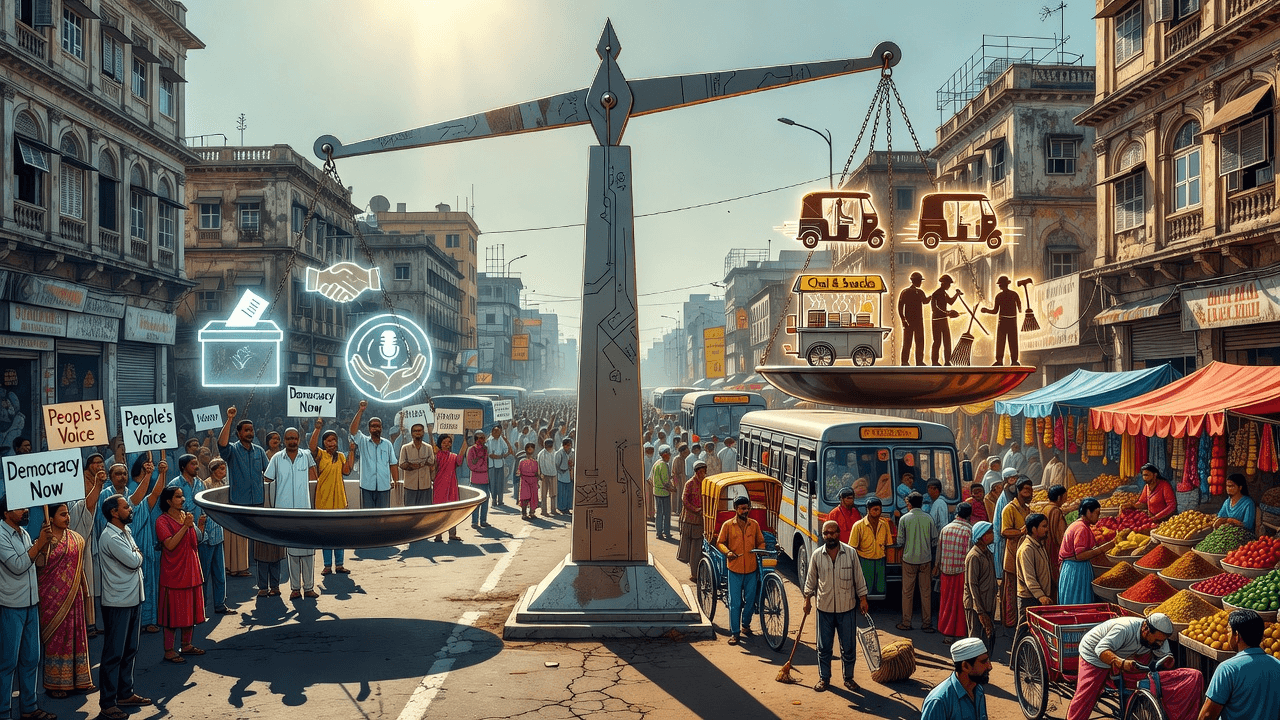
Watching the latest developments in Delhi as the city prepares for the Cockroach Janta Party (CJP) stir, I am struck once again by the delicate balance between the democratic right to dissent and the fundamental right to livelihood. The Supreme Court’s recent observation—that it hopes 'better sense will prevail' is a timely reflection on the necessity of proportionality in governance.
The Human Cost of Disruption
When administrative measures, such as the blanket closure of public transport or extensive traffic restrictions, become the default response to protest, it is the common citizen who pays the price. Students, daily wagers, and small business owners—the backbone of our economy—are often the hardest hit.
I have frequently emphasized that administrative actions must never feel like using a 'hammer to kill a fly.' A society that prioritizes security at the total expense of daily functionality eventually compromises the very freedom it seeks to protect.
Judicial Oversight as a Safeguard
It is heartening to see the judiciary maintaining a vigilant stance. When actions by the authorities become disproportionate, it is the courts that must step in to remind the executive that their powers are not absolute. Whether it concerns the metro station closures or the broader restrictions on movement, the focus must remain on the ordinary citizen’s ability to navigate the city safely.
Reflection and Responsibility
We must move toward a future where designated protest zones and regulated security measures allow for expression without grinding the city to a halt. As I have pondered in my previous writings on the intersection of urban planning and social harmony, a thriving city requires infrastructure that adapts, not one that is constantly paralyzed by fear or excessive precaution.
Let us hope that those organizing the protests, as well as the authorities tasked with maintaining order, find a middle ground that respects the rights of the many over the convenience of the few.
If you have read this blog carefully , you should be able to answer the following question:
"What principle did the Supreme Court highlight regarding the proportionality of administrative restrictions during protests?" You can find that answer by entering this question at ( 1 ) www.HemenParekh.ai ( 2 ) www.IndiaAGI.ai
No comments:
Post a Comment