Hi Friends,

Even as I launch this today ( my 80th Birthday ), I realize that there is yet so much to say and do. There is just no time to look back, no time to wonder,"Will anyone read these pages?"

With regards,
Hemen Parekh
27 June 2013

Now as I approach my 90th birthday ( 27 June 2023 ) , I invite you to visit my Digital Avatar ( www.hemenparekh.ai ) – and continue chatting with me , even when I am no more here physically

Translate

Showing posts sorted by relevance for query detention centres. Sort by date Show all posts

Thursday, 28 May 2026

Detention Centers in West Bengal

Detention Centers in West Bengal

Detention Centers in West Bengal

I write this with a mix of concern and a desire for clarity. Last week the West Bengal government opened what it described as the state's first holding centres for people labelled "illegal" — a move that placed 12 individuals in facilities reported to be in Malda and Murshidabad districts. The reports say those placed include people alleged to be from Bangladesh and some described as Rohingya. The development raises immediate questions about process, rights, and regional diplomacy.

What happened — the basics

  • Authorities have announced and activated holding centres in Malda and Murshidabad, initially housing 12 people reported as undocumented or "illegal" migrants.
  • Local administrations have framed these centres as places to detain individuals pending identification, legal processing, and, where applicable, deportation or transfer. The state release outlining the move emphasized law-and-order and migration management.

I want to be explicit: reporting on such sensitive actions requires careful sourcing. Immediate primary sources to consult are the official state government releases, district magistrate orders from Malda and Murshidabad, and local police statements.

Background: citizenship, migration and West Bengal

West Bengal sits on a long international border with Bangladesh and has a complex history of migration, cultural exchange, and periodic political contention over citizenship. A few contextual points:

  • Citizenship and undocumented migration have been politically salient for years, especially since national laws and proposals such as the Citizenship Amendment Act (CAA) and periodic discussions around a National Register have surfaced.
  • The Foreigners Act (and associated rules) empowers authorities to identify, detain and arrange the removal of persons deemed foreign/illegal. However, detention must still conform to legal safeguards and due process.
  • Unlike Assam — which completed a controversial National Register of Citizens (NRC) exercise — West Bengal resisted a similar NRC process at the state level while debates around CAA intensified nationally.

These legal instruments — the Foreigners Act, the debates around NRC, and the CAA — form the framework within which actions like the opening of holding centres are being justified and contested.

Reactions on the ground

Local communities in Malda and Murshidabad have shown mixed reactions.

  • Some residents and local leaders welcomed steps framed as addressing illegal migration and perceived pressures on local resources.
  • Others — including civil society activists and community groups — expressed alarm, fearing that detention could target vulnerable, marginalised people and inflame communal tensions.

Human rights NGOs and activists have urged restraint. Their concerns focus on potential arbitrary detention, lack of transparent identification procedures, limited access to legal counsel, and the risk of statelessness if people cannot be returned or certified as citizens.

Legal and human-rights concerns

Key legal and rights-related issues to watch:

  • Due process: Are detainees being informed of charges and given access to lawyers and independent verification of identity?
  • Detention conditions: Transparency about the centres’ conditions, duration of detention, medical access, and oversight is essential.
  • Refugee protections: Rohingya people are widely recognised as refugees from Myanmar. India is not a party to the 1951 UN Refugee Convention, which complicates formal refugee protections and resettlement pathways. International and domestic NGOs may press for humane treatment and international engagement (including UN agencies where appropriate).
  • Risk of statelessness: Without clear, fair processes for determining nationality or refugee status, there is a real danger that people will fall into legal limbo.

Statements and positions

Official statements so far appear to come primarily from state government releases and district administrations framing the centres as administrative steps for managing unauthorized crossings and pending deportation processes. Activist voices and NGOs have issued critiques calling for transparency and adherence to legal safeguards. Local media have reported interviews from both supporters and dissenters in the affected districts.

For readers seeking verification, I suggest looking first to the state government press notes and the district magistrate notifications for Malda and Murshidabad, followed by coverage from regional newspapers and verified NGO statements.

Implications for India–Bangladesh relations

Opening detention centres near the border has diplomatic dimensions:

  • If the detained individuals are nationals of Bangladesh, formal repatriation would require coordination through diplomatic channels, identity verification, and agreement from Bangladesh authorities — a process that can be politically sensitive.
  • Rohingya individuals are not Bangladesh nationals in the standard sense; they are refugees originally from Myanmar. Bangladesh itself has hosted large Rohingya populations and has been reluctant or unable to absorb further forced returns without diplomatic solutions involving Myanmar and international partners.
  • Such actions can raise bilateral tensions if not managed through established diplomatic protocols and clear communication.

Possible next steps

Several paths are likely or possible in the coming weeks:

  • Legal challenges: Civil society and legal aid groups may move to court seeking clarity on detention legality, access to counsel, and humane conditions.
  • Administrative processing: Authorities may undertake biometric and documentary verification; some individuals may face formal proceedings under the Foreigners Act.
  • Diplomatic engagement: Where nationality is claimed for Bangladesh, formal diplomatic approaches will be necessary for repatriation — a process that can take time and negotiation.
  • International engagement: For Rohingya or other refugees, involvement from UN agencies and international NGOs may increase, particularly if detention expands or conditions are questioned.

What to watch and how to follow responsibly

I recommend monitoring these sources for reliable updates:

  • Official state government releases and district administration orders (Malda, Murshidabad)
  • Credible local and national media reporting with named on-the-record sources
  • Statements and briefings from human-rights NGOs and legal-aid organisations
  • Diplomatic statements from the Ministry of External Affairs and Bangladesh’s foreign ministry for cross-border implications

Avoid relying solely on social media claims; verify identities and official documents before drawing conclusions or sharing reports.

My reflection

As someone who follows social and civic trends closely, I find this situation emblematic of the tensions between sovereign control of borders and human rights obligations. Managing migration is a legitimate state function, but it must be pursued with transparency, legal safeguards, and respect for human dignity. Detention for administrative reasons becomes deeply problematic when oversight is limited and pathways to resolution are unclear.

This will be a story of law, politics and human lives — and how the authorities, civil society, and neighbouring states navigate those forces will determine whether the next steps soothe tensions or inflame them.


Regards,
Hemen Parekh


Any questions / doubts / clarifications regarding this blog? Just ask (by typing or talking) my Virtual Avatar on the website embedded below. Then "Share" that to your friend on WhatsApp.

Get correct answer to any question asked by Shri Amitabh Bachchan on Kaun Banega Crorepati, faster than any contestant


Hello Candidates :

  • For UPSC – IAS – IPS – IFS etc., exams, you must prepare to answer, essay type questions which test your General Knowledge / Sensitivity of current events
  • If you have read this blog carefully , you should be able to answer the following question:
"What are the main legal protections and international mechanisms available to people detained as 'illegal migrants' in India, and how do they differ for refugees like the Rohingya?"
  • Need help ? No problem . Following are two AI AGENTS where we have PRE-LOADED this question in their respective Question Boxes . All that you have to do is just click SUBMIT
    1. www.HemenParekh.ai { a SLM , powered by my own Digital Content of more than 50,000 + documents, written by me over past 60 years of my professional career }
    2. www.IndiaAGI.ai { a consortium of 3 LLMs which debate and deliver a CONSENSUS answer – and each gives its own answer as well ! }
  • It is up to you to decide which answer is more comprehensive / nuanced ( For sheer amazement, click both SUBMIT buttons quickly, one after another ) Then share any answer with yourself / your friends ( using WhatsApp / Email ). Nothing stops you from submitting ( just copy / paste from your resource ), all those questions from last year’s UPSC exam paper as well !
  • May be there are other online resources which too provide you answers to UPSC “ General Knowledge “ questions but only I provide you in 26 languages !




Interested in having your LinkedIn profile featured here?

Submit a request.
Executives You May Want to Follow or Connect
Ravinder (Ravi) Singh
Harvard Business School
The core mission is to help C-Suite engage with the innovation ... technology leadership and innovations through its premiere award program—CIO100.
Loading views...
Lalit Singla
Lalit Singla
Founder & CEO, SteerX | Healthcare
Founder & CEO, SteerX | Healthcare | Innovations | Startups | Investments | TIH, IIT Bombay Fellow · I'm a seasoned industry leader, innovation ecosystem ...
Loading views...
lalit.singla@steerxglobal.com
Mitika Bajpai
Mitika Bajpai
Sustainability Leader at Reliance Industries
Deputy General Manager - Sustainability · Senior Sustainability Manager · Sustainability Manager · Consultant · Deputy Project Manager, Capstone · Teaching Assistant ...
Loading views...
mitika.bajpai@ril.com
Dhruba Purkayastha, PhD
Sustainable Development, Green and ...
He currently serves as Senior Programme Adviser to the Energy Policy ... General Manager and Head - Infrastructure, Energy and Government Advisory.
Loading views...
dhruba.purkayastha@csiglobal.co

Sunday, 24 May 2026

The Great Indian Detention Centre Paradox


 ==================================================

Respected Suvendu-ji,

Your government's recent order directing 23 District Magistrates to establish "holding centres" for illegal immigrants — Bangladeshis and Rohingyas alike — reflects a firmness of purpose that many citizens will appreciate.[1] The "detect, delete, deport" policy is, in spirit, precisely what border integrity demands.

However, as a concerned citizen who has examined this question in some depth,[2] I feel compelled to draw your attention to an aspect of this order that appears to have received inadequate deliberation: the catastrophic financial burden it will impose on an already stretched State exchequer — for a problem that is, constitutionally and legally, entirely a Central subject.

Allow me to place before you a simple but sobering arithmetic.[2]

A recent national television broadcast showed a brand-new, three-storey detention facility constructed in Uttar Pradesh — purpose-built to house just 50 persons (30 men and 20 women). A conservative estimate of its construction cost: not less than ₹ 5 crores.

Capital cost — building the centres (West Bengal alone)
Construction cost for 50 persons (1 centre — UP benchmark[2])₹5 Cr
Estimated illegal migrants in Bengal (conservative)~1 crore
Number of such buildings required2 lakh
Total capital expenditure₹ 10 lakh crore

Ten lakh crore rupees — just to build the centres. That is roughly equal to West Bengal's entire GSDP for three years. But the capital cost, shocking as it is, is not even the deepest wound.

Recurring annual operational cost[2]
Annual cost per detainee (food, medicine, maintenance, electricity, security, staff)₹ 2 lakh
Persons detained1 crore
Annual operational cost₹ 2 lakh crore / year

And this brings us to the most inconvenient question of all :  

>   for how long must we feed and house these detainees ?


The honest answer, Suvendu-ji, is : 

>  indefinitely. Possibly forever.


Over 99% of these migrants are from Bangladesh. Does anyone — in New Delhi or in Nabanna — genuinely believe that the Bangladeshi government will formally accept them back, en masse, with documentation, in an orderly process ? 

History gives us no reason for such optimism. Bangladesh has repeatedly and categorically denied that its nationals are present illegally in India in any significant number. Without a receiving country's cooperation, deportation is legally and practically impossible. The detainees simply... stay.

One cannot help but imagine what these detainees might quietly say to themselves, with a certain irony:

"Hey Yogiji — how soon can we move out of our jhuggi-jhopdis and into those palatial new mansions you are building for us?"

The State of West Bengal would, in effect, be constructing a vast, permanent, subsidised housing programme — for foreign nationals — funded by Bengali taxpayers.

This leads to the crux of the matter: immigration is a Central subject.

Under the Constitution of India, Entry 17 of the Union List (Seventh Schedule) explicitly assigns "Citizenship, naturalisation and aliens" to Parliament. Entry 19 covers "Admission into, and emigration and expulsion from, India.

" The Foreigners Act 1946, the Passport (Entry into India) Act 1920, and all related legislation flow from Union authority. 

The BSF — which guards the very borders through which these migrants entered — is a Central force. The deportation process itself is supervised by the Ministry of Home Affairs.

In short: this is not Bengal's problem to finance. It is India's problem, and the financial responsibility must rest entirely with the Government of India.

My respectful submission to you is therefore threefold:

First — before issuing construction orders to 23 DMs,[1] formally write to the Union Home Minister demanding that 100% of the capital and recurring cost of all holding centres be borne by the Central Government, with funds transferred directly to the State under a dedicated budgetary head.

Second — insist that the Centre provide a concrete, time-bound bilateral diplomatic framework with Bangladesh for verified deportations. Detention without deportation is not a policy; it is an indefinitely funded waiting room.

Third — until such financial assurance is in writing from New Delhi, direct your DMs to identify and document illegal immigrants rigorously, but defer all construction expenditure. The State must not be left holding a ₹10-lakh-crore bill for a problem it did not create and does not have the constitutional mandate — or the resources — to resolve alone.

Your instincts on infiltration are, I believe, correct. But good intentions must be backed by sustainable economics and constitutional clarity — otherwise, Bengal's taxpayers will end up permanently subsidising the very situation your government set out to fix.


With Regards,

Hemen Parekh

www.ntaNEET.net  /  www.My-Teacher.in / www.HemenParekh.ai / www.IndiaAGI.ai

25  May  2026

=================================================================

Sources cited in this letter


Wednesday, 31 December 2025

Migrant Return Hubs ( MRB ) = Detention Camps


 ==================================================


Migrant  Return  Hubs (  MRB  ) =  Detention Camps


SITUATION  IN  EUROPE :

A ….        MUAMMAR GADDAFI - A VISIONARY ? ………………… 04  Aug  2015


Extract :

Guardian  reported on  01 Sept 2010 , as follows :

"In a highly theatrical visit to Italy this week, Gaddafi warned that Europe would turn "black" unless it was more rigorous in turning back immigrants. Libya is a key transit point for illegal migration from Africa to Europe. The Libyan leader said the bill for sealing the crossing routes would be at least € 5bn  a year.

While in Rome Gaddafi advised Europeans to convert to Islam and sought to bolster his claim for billions from Europe by warning that millions of Africans were seeking to migrate to the EU.

"We don't know what will be the reaction of the white and Christian Europeans faced with this influx of starving and ignorant Africans," the Libyan leader told a Rome meeting attended by Silvio Berlusconi, the Italian prime minister. "We don't know if Europe will remain an advanced and united continent or if it will be destroyed, as happened with the barbarian invasions."

B ….  Gaddafi returns to haunt EU ……………………………………  18  Dec  2023


C ….  On its Way : Refugee-Migrant Tsunami ………………….. 19 Sept 2016


D ….  FREEDOM BEHIND BARS ?.................................... 16 Sept 2015


Extract :

INVASION  OF   EUROPE ,


by hundreds of migrants trying to cross the Serbia - Hungary border


Of course , closed gates / 4 meter high barbed wire fence / water cannons and tear gas shells , held back those few hundred refugees


But , for how long , when those few hundred become few thousands  ?


Hungary's response :


Passed a law treating illegal migration as a criminal offence


I presume , Hungary will prosecute those thousands of Syrian / Libyan / Iraqi refugees and imprison them on its own soil


A step that would be welcomed by those refugees , even though they have no intention to seek asylum in Hungary !


Getting imprisoned in Hungary will ensure that


>  they have a roof on their heads


>  they will not die of cold in coming harsh European winter


>  their children / infants will not starve


>  they will not get killed by wars ravaging their own countries


I expect them to sing :


" Stone walls do not a prison make , nor iron bars a cage "


I hope rest of Europe realizes that no fence can stop millions of migrants marching from its eastern borders and over the Mediterranean sea


They are trying to escape from war / hunger, to peace / food  !


But then, this problem will not remain an European Problem alone, for long !


It is bound to get replicated all over the World !


World over, poor people will try to migrate to " Islands of Prosperity " - whether just across the borders or across oceans


FAST FORWARD 10 YEARS :

EU countries talk on immigration, set to back ‘return hubs  …….. 09  Dec  2025

Extract :

EU countries yesterday were expected to approve a significant tightening of Europe’s immigration policy, including endorsing the concept of setting up “return hubs” for migrants outside the 27-nation bloc.

Fearful of far-right parties making gains at the ballot box, governments across Europe are scrambling to take a tougher stance. Interior ministers meeting in Brussels were to vote for the first time on a series of measures presented this year by the bloc’s executive to more strictly regulate the arrival and return of migrants.

If adopted, these measures would notably allow the opening of centers outside the EU’s borders, to which migrants whose asylum applications have been rejected would be sent, or the so-called “return hubs”; harsher penalties for migrants who refuse to leave European territory, including through longer periods of detention; and returning migrants to countries that are not their country of origin, but which Europe considers “safe.”

A decline in irregular entries to Europe — down by about 20 percent so far this year compared with last year — has not eased the pressure to act on the politically explosive issue.

The latest proposals come just a few months after the EU adopted a mammoth new migration law that is to come into effect in June next year.

“We have to speed up to give the people the feeling that we have control over what is happening,” European Commissioner for Internal Affairs and Migration Magnus Brunner said.

The new initiatives have caused consternation among activists working with migrants.

“Instead of investing in safety, protection, and inclusion, the EU is choosing policies that will push more people into danger and legal limbo,” Platform for International Cooperation on Undocumented Migrants advocacy officer Silvia Carta said.

Under the impetus of Denmark, which holds the EU’s rotating presidency and has long advocated for these measures, member states are moving forward at a rapid pace.

However, some in the bloc remain sceptical.

France is questioning the legality and effectiveness of some of the proposals, while Spain is not convinced that “return hubs” work after several unsuccessful trials by other countries.

They likely also discussed the distribution of at least 30,000 asylum seekers under the recent legal changes.

That move is part of a new “solidarity” system to help relieve pressure on countries that see large numbers of arrivals, such as Greece and Italy.

Other EU countries are expected to accept asylum seekers or to contribute 20,000 euros (US$23,304) per person to the countries under pressure.


However, with governments across the bloc being urged to tighten immigration policies, putting a hand up to take in extra asylum seekers is fraught with political risk.

The EU is nevertheless under pressure to hammer out a compromise on resettlement, with the clock ticking to come up with a final decision by the end of the year.


SITUATION  IN  INDIA :

>   For past several months , Election Commission is conducting SIR { Special Intensive Revision ) in several States. As a result , it has removed from Voters Lists , millions of voter-names for following reasons :

( A )   Person not found at given address

( B )   Person not able to produce documents to prove that he is an Indian Citizen , living in that State

EC will not allow such persons to vote { Only genuine Citizen of India , can vote }

EC has ( may be indirect ) obligation that Non – Citizens ( Foreigners who have illegally entered India – may be decades ago – and settled down , by acquiring Ration Cards / Aadhar Cards / even Voter Cards etc ) are NOT allowed to vote

Beyond that , our Central Government has obligation to return these illegal migrants to their original countries

In this connection , read :

 >      Detect, delete, deport’: Shah defends SIR in LS  …………….. 11 Dec 2025

Home Minister Amit Shah insists on detecting and deporting undocumented migrants from voter lists


> UP to set up detention centres after compiling detailed list of illegal immigrants  ..  03  Dec  2025


On November 22, Adityanath had issued clear instructions to all district magistrates of the state to take prompt and strict action against illegal immigrants and had directed that temporary detention centres be established in each district to house infiltrators

 Detention Centre In UP

So , in Europe , there will be hundreds of “ Migrant Return Hubs “

I cannot escape a feeling that these will cost ( Construct + Operate ) many more times than Euro 5 BILLION which Gaddafi had asked Europe, some 10 years ago !

How much would it cost India to construct + operate , its own DETENTION CENTRES ?

In a recent TV broadcast , a journalist showed a brand new, 3 story building constructed in UP , for detaining 30 men + 20 women ( identified as illegal migrants )

It must have cost , nothing less than Rs 5 crores

If UP wants to lodge 1 CRORE illegal migrants in detention centres, it would need to build 2 LAKH buildings , costing Rs. 10 LakhxCrores ! That is initial capital cost. What about recurring OPERATIONAL cost ?

Let us assume that it would cost approx.. Rs 2 lakh per year to detain 1 person ( Food / medicines / building maintenance / electricity / security etc )

So , that will cost Rs 2 LAKHxCRORE per year ( for 1 crore persons )

Now ask yourself :

For how long will we need to “ Support / Feed “ these 1 CRORE illegal migrants ?

My guess >  INDEFINITELY – FOREVER  !

99 % of these migrants have come from Bangla Desh

Do you believe Bangla Desh Government would EVER agree to take them back ?

I cannot escape wondering what those migrants are thinking :

>  “  Hey , Yogiji , how soon can we move out of our ZUGGIES into those palatial mansions ? “


With regards,

Hemen Parekh

www.HemenParekh.ai  /  www.IndiaAGI.ai  /  www.My-Teacher.in /  01 Jan  2026


Tuesday, 17 March 2026

Citizenship After Detention

Citizenship After Detention

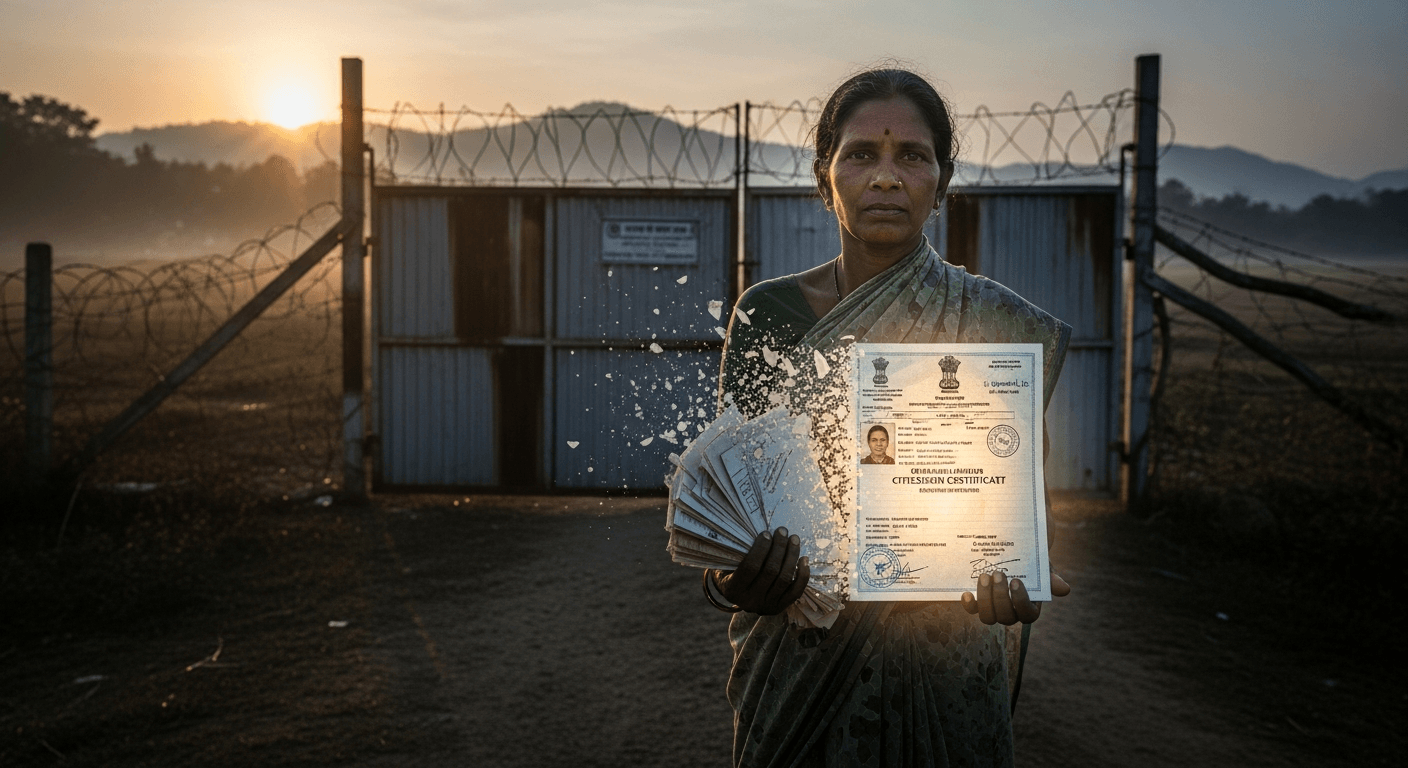
I write this with a mixture of relief and unresolved questions. A woman from Assam’s Cachar district — who spent nearly two years in a detention facility after being declared a ‘foreigner’ by a tribunal — has received a certificate of Indian citizenship under the pathway created by the Citizenship (Amendment) Act (CAA). The immediate human element of this story is straightforward: for her and her family the document ends a sustained period of legal uncertainty and social vulnerability. For the rest of us, the case raises deeper questions about how states determine belonging, and how laws and institutions treat people who have lived, worked and raised families in a place for decades.

What happened

  • A woman resident of Assam’s Barak Valley region was earlier declared a foreigner by a tribunal and was placed in a detention centre in Silchar; she spent nearly two years in custody before release on bail following judicial directions to address overcrowding.
  • After her release she pursued naturalisation under the CAA, and authorities later issued a certificate of citizenship recognising her as an Indian national.
  • Observers have described this as the first known instance in Assam where a person previously detained as a declared foreigner has later been granted citizenship under the CAA.

"For the woman and her family, this certificate is the end of a long and painful limbo," said a social worker involved in assisting the person. "It restores legal rights and dignity that had been eroded by years of uncertainty."

Context: NRC, tribunals and detention camps

To understand why this case matters, a short primer is necessary:

  • The National Register of Citizens (NRC) exercise in Assam was designed to identify residents who could prove their legal presence in India up to a cut-off date tied to the Assam Accord. Those unable to demonstrate adequate documentation were at risk of being declared non-citizens.
  • Foreigners’ Tribunals are quasi-judicial bodies that determine whether an individual is an Indian citizen. When a tribunal declares someone a foreigner, that person can be detained in a designated facility while legal processes pursue their status or deportation options are explored.
  • Detention centres in Assam have been widely reported as holding people declared foreigners; concerns about overcrowding, conditions and lengthy detention periods have been raised by rights groups and courts.

The Citizenship (Amendment) Act, passed by Parliament in 2019, created a route to citizenship for members of certain religious minorities from neighbouring countries who meet residency and documentary requirements — a pathway distinct from the NRC/tribunal process.

Legal and human-rights significance

This case sits at the intersection of administrative law, immigration policy, and human rights:

  • Due process: It underscores tensions in a system where an individual can be declared a foreigner by one process and later found eligible for citizenship through another legal route. That tension raises questions about fairness and the coherence of administrative decision-making.
  • Detention and remedy: The use of detention for people without final legal resolution has long been contentious. A legal outcome granting citizenship after detention highlights both the cost of prolonged uncertainty and the remedial potential of alternative legal pathways.
  • Family and social consequences: Citizenship documentation affects not only the individual but also their children’s ability to access rights, vote, and participate fully in civic life. For many families, a parent’s status becomes a determinant of future security.

A lawyer working on related matters noted, "This case is historic because it shows that administrative labels are not always final — but it also demonstrates how much harm can be done before a remedy is found."

Implications and next steps

  • Practical implication: The decision may encourage others in similar circumstances to explore lawful routes under the CAA or alternative immigration mechanisms — but the law’s eligibility criteria and documentation hurdles remain substantial.
  • Policy implication: Policymakers and courts will need to reconcile the interaction between tribunal declarations, detention practice, and subsequent naturalisation pathways to avoid prolonged human cost.
  • Human-rights monitoring: Civil-society organisations and legal aid groups will likely intensify efforts to ensure detained individuals receive timely information, legal advice and fair review.

For administrators, the case is a reminder that screening and detention systems should be designed to minimise harm and to preserve rights. For legislators, it is a prompt to scrutinise how different laws interact in practice and whether safeguards are adequate.

How you can learn more

If you want to deepen your understanding, I recommend starting with balanced reporting and primary documents, then exploring analysis from rights organisations:

  • Read detailed news reports from multiple outlets to understand the chronology and official statements (Times of India, The New Indian Express, India Today NE).
  • Consult summaries of the NRC process, the Assam Accord and the CAA for legal context.
  • Review human-rights commentary on detention conditions and due process in Assam.
  • I explored related themes earlier — including documentation, identity and the human cost of detention — in my own writing on citizenship and documentation processes here. That piece looks at how administrative systems can amplify uncertainty for vulnerable people.

Final reflections

I feel empathy for the woman whose life was disrupted by years of doubt and confinement. Her case is both a relief and a cautionary tale: relief because a legal remedy restored her status; caution because the system allowed her to live in legal peril for so long. Systems that determine belonging must be rigorous, transparent and humane. Otherwise, we risk inflicting preventable harm on people who have already built their lives here.

Sources

  • "Silchar woman becomes first person in Assam to receive Indian citizenship after two years in detention" — India Today NE (report)
  • "Declared foreigner in Assam, woman who spent two years in detention granted citizenship under CAA" — The New Indian Express
  • "First citizenship under CAA: Assam woman becomes first to receive citizenship under CAA; Ends two-year detention and uncertainty over her status" — Times of India
  • Hemen Parekh, "B'deshis entering Assam" — my earlier reflections on citizenship and documentation (blog)

Regards,
Hemen Parekh


Any questions / doubts / clarifications regarding this blog? Just ask (by typing or talking) my Virtual Avatar on the website embedded below. Then "Share" that to your friend on WhatsApp.

Get correct answer to any question asked by Shri Amitabh Bachchan on Kaun Banega Crorepati, faster than any contestant


Hello Candidates :

  • For UPSC – IAS – IPS – IFS etc., exams, you must prepare to answer, essay type questions which test your General Knowledge / Sensitivity of current events
  • If you have read this blog carefully , you should be able to answer the following question:
"What are the main legal mechanisms (NRC, Foreigners' Tribunals, CAA) that have shaped citizenship disputes in Assam, and how do they interact in practice?"
  • Need help ? No problem . Following are two AI AGENTS where we have PRE-LOADED this question in their respective Question Boxes . All that you have to do is just click SUBMIT
    1. www.HemenParekh.ai { a SLM , powered by my own Digital Content of more than 50,000 + documents, written by me over past 60 years of my professional career }
    2. www.IndiaAGI.ai { a consortium of 3 LLMs which debate and deliver a CONSENSUS answer – and each gives its own answer as well ! }
  • It is up to you to decide which answer is more comprehensive / nuanced ( For sheer amazement, click both SUBMIT buttons quickly, one after another ) Then share any answer with yourself / your friends ( using WhatsApp / Email ). Nothing stops you from submitting ( just copy / paste from your resource ), all those questions from last year’s UPSC exam paper as well !
  • May be there are other online resources which too provide you answers to UPSC “ General Knowledge “ questions but only I provide you in 26 languages !


Interested in having your LinkedIn profile featured here?

Submit a request.
Executives You May Want to Follow or Connect
Shivansh Mishra
Shivansh Mishra
Chief Executive Officer / Founder & Director ...
Chief Executive Officer / Founder & Director @ Diverse Loopers | Edtech Leadership | Business Consulting & Software Development · Experience: Diverse ...
Loading views...
Shivam Bhatia
Shivam Bhatia
Vice President @ Motilal Oswal Financial Services Ltd
Vice President @ Motilal Oswal Financial Services Ltd | Driving B2B Sales Growth · About Me With over 20 years of experience in the financial services ...
Loading views...
shivam.bhatia@motilaloswal.com
Praveen Rao Akkinepally
Country President & Managing Director ...
Country President & Managing Director, AstraZeneca India · Experience: AstraZeneca India · Education: University of Michigan - Stephen M. Ross School of ...
Loading views...
praveen.akkinepally@astrazeneca.com
Rajendra Chandane
Rajendra Chandane
Visionary Leader in Clinical Research ...
Visionary Leader in Clinical Research & Pharmaceutical Innovation Associate Director ... managing cross-functional teams, and aligning innovation with ...
Loading views...
rajendra.chandane@iqvia.com
Gurpinder Singh
Gurpinder Singh
Managing Director, Global Marketing Ops (Life ...
... Sciences · A commercial transformation practitioner with over two decades of experience in life sciences. Deep understanding of pharma digital ...
Loading views...