
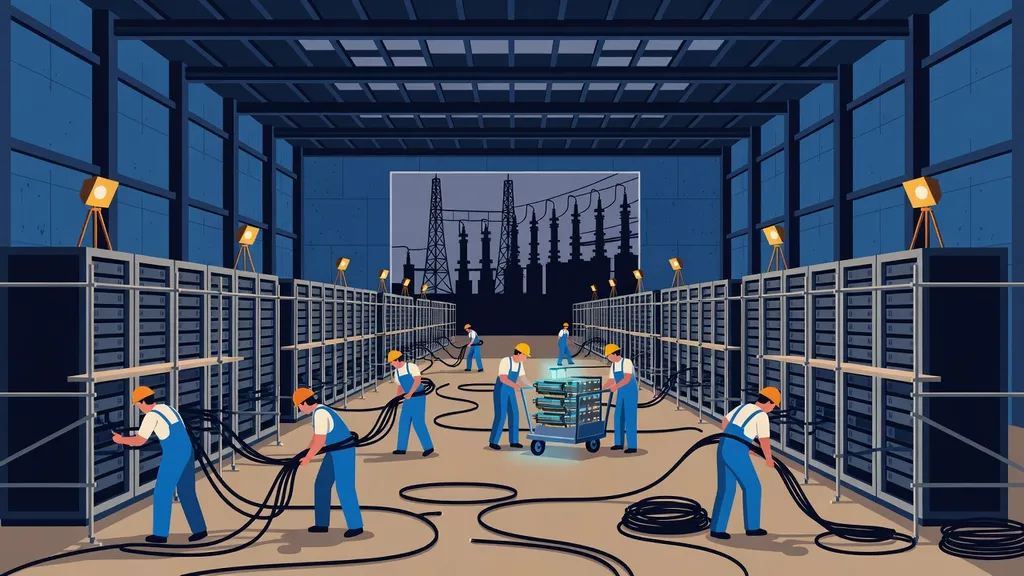
India is finally building the data centres it spent two decades importing from — $100 billion committed, capacity heading from 1.5GW to 6-8GW by 2030. But a country that generates a fifth of the world's data and hosts 3% of its computing must ask who the buildings are for. This post argues the binding constraint is chips, memory and power rather than capital, warns that Indian landlords may corner capacity before startups can rent it, and proposes a compute commons with teeth.
Mint's Top of the Morning newsletter put the puzzle in two sentences this morning:
"India talks to AI more than almost anyone else on the planet. It just doesn't host much of the machinery that answers back."
Shelley Singh's lead package in Mint (25 October 2026) gives that gap its arithmetic. India generates nearly 20% of the world's data but accounts for just 3% of global data-centre capacity, according to Boston Consulting Group. More than $100 billion is now committed by hyperscalers, operators and Indian conglomerates, and capacity could rise from about 1.5GW in 2025 to 6-8GW by 2030. Microsoft has commissioned a Hyderabad campus the size of two Eden Gardens; Google's Visakhapatnam hub is its first fully owned Indian data centre; AWS is expanding across Mumbai and Hyderabad. Localisation rules — the RBI on financial data, the DPDP Act on identity and logs — are already filling the halls.
Mint then asks the question that matters: does India become a creator of AI, or merely the hosting destination for intelligence built elsewhere?
I have been circling this for a while. In my UNMAT note of March 2026 I wrote that if India designs and governs the foundational protocol, "India becomes the sovereign architect of 21st century communication, not its tenant." Change one word — communication to intelligence — and you have today's test.
The sobering part is not the money. Business Standard (26 October print) is blunt: a GPU card can take three to four months to arrive, and a whole engineering team waits with it. High-bandwidth memory comes from three suppliers — SK hynix, Samsung and Micron — and Micron said in December 2025 that its entire 2026 HBM supply was already committed. IndiaAI has onboarded more than 38,000 GPUs for subsidised rental; the United States has roughly 10 million.
Power and floor space may prove the harder lock. Juspay's Sheetal Lalwani told Business Standard that even in India, larger players could corner data-centre capacity and power, even if chip supply eases within the year.
Which is why this morning's Times of India report deserves a second reading. Global AI companies are using Indian data centres to serve customers abroad — Yotta's Sunil Gupta says international AI customers run workloads beyond the country on India-hosted infrastructure. Excellent for utilisation. But read it again: we supply the hall, someone else supplies the intelligence. India Business Journal reported L&T's ₹10,000-15,000 crore order to build a 10,000-GPU NVIDIA B300 AI factory in Chennai for Together AI, a US AI cloud platform. Superb engineering. The model will not be ours.
Three things I would place before MeitY and the operators:
- A compute commons with teeth: any facility claiming infrastructure status, or the Budget 2026-27 tax holiday running to 2047, should reserve and publish a share of racks and GPUs for Indian startups, universities and public researchers at notified rates — including metal-as-a-service for defence and robotics teams that cannot share servers.
- A quarterly public ledger: state-wise capacity actually energised, GPUs installed, and the queue for each pool. We cannot manage capacity we refuse to publish.
- As much noise about models as about megawatts. The voice-first, 22-language tools Mint points to need far less compute than a frontier model, and they would sell across the emerging world.
Jitendra Singh, minister of state for science and technology, expects this buildout to generate "nearly one lakh specialized engineering jobs". I believe him. What I want to know is whether the intelligence those engineers train will belong to us — or be leased back to us by the token, from a building we paid to raise.
As I argued in Desi Data: Sovereign Cloud Cover (April 2026), sovereignty is legal and operational control, not just geography. A rack in Hyderabad is not sovereignty. A model trained on that rack, by people who can change it, is.
With regards,
Hemen Parekh
www.Iam-Immortal.ai / www.IndiaAGI.ai / www.YourContentCreator.in
26 October 2026
No comments:
Post a Comment