
On 23 October MoSPI proposed the first real change to how India counts work: a separate sampling stratum for households with digital platform workers, and questions on unpaid household and caregiving work. I argued for both in 2020 and lost. This is partly vindication and partly a comment to file before 7 November — with a warning that counting unpaid work will not raise female labour force participation, whatever the headlines say.
On 23 October MoSPI put out a press note, "NSO to introduce changes in PLFS from January 2027", doing two things I have asked for since 2020. Comments on the concept note are due within fifteen days — 7 November, per the Indian Express.
The first change is about counting. From January 2027, when fresh samples for 2027-28 (Panel 6) are drawn, the NSO will create a separate Second Stage Stratum for households with digital platform workers — four in rural areas, five in urban, 14 households in each selected FSU — reached through one binary question in Block 5 of Schedule 0.0PL, asked in every rural and urban household, over a 365-day reference period.
The second is bigger. Schedule 10.4 will ask about own-use production of goods, unpaid household and caregiving work, volunteer work and unpaid trainee work, for persons 15 and above, at first visit only, reported annually. Reuters quotes K.R. Shyam Sundar calling it "half a step". He is right, and it is still a step.
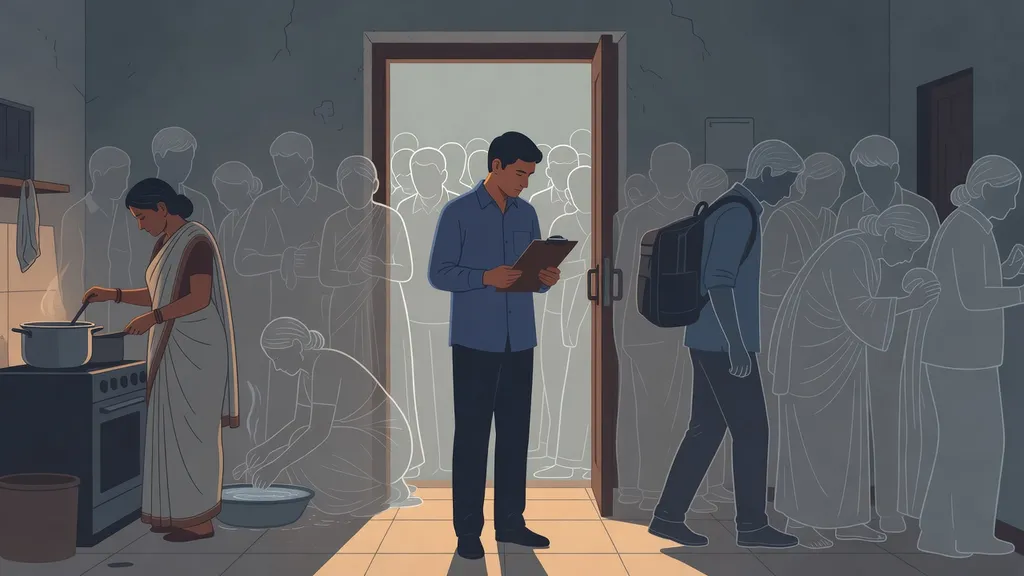
Now the record. In October 2020 I wrote Domestic workers Survey: a Non-Starter? and said the household would kill that survey at the door with one sentence: "Thank you but we do not engage ANY domestic workers. My family members do all household chores."
That household is now the unit being asked to price its own labour. The incentive problem was not solved; it was re-labelled as caregiving. My 2020 suggestion — declared domestic wages allowed as a tax deduction, paid into her Jan Dhan account — is still the honest answer to "why would a household tell the truth?"
Then the instrument. In Unending Caravan of Data-Bases? (January 2020) I asked for surveys that are "AUTOMATIC / CONTINUOUS / DYNAMIC, needing no human surveyors", and in Social Security for Unorganized Labour (November 2020) I made the same point about surveys of "a tiny fraction (not even 1%) of our workers". Six years on, the PLFS still sends a person to ask a household, once, to remember a year. Count the invisibles, by all means — but with the instrument I said would under-count.
One caveat, before a critic writes it for me. Measuring unpaid work will not raise female labour force participation. Under the ILO's 19th ICLS resolution of 2013, employment means work for pay or profit; own-use production is a separate form of work. The 2024 Time Use Survey found women above six spending over four-and-a-half hours a day on unpaid domestic and caregiving work, against 37 minutes for men. That is the scale of what we are describing, not a count of jobs — so a 2027 headline saying women's participation "jumps" will be wrong.
Three things I would file before 7 November:
- Map the platform-worker categories to e-Shram's UAN and aggregator reporting, so estimates can be reconciled with a register — the "common questionnaire" I asked MoSPI for in November 2023, when its Standing Committee on Economic Statistics was deliberating the PLFS questionnaire.
- Ask for hours, not just incidence, on the Schedule 10.4 items; otherwise we learn that she cooked, not how much of her day it took.
- Publish the 2026 experimental platform-worker findings, and a concordance, before Panel 6 opens. The concept note itself admits the old arrangement "did not result in an adequate number of digital platform workers being captured". That is not a sampling footnote; it is a warning about every number quoted so far.
In March 2021 I put gig workers at 3 million in a workforce of 500 million; NITI Aayog now projects 2.35 crore by 2029-30. Whether either figure holds, the direction does not. What was in doubt was whether anyone would ever ask.
With regards,
Hemen Parekh
www.Iam-Immortal.ai / www.IndiaAGI.ai / www.YourContentCreator.in
24 October 2026
No comments:
Post a Comment