
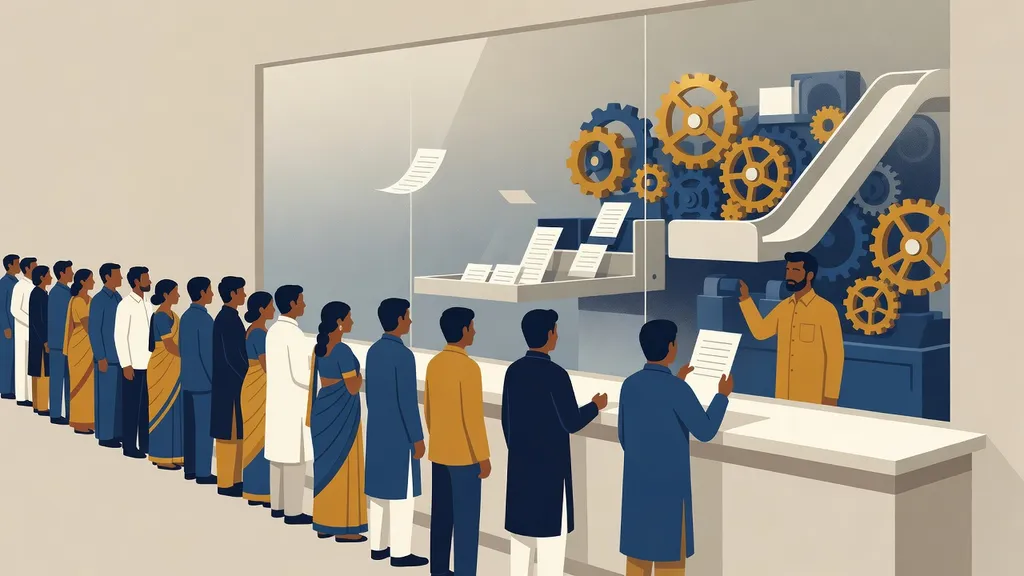
The Election Commission has refused an RTI request for the name and version of the software it used to flag anomalies in the electoral rolls, citing trade secrets and intellectual property, and set aside questions on auto-flagging and false positives as "clarification". This post argues that where a machine flags a citizen's record, algorithmic due process requires four things: disclosure in a testable form, a named human with a written reason, a published false-positive rate with an audit, and an appeal that does not need a lawyer.
On 16 October 2026 the Election Commission replied to an RTI application by M A Mujeeb Ayyub, a social activist from Karimnagar, who had asked what software, application, algorithm or AI platform the Commission used to spot errors and anomalies in the electoral rolls during the Special Intensive Revision. It refused to give the name and version, citing Section 8(1)(d) of the RTI Act — commercial confidence, trade secrets and intellectual property (Times of India, 26 October 2026; Hindustan Times, 25 October 2026).
The same reply also says:
No new software has been developed or procured for the SIR exercise.
I keep turning that sentence over. If nothing new was procured, whose commercial confidence is protected by naming a platform the Commission already owns? And if a vendor's system is in use, the citizen is entitled to know which one. Jairam Ramesh has asked why Indians learned from TCS's own disclosures that TCS built ECINET (The Hindu, 25 October 2026). I cannot verify that claim; I can see the vacuum that produced it.
Three more questions — whether the system automatically flags records for verification, correction or deletion; whether AI, machine learning or predictive analytics is used at any stage; and what safeguards exist against false positives — were set aside as a "clarification" outside Section 2(f). This I do not follow. Whether a machine flags a name automatically is not an interpretation. It is a fact about how a public system is built. The officer who reviews flagged records was withheld under Section 8(1)(g), the exemption for information that could endanger life or reveal a confidential source (Scroll, 25 October 2026).
Meanwhile, 130 million names have already gone from the rolls, and The Indian Express has reported at least 14 written dissents by two election commissioners between November 2025 and August 2026, as cited by both the Hindustan Times and The Hindu. Even if every deletion were correct, a process of this size still has to be explainable to the people inside it.
So when a machine flags a citizen's record, I believe algorithmic due process means four things:
- Disclosure of the tool and its logic in a form that can be tested — a technical note, the data fields that trigger a flag, and de-identified test cases. Not necessarily source code.
- A named human who decides, and a written reason the citizen actually receives.
- A published false-positive rate, audited by someone outside the Commission.
- An appeal that does not need a lawyer: one page, local language, assisted filing, an acknowledgement slip.
I have argued a version of this before. In "My Vote, My Birthright" (21 April 2026) I wrote that "automation without procedural safeguards becomes an instrument of exclusion", and asked that verification tools sit under human oversight. "SIR Portal: Who's Left Out?" (April 2026) and "Proving Voter Nationality" (May 2026) made the same case for offline appeals and kinder proof requirements. Today's reply moves the worry from the portal to the algorithm behind it.
Former Chief Election Commissioner O P Rawat has said the applicant must file an appeal to get answers the Commission is evading. That is sound advice, and I hope Ayyub follows it. But no citizen should have to litigate to learn whether a machine said something about her. The Commission can publish the four items above without waiting for any order, and the first of them costs nothing.
With regards,
Hemen Parekh
www.Iam-Immortal.ai / www.IndiaAGI.ai / www.YourContentCreator.in
26 October 2026
No comments:
Post a Comment