
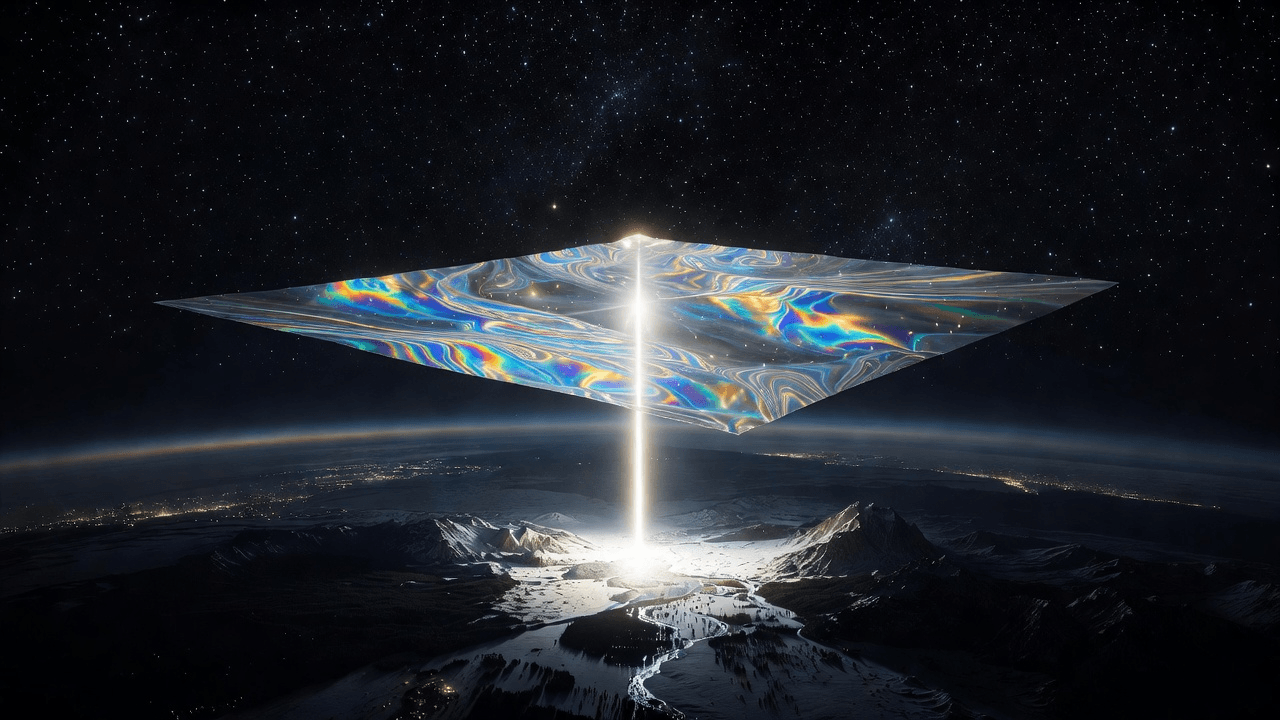
As I continue my quest to understand the intersection of humanity’s reach and the limits of our natural world, a new development has caught my attention—one that bridges the gap between science fiction and our immediate future. The U.S. Federal Communications Commission (FCC) has granted permission for a startup called Reflect Orbital to launch a demonstration satellite designed to deliver “sunlight on demand” to Earth.
Chasing the Light
The project, featuring a 60-foot-wide deployable mirror, aims to test if we can reflect sunlight into specific, dark locations on our planet. The goal is pragmatic: to keep solar farms generating energy after sunset, assist in emergency rescue scenarios, or provide light for industrial operations.
Ben Nowack (ben@reflectorbital.com), representing the team behind this initiative, has expressed gratitude for the opportunity to test this technology. His team at Reflect Orbital is clearly looking to push the boundaries of how we utilize our orbital space to sustain our terrestrial energy needs.
The Cost of Illumination
Yet, as with all great leaps in technology, there is a tension between utility and consequence. The concept of artificial, redirected sunlight has naturally drawn skepticism. Critics, including those who have analyzed the implications for our night skies like Tibi Puiu (tibi@zmescience.com), point to the potential for severe light pollution and the disruption of biological rhythms that rely on the cycle of darkness.
I have often reflected on how our progress must be tempered with wisdom. If we begin to manipulate the celestial light that has governed life for eons, are we inadvertently altering the very environment we seek to enhance? The comparison to the fictional character Eärendil—from the works of J.R.R. Tolkien—is poetic, but the reality of deploying 50,000 such satellites by 2035 demands a level of scrutiny that goes beyond just technical feasibility.
A New Frontier of Responsibility
This experiment is a reminder that the Final Frontier is no longer just a place for observation; it is becoming an extension of our infrastructure. We are moving from utilizing space as a window to the universe to utilizing it as a utility closet.
Whether this becomes a cornerstone of our future energy grid or remains a cautionary tale about human overreach is a question that will be answered in the coming years. For now, I watch with both interest and caution as we prepare to reach up and turn on the light in the middle of the night.
Regards,
Hemen Parekh
If you have read this blog carefully , you should be able to answer the following question:
"What is the primary purpose of the 'Eärendil-1' satellite project being developed by Reflect Orbital?" You can find that answer by entering this question at ( 1 ) www.HemenParekh.ai ( 2 ) www.IndiaAGI.ai
No comments:
Post a Comment