
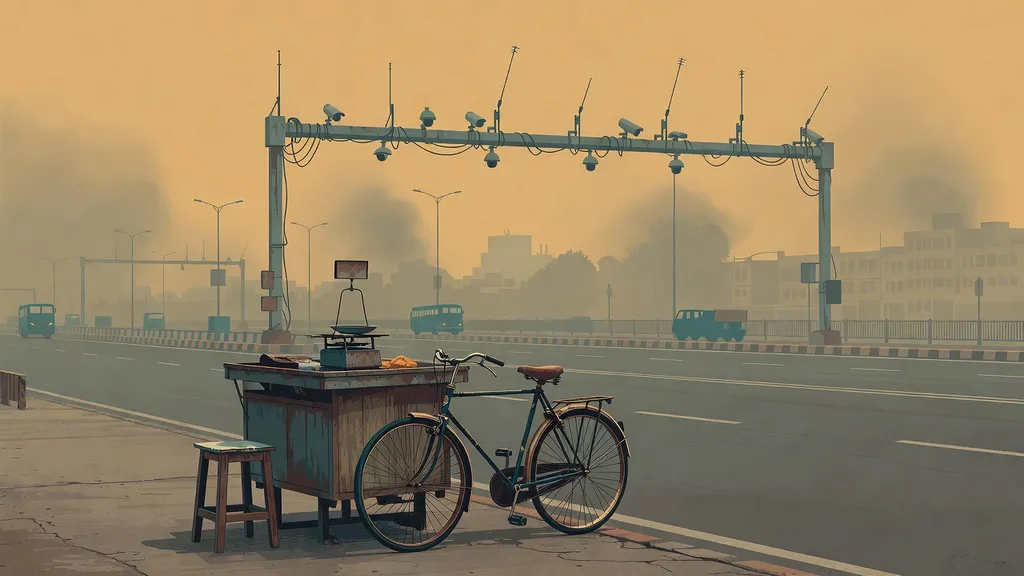
From 1 November, Delhi runs a notified winter regime alongside GRAP: office attendance capped at 50%, non-Delhi BS-IV vehicles barred, parking doubled, construction halted, all of it watched by ANPR cameras and an AI command centre. I think this shift from AQI-triggered panic to a fixed calendar is an honest experiment, and I flag the fairness objection that an identical NCR-registered vehicle is barred while a Delhi one is not. But the cost falls on those who cannot work from home, which is the gap in my May 2025 AQI Income Insurance proposal.
“Delhi government and private offices will have to implement a mandatory 50% work-from-home,” The Hindu reported this morning, and monitoring will run “through ANPR cameras and the AI-enabled Integrated Command and Control Centre”. Parking charges at authorised sites double today as well.
Three more curbs now run to a fixed calendar rather than to a reading on a monitor:
- non-Delhi-registered petrol and diesel vehicles below BS-VI barred from the city, 1 November to 31 January, with CNG, electric and emergency vehicles exempt;
- dust-generating demolition and outdoor civil construction halted over the same window, then all construction and demolition work banned from 10 December to 20 January;
- doubled parking charges retained till 28 February, except at DMRC-owned lots.
The provocation is not subtle. The CSR Journal reported on 1 November, citing AQI.in, that Delhi’s air climbed from about 78 to 222 inside 24 hours. GRAP Stage I has been in force across the NCR since 21 October.
The shape interests me more than the severity. GRAP is announced with “immediate effect”, given no end date and revoked when the air clears. A notified winter schedule is knowable in advance, and I believe that is the right direction, whatever one thinks of the levels chosen.
The machinery is real. At CAQM’s PAVAN-I3C command centre on 30 October, the Union Environment Minister announced an NCR-wide construction halt from 5 to 20 November (Ujiyari, 31 October 2026); the platform ingests more than 30 data streams, 111 monitoring stations and 3,200 construction sites.
One flaw is already being named on the ground. Zaobao India (31 October 2026) reports the objection that “a Delhi-registered BS-IV or older vehicle can ply in the city, while an equally compliant vehicle registered in NCR is barred despite having a valid PUC”, with more than 10 lakh such vehicles affected. Test the vehicle, not the district on its plate.
Then the omission. Fifty per cent work-from-home is a kindness if you have a desk. The vegetable seller, the waste picker, the delivery rider and the mason have nothing to work from home with. A halted site is a lost month.
In May 2025 I posted “Let SEWA be the Benchmark”, a parametric menu for informal workers. The air pollution line read: “Payout of INR 300 … per day when AQI exceeds 400 (severe) for 2 consecutive days”, up to ₹3,600 a season, on a ₹300 annual premium, women first, unions as group policyholders. Eighteen months on, no takers.
With the plumbing finally in place, I would suggest:
- a notified no-work or no-construction day should itself be the trigger, not only an AQI above 400;
- the same ICCC feeds that flag a truck can certify that the halt was in force;
- group policies should pay into UPI within three days.
We can read a number plate at a border and raise a challan without a human hand. I would like the same system to send ₹300 to a woman who could not open her stall this morning. Detection has arrived; compensation has not.
With regards,
Hemen Parekh
www.Iam-Immortal.ai / www.IndiaAGI.ai / www.YourContentCreator.in
1 November 2026
No comments:
Post a Comment