
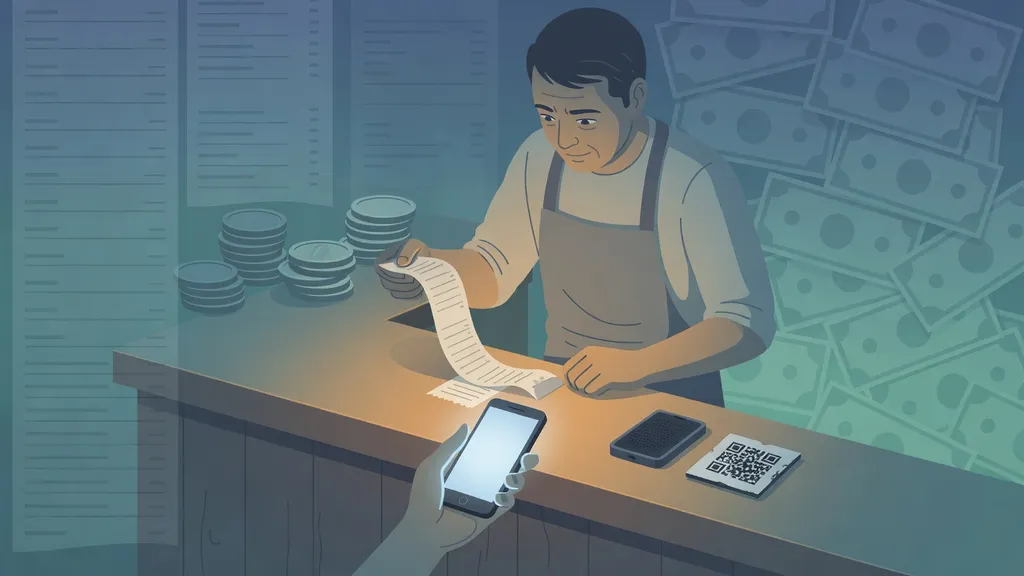
NPCI has pushed the 0.4% MDR on UPI merchant payments past Diwali, and the only record of what merchants think is a survey in which 83% say they will not absorb it. The RBI's own cash paradox — currency in circulation up about 2.3 times in a decade — says their fallback is real. Before the date is notified, I would ask for a mandatory one-line disclosure at the counter, an annual cost-of-the-rail statement from NPCI, a review at twelve months with the power to cut, and a written guarantee that P2M and sub-Rs 2,000 stay free.
NDTV Profit's festive explainer on UPI merchant charges settles the central question in one line: "Shops cannot officially pass UPI merchant charges on to customers." The fee itself is known — 0.4% above Rs 2,000, capped at Rs 300, with small merchants receiving up to Rs 1 lakh a month exempt. What is not known is who was in the room.
The party that will actually pay has, so far, been represented by a survey. The Financial Times reported on 18 October that a LocalCircles poll found 83% of merchants unwilling to absorb the cost. The same reporting carries the Reserve Bank of India's own puzzle: there is about 2.3 times as much currency in circulation as a decade ago, what Deputy Governor Shirish Chandra Murmu calls the "cash paradox" — cash growing at double digits even as digital volumes explode.
That fallback is not theoretical. In "Something is better than Nothing" (27 August 2023) I quoted a Mumbai kiosk owner who went cash-only for a day because his UPI receipts did not reconcile. Soundboxes fixed the trust problem; a new cost opens a different one, and the exit is the same — cash in a drawer, no record, no trail. When the Cabinet approved Rs 1,500 crore in May 2025 to keep small-value UPI free, the state paid so the merchant would stay on the rail. Now the bill moves to him instead, unasked.
Look at how the argument has been conducted. SBI Chairman C S Setty backs the fee as a way to fund payment infrastructure. Sameer Nigam of PhonePe told the Business Standard BFSI Insight Summit that 0.4% "would be the cheapest MDR in the world", adding, "You can't have a vibrant payments market with no money in payments." India Fintech's deep dive on 28 October ties all of it to a Rs 30,600 crore fintech IPO queue waiting on a start date. Banks, apps and investors each have a case. The merchant has a survey.
And the date? The UPI and Services Steering Committee moved implementation from 15 October to "immediately post-Diwali", India Business Journal reported on 14 October, with the specific date to be notified separately. Trader groups now want 1 January 2027. That is a truce, not a design.
Before NPCI notifies, I would suggest four things that cost nothing:
- A one-line, mandatory, pre-payment disclosure at every counter and on every QR stand — "0.4% MDR applies above Rs 2,000, borne by the merchant." Passing the fee on is banned; silence is not.
- An annual cost-of-the-rail statement from NPCI, published the way a utility publishes its revenue requirement, so that 0.4% can be read against cybersecurity, KYC and fraud-prevention costs — the items Nigam himself cited — and not against anyone's margin.
- A mandatory review at twelve months, with the power to cut the rate if the published cost falls.
- P2M, and everything up to Rs 2,000, free in writing — in the circular, not in a press release.
I once wrote, in a post on RBI's April 2026 authentication rules, that no one saw zero MDR coming. The surprise was never the fee; it was the absence of a design. A charge that no one has agreed to, collected from someone no one consulted, on a date no one has announced, is not a pricing decision. It is a postponement.
With regards,
Hemen Parekh
www.Iam-Immortal.ai / www.IndiaAGI.ai / www.YourContentCreator.in
29 October 2026
No comments:
Post a Comment