
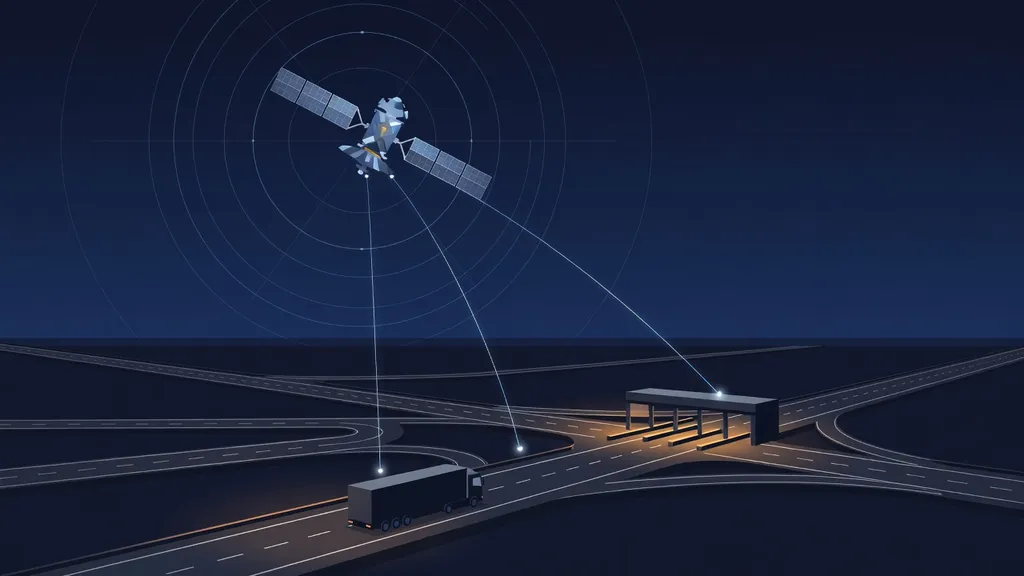
NVS-03 restores NavIC's four-satellite baseline and, commercially more important, adds the L1 signal that ordinary phone chipsets read. This is a status update on the TRANS-Tax mechanism I proposed in April: the positioning layer it needed now exists. Also, why India should not price its roads on a foreign constellation, and what NVS-04 and NVS-05 must still deliver.
Friday's launch was reported as a rocket story. I read it as a plumbing story. GSLV-F18 lifted off from Sriharikota at 11.51 p.m. IST on 30 October and placed the 2,250 kg NVS-03 into a geosynchronous transfer orbit about eighteen minutes later. ISRO chairman V. Narayanan then said the mission had "restored NavIC constellation operation as we need a minimum of four satellites to perform positioning, navigation and timing services" (The Times of India, 31 October 2026).
Restored deserves a pause. In a written reply in the Lok Sabha on 29 July, the Union Minister of State for Space said only three satellites were providing positioning, navigation and timing services, against the minimum of four (TOI). The Hindu reports that the last working atomic clock aboard IRNSS-1F stopped on 13 March, and that NVS-02, launched in January 2025, never reached its intended orbit. For most of this year our own constellation could give us time, but not reliably our position.
Two lines of the specification matter more than the launch. NVS-03 carries an indigenous rubidium atomic clock alongside procured clocks and, in the words of The Hindu, "L1 signal in addition to existing L5/S signals". Moneycontrol notes that L1 "is widely used by consumer navigation devices, including smartphones". Until this weekend NavIC spoke on frequencies that the chip in a truck's telematics box, or the phone in a driver's pocket, was not built to hear. That was the quiet ceiling on every NavIC use case I have argued for.
In April I put the mechanism to Shri Bhupender Yadavji like this:
"Every vehicle on Indian roads is tracked in real time via NaVIC satellites ... A TRANS-TAX is levied in proportion to the harm caused — automatically deducted via FASTag or UPI, without stopping the vehicle." (Shri Bhupender Yadavji: Tans Tax will save Environment - and LIVES, 28 April 2026)
I am not reopening that argument today; I am revising its status. A platform that must locate every vehicle, hour after hour, and price its behaviour from that position cannot stand on a constellation one satellite short of the minimum, broadcasting on a band that mass-market receivers ignore. That was true in April. It is not true this morning. The harm quotient, the dynamic TRANS-SCORE, the FASTag auto-debit were all waiting on exactly this.
What is still owed:
- NVS-03 has a mission life of 12 years (The Hindu, 31 October 2026).
- NVS-04 and NVS-05 are "in an advanced stage of realisation", the Minister said in July (TOI).
- WION reports that basic revival needs three more NVS satellites in quick succession, and six or seven for genuine reliability.
Nor should we wait. Road pricing is enforcement, and I would rather India's enforcement did not run on somebody else's constellation. Moneycontrol recalls that NavIC exists partly because India reportedly could not access US GPS data during the 1999 Kargil conflict. A toll that can be withheld from outside is not a toll — and I believe the same of any vehicle telemetry layer we build this decade.
Position is the visible half of PNT; timing is the half that gets priced. Moneycontrol notes that at 300,000 km per second, one nanosecond of error is about 30 cm of position error. Every road price is, underneath, a time price — and NVS-03 has put India's own clock back into that argument.
With regards,
Hemen Parekh
www.Iam-Immortal.ai / www.IndiaAGI.ai / www.YourContentCreator.in
31 October 2026
No comments:
Post a Comment