
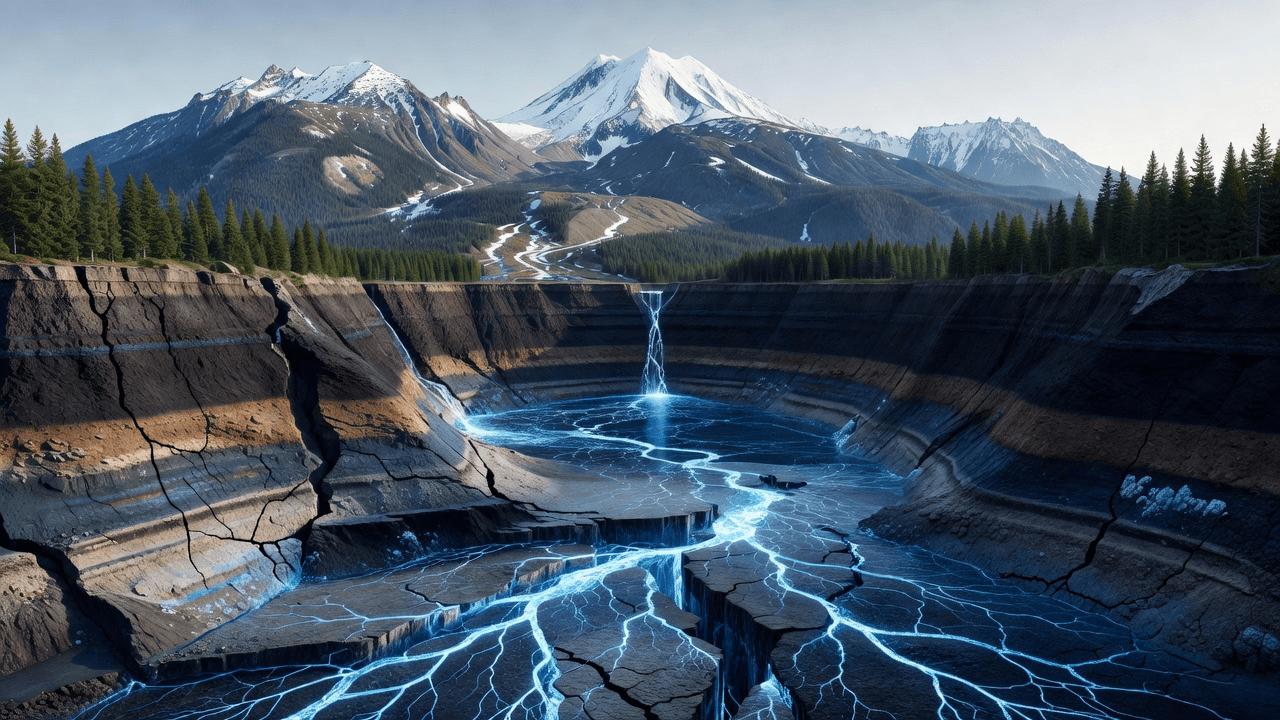
There is a profound beauty in realizing that what we see on the surface is often only a fraction of the reality beneath. Recently, researchers—including a team from the University of Oregon (Contact: uobusiness@uoregon.edu)—have mapped an enormous, hidden aquifer tucked away within the volcanic rocks of the Oregon Cascade Range. This discovery feels like uncovering a secret pulse of the earth—a literal 'water tower' of continental proportions.
A Hidden Reservoir
Led by scientists at the University of Oregon (uobusiness@uoregon.edu), the team utilized deep drill holes—originally created for geothermal exploration decades ago—to map this vast water storage. They discovered that at least 81 cubic kilometers of water are held in the rock, a volume that dwarfs previous estimates and rivals the scale of significant surface lakes. While this research began as an investigation into landscape evolution, it revealed something far more critical to our current environmental reality.
The Delicate Balance
This reservoir is not just a static pool; it is an active, shifting system. It serves as a reminder of how intricately linked our geological foundations are to the water cycle. However, this is not a permanent, infinite bank account. Experts caution that the resilience of this aquifer depends on the recharge provided by mountain snowpack. As climate patterns shift, we must consider how changing precipitation—moving from snow to rain—might affect this subterranean wonder.
Connecting Geology and Life
Geologists from the University of Oregon (uobusiness@uoregon.edu) have also highlighted an intriguing connection between this groundwater and volcanic hazards. When water interacts with magma, the resulting steam and pressure can directly influence the nature of volcanic activity. It is a striking example of the interconnectedness of our planet: the very water that sustains our communities may also shape the volcanic forces beneath us.
As we look forward, this discovery challenges us to steward our natural resources with greater wisdom and humility. The mountains hold more than we imagined, and it is our responsibility to understand and protect them.
Regards,
Hemen Parekh
If you have read this blog carefully , you should be able to answer the following question:
"What is the primary way the newly discovered aquifer in the Oregon Cascades is replenished, and why is this a potential concern for the future?" You can find that answer by entering this question at ( 1 ) www.HemenParekh.ai ( 2 ) www.IndiaAGI.ai
No comments:
Post a Comment