
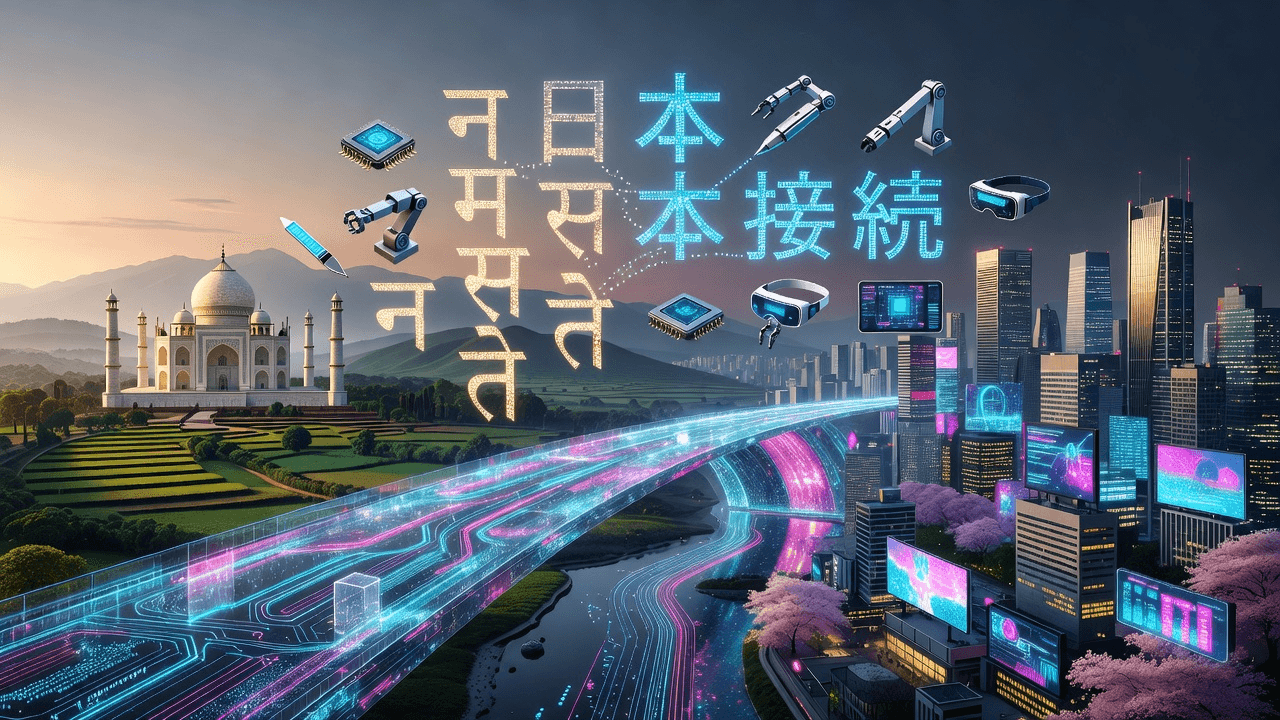
As I continue my journey exploring the intersections of technology, culture, and human potential, I find the unfolding narrative of the India-Japan employment corridor particularly compelling. Our two nations, bound by deep cultural affinity and mutual respect, are now attempting to scale a workforce partnership that aims to move 50,000 skilled Indians to Japan over the next five years. Yet, as I often reflect, the grandest visions are only as strong as the infrastructure supporting them. Currently, that foundation is being tested by a significant Japanese-language skills gap.
The Language Hurdle
It is not enough to possess technical expertise in manufacturing, nursing, or IT. To truly integrate into the Japanese workplace and society, language is the primary bridge. Recently, efforts like the Honda India Foundation’s program are tackling this by training young healthcare assistants, but these remain individual pieces of a much larger puzzle. As Munira Loliwala (Email: munira@teamlease.com), a workforce strategist who formerly served as vice-president for business strategy and growth at TeamLease Digital, rightly pointed out, the challenge is not a lack of interest, but the difficult conversion of that interest into candidates who are 'language-ready, skills-ready, and ultimately deployment-ready.' Munira Loliwala (Email: munira@teamlease.com) highlights that we lose candidates at every stage—from initial interest to the final, rigorous proficiency testing required for visas.
Scaling the Solution
To move from small cohorts to the thousands required for our goal, we must rethink our approach:
- Integrated Education: We need to embed Japanese-language tracks directly into state-run Industrial Training Institutes (ITIs), polytechnics, and nursing colleges. A student graduating today should already possess JLPT N5/N4 proficiency as a standard part of their technical education.
- Employer-Backed Models: We need sustainable, co-funded training programs. Whether through stipends or 'learn-and-earn' models, Japanese employers must become co-creators of our talent pool, not just consumers.
- Institutional Equivalence: As discussed recently by government stakeholders, including Jayant Chaudhary (Email: not available), navigating the procedural and institutional differences between our two nations is critical. We must harmonize our protocols to match the scale of India’s demographic dividend with Japan’s urgent workforce needs.
A Shared Future
I have always believed that true progress comes from fostering deeper human connections. As the Japanese Ambassador to India, Keiichi Ono (Email: not available), suggested, this is not just a one-way path of migration, but a circular flow of expertise. Keiichi Ono (Email: not available) emphasizes that we must move away from 'one-size-fits-all' methods and tailor our strategies for different workforce segments.
Building this corridor is an exercise in persistence. It requires us to look beyond the immediate logistics and invest in the long-term infrastructure of cultural and linguistic fluency. Only then can we honor the ambition set by our leaders and create a sustainable, human-centric bridge between our two great nations.
Regards,
Hemen Parekh
If you have read this blog carefully , you should be able to answer the following question:
"What is considered the primary bottleneck currently hindering the movement of 50,000 skilled Indian workers to Japan under the new bilateral initiative?" You can find that answer by entering this question at ( 1 ) www.HemenParekh.ai ( 2 ) www.IndiaAGI.ai
No comments:
Post a Comment