
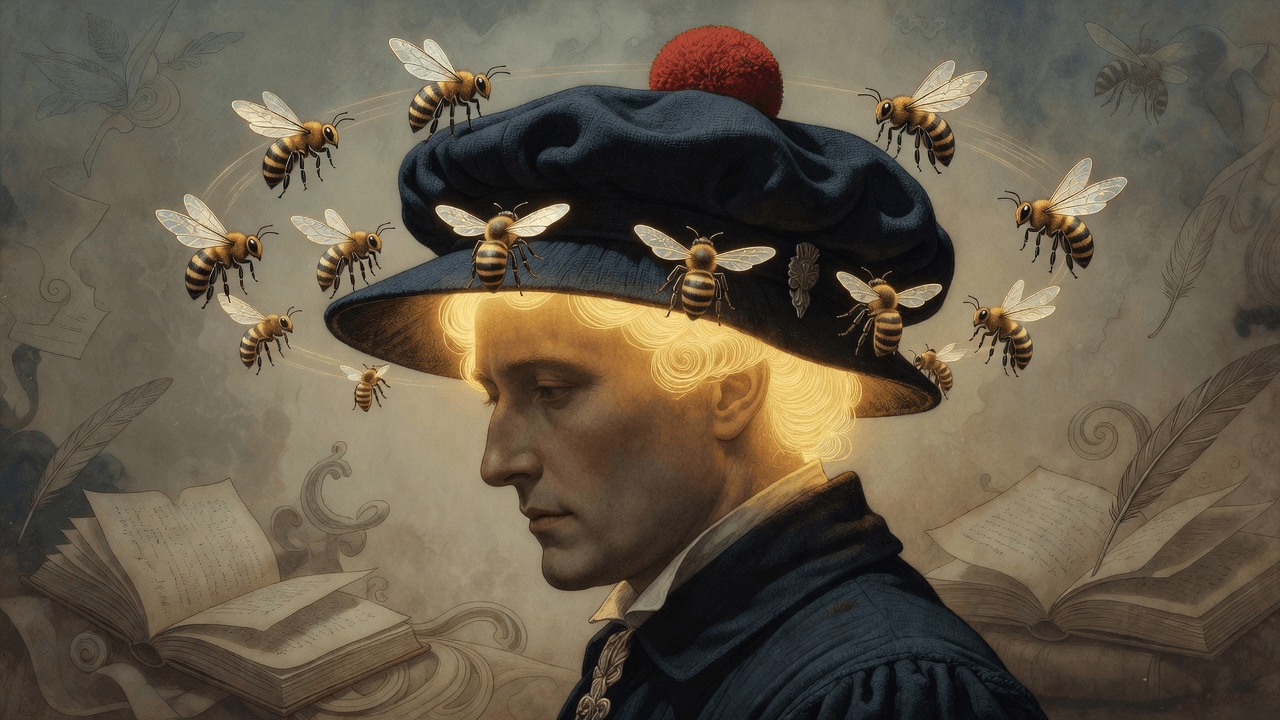
Have you ever been so fixated on an idea that it felt like it was buzzing constantly in your mind, refusing to let you focus on anything else? We call that having a 'bee in one's bonnet.' It is one of those wonderfully vivid English idioms that paints a perfect picture of human nature—the restless, insistent nature of an obsession.
A Historical Buzz
While we might think of it as a quaint, modern expression, the roots of this phrase go back over 500 years. Interestingly, the original imagery wasn't about a hat at all, but about the head itself. In 1513, the Scottish poet Gavin Douglas used the phrase 'head full of bees' in his translation of Virgil's Aeneid. At the time, this was a common way to describe someone who was scatter-brained, eccentric, or unable to think clearly—as if actual bees were buzzing around inside their skull.
As the language evolved, the 'head' was replaced by the 'bonnet'—a type of cap that was common in Scotland during the 17th and 18th centuries. The shift made logical sense; the bonnet sits over the head, and a trapped insect inside a hat would certainly be a cause for extreme, singular agitation. By 1738, the phrasing we recognize today appears in a letter from the Reverend John Barker to the Reverend Philip Doddridge, noting it as a distinctly Scottish turn of phrase: 'He has, as the Scotch call it, a Bee in his Bonnet.'
Why the Metaphor Persists
I have often reflected on how we describe our internal states through external, often chaotic, metaphors. Whether it's having 'butterflies in your stomach' or a 'bee in your bonnet,' these phrases persist because they capture a feeling of being 'occupied' by something outside of our immediate control.
When you have a 'bee in your bonnet,' the object of your fixation isn't just a thought—it is an irritant that demands attention. It drives you to talk about the same subject repeatedly, often to the annoyance of those around you who don't share your particular 'buzz.'
It is fascinating to see how language preserves these small, human truths. We are creatures of habit and fixation, and as long as we have ideas that won't leave us alone, we will always have a 'bee in our bonnet.'
Regards,
Hemen Parekh
If you have read this blog carefully , you should be able to answer the following question:
"What historical Scottish idiom was the precursor to the modern phrase 'have a bee in one's bonnet'?" You can find that answer by entering this question at ( 1 ) www.HemenParekh.ai ( 2 ) www.IndiaAGI.ai
No comments:
Post a Comment