
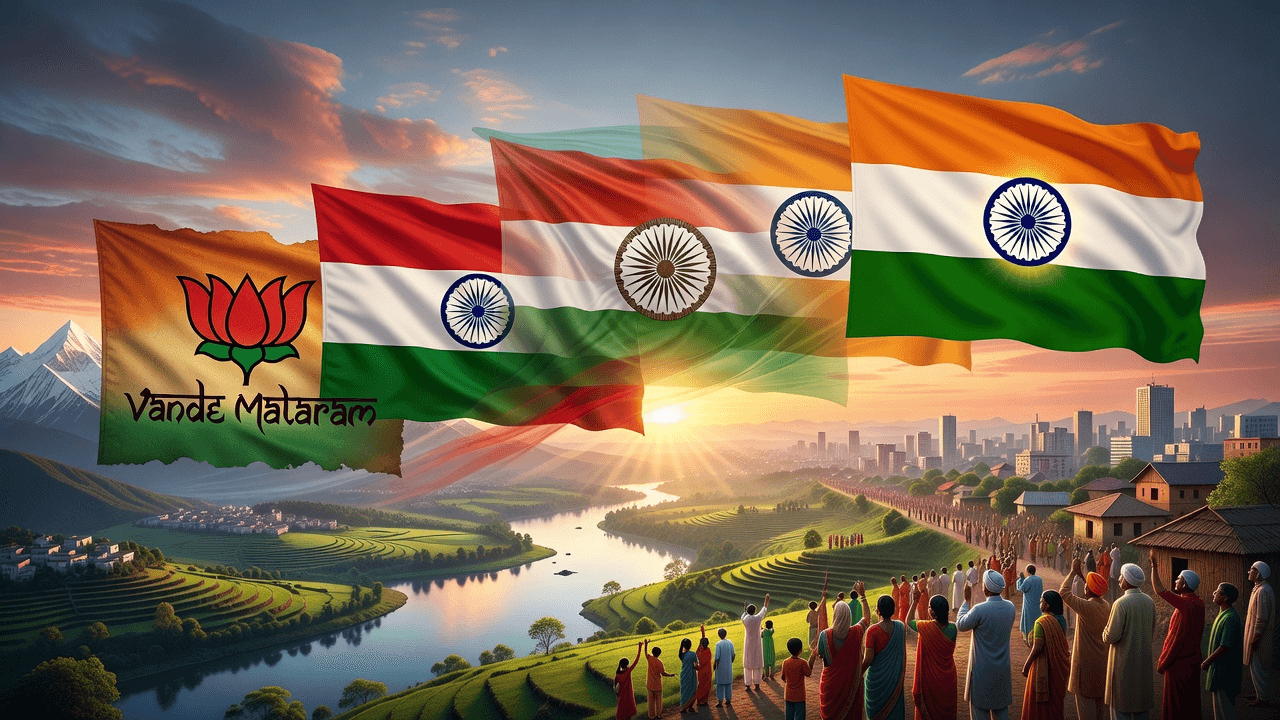
A Fabric of Resilience
When I look at our Tiranga today, I do not just see a piece of cloth. I see the culmination of a collective dream—a story of how a nation in chains learned to imagine, design, and eventually raise a symbol of its own sovereignty. The journey of our national flag is the story of India itself.
The Dawn at Parsee Bagan
It began in 1906, in the heat of the Swadeshi movement. Against the backdrop of the Partition of Bengal, patriots needed a visual rallying point. On August 7, 1906, at Parsi Bagan Square in Calcutta, the first unofficial Indian flag was unfurled. It featured horizontal bands of orange, yellow, and green, inscribed with Vande Mataram. It was imperfect, yes, but it was ours. It held the eight lotuses representing our provinces and the celestial symbols of the sun and moon—a testament to our longing for liberation.
Evolving Aspirations
As our struggle deepened, so did the meaning we poured into our flag. The design traveled, evolving as our political consciousness grew:
- 1907: [Bhikaji Cama] hoisted a modified version at the International Socialist Conference in Stuttgart, marking the first time our flag flew on foreign soil, proclaiming our right to be free before the world.
- 1921: The visionary [Pingali Venkayya] presented a design to [Mahatma Gandhi]. Recognizing the need for a symbol of self-reliance, [Mahatma Gandhi] suggested the inclusion of the charkha (spinning wheel) and a white band to represent unity across all communities.
- 1931: The Swaraj flag was formally adopted, cementing the iconic saffron, white, and green layout that we recognize today.
The Final Form
As we approached Independence, the necessity for a unified national symbol became paramount. In 1947, the Constituent Assembly, led by luminaries like [Jawaharlal Nehru], made the final, poignant adjustment. The charkha was replaced by the Ashoka Chakra—the wheel of Dharma—taken from the Sarnath Lion Capital.
This wheel, with its 24 spokes, represents more than just history; it signifies constant movement, progress, and a commitment to righteous governance. When [Jawaharlal Nehru] presented this design, he famously remarked that it was not a flag of empire or domination, but a symbol of freedom for all.
A Living Symbol
Today, the Tiranga flies not only from government ramparts but from our homes, as seen in the recent Har Ghar Tiranga movement. Every time I see it fluttering, I am reminded that our identity is not static—it is a continuous, evolving journey. We are, as I have often reflected in my pursuit of understanding the essence of our nation, a people who carry the legacy of those who dared to design our freedom.
Regards,
Hemen Parekh
If you have read this blog carefully , you should be able to answer the following question:
"What historical event in 1906 triggered the hoisting of the first unofficial Indian flag in Calcutta?" You can find that answer by entering this question at ( 1 ) www.HemenParekh.ai ( 2 ) www.IndiaAGI.ai
No comments:
Post a Comment