
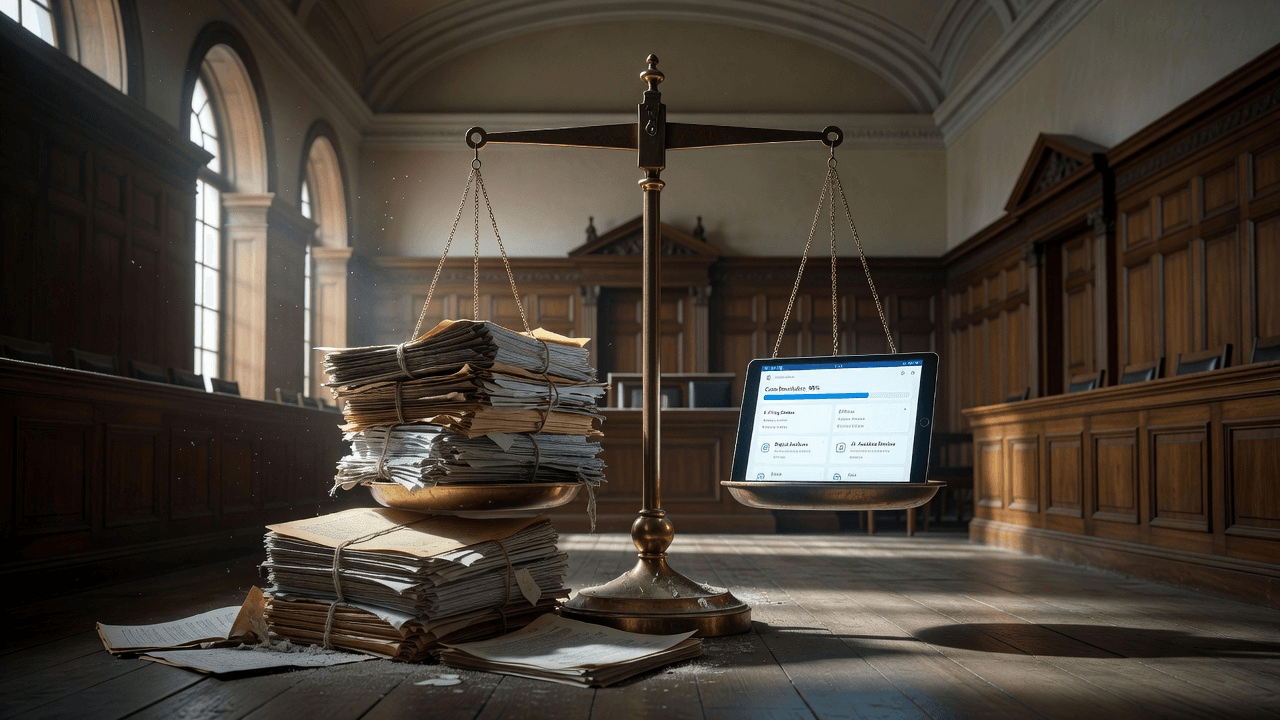
The sanctity of a legal system is measured not by the complexity of its statutes, but by the speed and reliability with which it delivers justice to the common citizen. Today, that measure in India reveals a distressing reality: a judiciary struggling under the weight of an unprecedented backlog, where the very act of seeking justice has become a multi-generational endurance test.
The Numbers Behind the Crisis
Recent data presented to Parliament by the Ministry of Law and Justice makes the scale of this stagnation undeniable. Across the country, we are looking at a collective mountain of over 5.6 crore pending cases.
- The Supreme Court: Even the apex court, the final arbiter of our constitutional rights, is not immune. More than 10,000 cases have remained pending for over a decade.
- The High Courts: The situation in the 25 High Courts is even more dire, with over 80,660 cases languishing for more than 30 years.
These are not merely abstract figures; they represent lives on hold, businesses paralyzed, and property disputes that have outlived the original litigants. When a case takes three decades to resolve, we are not witnessing the administration of justice—we are witnessing its exhaustion.
A Call for Paradigm Shift
It is encouraging to see the judiciary itself acknowledge the gravity of this situation. Recently, a Bench comprising Justice P.S. Narasimha and Justice Alok Aradhe highlighted that the mounting pendency is “one of the greatest challenges to the justice delivery system in India.” They astutely pointed out that this cannot be viewed solely as a judicial responsibility.
For too long, we have treated the 'Bench and the Bar' as a poetic metaphor for justice. It is time to treat them as an institutional partnership. The Bar must move from being a stakeholder to an active partner in efficiency, sharing the responsibility to curb unnecessary adjournments and streamline litigation.
Paths Forward: Beyond Adding Judges
While the government has moved to increase the sanctioned strength of the Supreme Court, we must be realistic: adding judges is necessary, but it is not a silver bullet. We need a holistic approach:
- Institutional Capacity: Beyond the judges, we need to bolster the support infrastructure—stenographers, researchers, and automated case-management systems—that currently act as significant bottlenecks.
- Alternative Dispute Resolution (ADR): We must move the culture of litigation away from adversarial courtroom battles toward mediation and arbitration, particularly in commercial and civil disputes, to unclog the system.
- Judicial Vacancies: We cannot expect efficiency when a significant percentage of judicial posts remain unfilled across the country. The appointment process itself needs to be as efficient as the justice it seeks to uphold.
My Reflection
I have often spoken about the need for systems to adapt to the velocity of our changing world. A judicial system that moves at the pace of the 19th century cannot serve a digital-first, 21st-century India. If we do not address this, we risk creating a two-tiered system where justice is swift for the few who can afford private arbitration, and glacial for the millions who rely on the state.
We owe it to the next generation to leave them a system where justice delayed is no longer justice denied.
Regards,
Hemen Parekh
If you have read this blog carefully , you should be able to answer the following question:
"What is the approximate total number of pending cases in the Indian judiciary as of 2026, and which level of court handles the majority of these cases?" You can find that answer by entering this question at ( 1 ) www.HemenParekh.ai ( 2 ) www.IndiaAGI.ai
No comments:
Post a Comment