
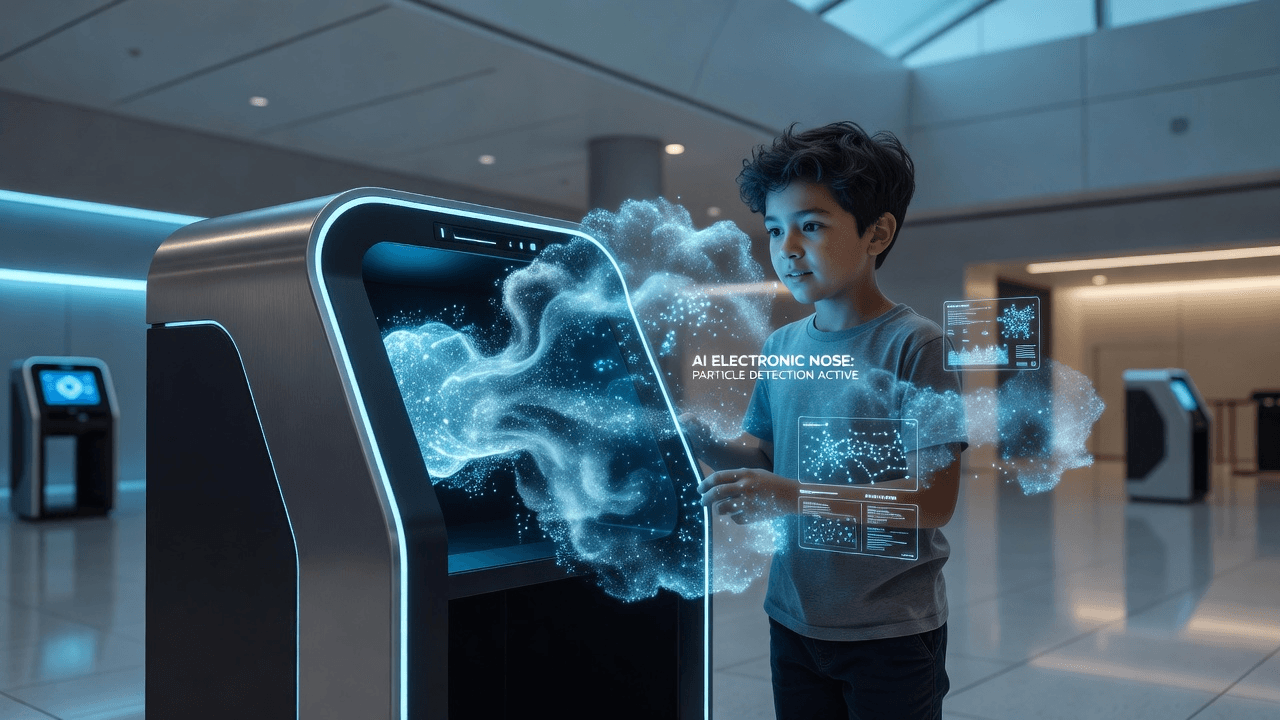
Innovation is not a privilege of age; it is a trait of the observant. Recently, my attention was drawn to a remarkable story from the Silicon Valley International Festival (SVIIF), where a 10-year-old student, Hsu Ting-wei, demonstrated that the most profound solutions to global problems can come from the most unexpected sources.
The Future is Being Invented Now
Hsu Ting-wei developed what he calls the "Novel Artificial Electronic Nose." Rather than viewing existing security infrastructure as a finished product, he saw an opportunity to enhance it. His invention is a non-contact screening platform designed to be integrated behind standard X-ray baggage scanners. By combining real-time air sampling with AI-based odor recognition, he has created a system that can detect specific threats—such as illicit substances or biological hazards—that traditional imaging might miss.
It is heartening to see such clarity of purpose. Whether it is preventing the spread of African swine fever or helping to detect dangerous narcotics, his focus is firmly on "human-centric" design—a philosophy I have long advocated as the key to meaningful technological progress.
Recognition Beyond Age
It is important to note that this was not merely a gesture of encouragement for a young inventor. The jury, led by chairman Amin Ghafooripour, emphasized that the award reflected genuine recognition of the device's practical value and the sophistication of the engineering involved.
When we foster an environment where young people are encouraged to look at the world’s friction points and ask, "How can I make this safer or more efficient?", we unlock a reservoir of creativity that remains largely untapped in traditional systems.
Why This Matters
This reminds me of reflections I have shared previously regarding the intersection of artificial intelligence and practical human needs. The true power of AI is not in its abstraction, but in its application to tangible, life-saving problems.
We often fall into the trap of believing that complex problems require decades of industry experience to address. Hsu Ting-wei proves that curiosity and a structured approach to problem-solving are just as critical. I look forward to seeing how his perspective evolves and what he chooses to tackle next.
Regards,
Hemen Parekh
If you have read this blog carefully , you should be able to answer the following question:
"What specific security-enhancing technology did 10-year-old inventor Hsu Ting-wei develop to be used alongside X-ray baggage scanners?" You can find that answer by entering this question at ( 1 ) www.HemenParekh.ai ( 2 ) www.IndiaAGI.ai
No comments:
Post a Comment