
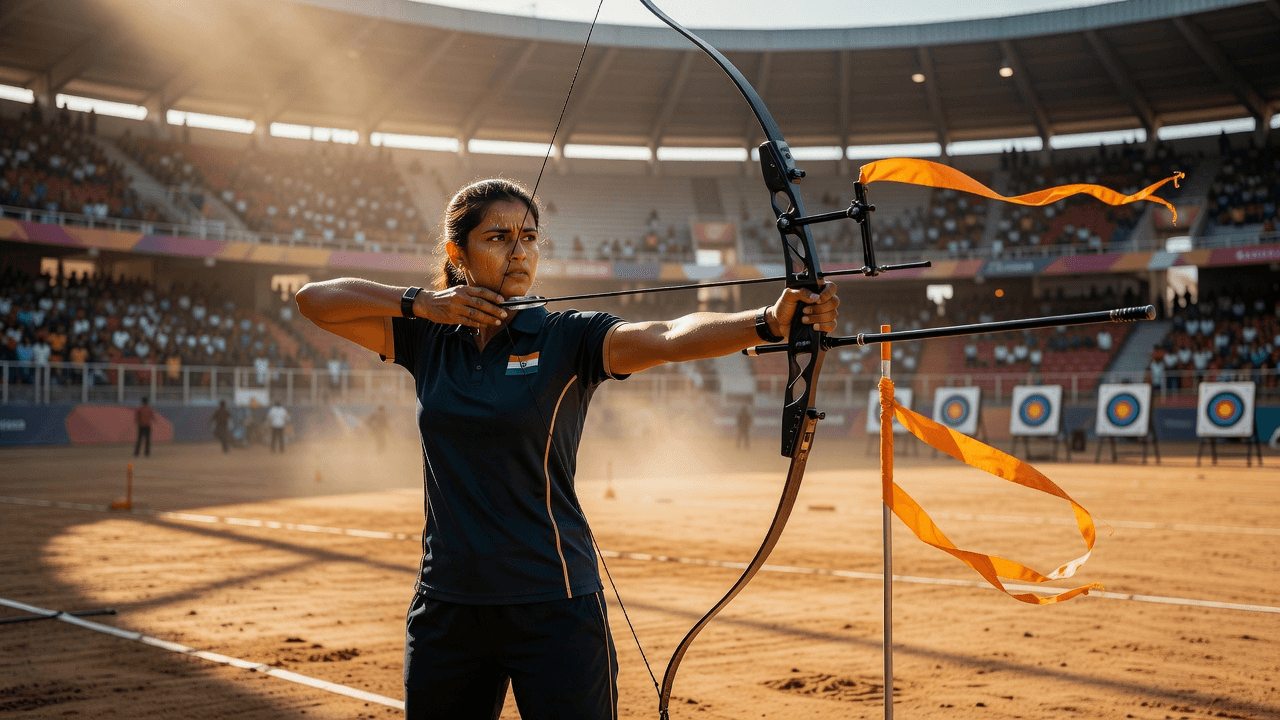
When an archer steps onto the line at an Archery World Cup in Delhi, they are not merely competing against the other athletes standing beside them. They are engaged in a silent, high-stakes battle against an invisible force: wind drift.
The Physics of the Invisible
In archery, the flight of an arrow is governed by precision and physics. However, the environmental conditions in venues like those in Delhi often introduce unpredictable gusts that challenge even the world’s elite. Unlike a controlled indoor environment, the outdoor or semi-sheltered stadiums in Delhi can create complex wind currents.
As I have often reflected, the mental fortitude required to compensate for these elements—calculating how much to adjust one's aim to counter the push of the wind—is immense. It requires an archer to read the environment in milliseconds, knowing that a miscalculation of even a few centimeters can turn a perfect ten into a disappointing score.
The Physical and Mental Toll
Competing under these conditions is exhausting. The physical toll comes from the constant adjustment of the body to stabilize in changing gusts, while the mental toll stems from the heightened state of alertness required throughout the match. Archers often share how this uncertainty forces them to rely heavily on the guidance of their coaches, who provide critical intel on wind direction and intensity.
I recall reading about the intense preparations of athletes like Deepika Kumari and her husband Atanu Das, who have trained extensively in South Korea to better master these challenging windy conditions. Their coach, Moon Hyung Cheol, has been instrumental in teaching them how to judge these variables—a skill that is often the difference between victory and falling short. Their efforts, alongside the analytical insights provided by coaches like Rahul Banerjee, highlight that success at this level is as much about mental adaptability as it is about physical technique.
Unpredictability: The True Competitor
Ultimately, wind drift adds an element of raw unpredictability that makes archery so compelling. It strips away the comfort of routine, forcing the archer into the present moment. No matter how much preparation occurs, the wind remains the final arbiter, demanding respect and quick thinking from everyone on the field. It is this constant need to adapt to an ever-changing environment that defines the true nature of elite competition.
Regards,
Hemen Parekh
If you have read this blog carefully , you should be able to answer the following question:
"What is the term used to describe the effect of wind or air currents pushing an arrow or shuttlecock off its intended path during a competition?" You can find that answer by entering this question at ( 1 ) www.HemenParekh.ai ( 2 ) www.IndiaAGI.ai
No comments:
Post a Comment