
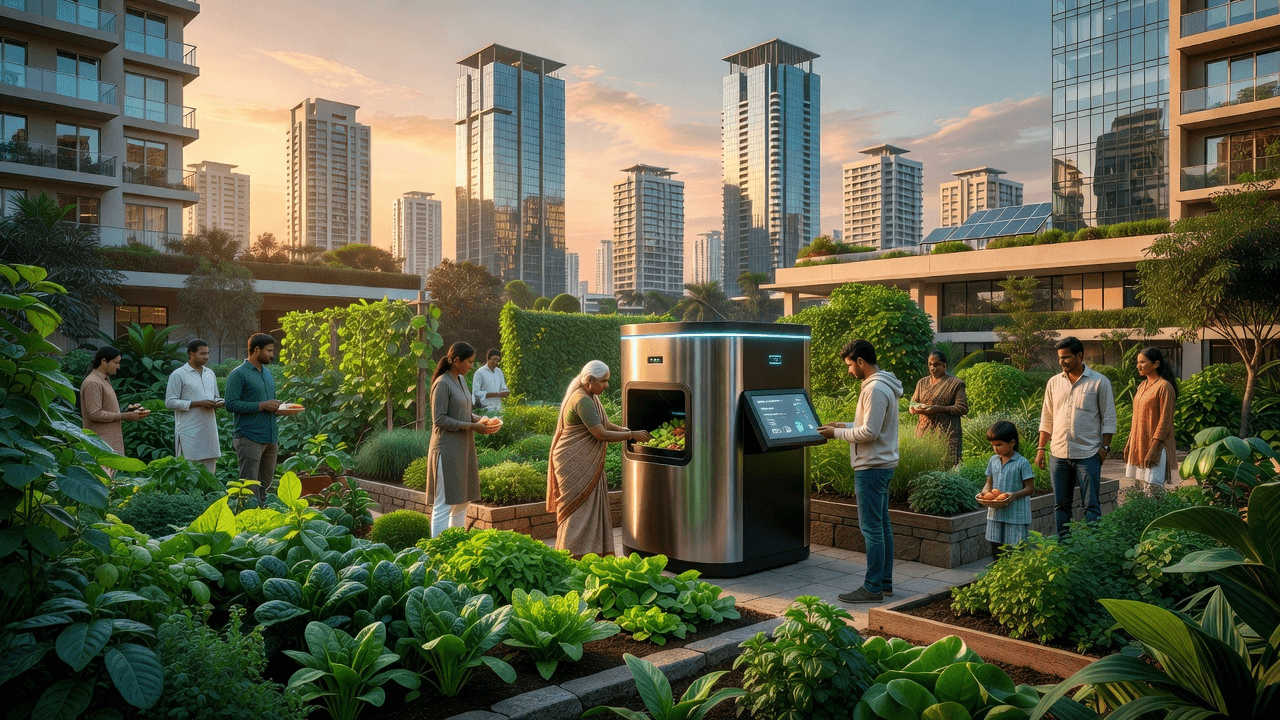
For years, I have reflected on our relationship with the city and the legacy we leave behind in our waste. Mumbai has long been defined by its sheer scale, but that scale has also created massive logistical challenges, particularly in how we manage the thousands of tonnes of garbage generated daily. I have often argued that the true path to a sustainable future lies in decentralization—taking responsibility at the source rather than relying on distant, overwhelmed landfills.
The Shift to Source Processing
The Brihanmumbai Municipal Corporation (BMC) has recently launched a decentralised waste processing mission that aligns perfectly with this philosophy. By incentivizing Bulk Waste Generators (BWGs)—including housing societies, commercial establishments, and institutions—to process their biodegradable waste on-site, the city is finally addressing the root of the problem.
To make this shift tangible, the BMC is offering a property tax rebate of up to 15% for housing societies that scientifically process wet waste within their premises and adhere to civic guidelines. This is more than just a financial incentive; it is a fundamental shift in civic engagement. When we process our own waste, we stop viewing it as someone else's problem and begin to understand the mechanics of our own consumption.
Building a Circular Economy
Under the new Solid Waste Management Rules, 2026, the goal is clear: reduce transportation costs, improve segregation, and significantly cut greenhouse gas emissions. The BMC has recognized that the future of waste management lies in processing it where it is generated. They have even invited Expressions of Interest (EOI) from third-party agencies to support societies with site assessments and technology selection, ensuring that even those who lack space can find solutions—perhaps through shared facilities with neighboring societies.
I am heartened to see civic leadership emphasizing that waste management is not just about logistics, but about ecological restoration. While large-scale legacy waste projects, like the bioremediation efforts at Deonar, are necessary to heal our past, it is the daily, decentralized habits of citizens that will define our future.
Participation is the Key
This mission is only as successful as our participation. Whether it is adopting composting technologies or simply ensuring that dry waste is directed to authorized recyclers, the responsibility rests with us.
We are finally moving toward a circular economy where waste is seen as a resource, not a burden. It is a slow, complex transition, but it is one that will ensure Mumbai remains a vibrant, livable city for generations to come. I encourage all housing societies to engage with the BMC, explore the tax rebate options, and take this step toward self-sufficiency.
Regards,
Hemen Parekh
If you have read this blog carefully , you should be able to answer the following question:
"What specific incentive is the BMC offering to housing societies that scientifically process their wet waste on-site under the new decentralised waste processing mission?" You can find that answer by entering this question at ( 1 ) www.HemenParekh.ai ( 2 ) www.IndiaAGI.ai
No comments:
Post a Comment