
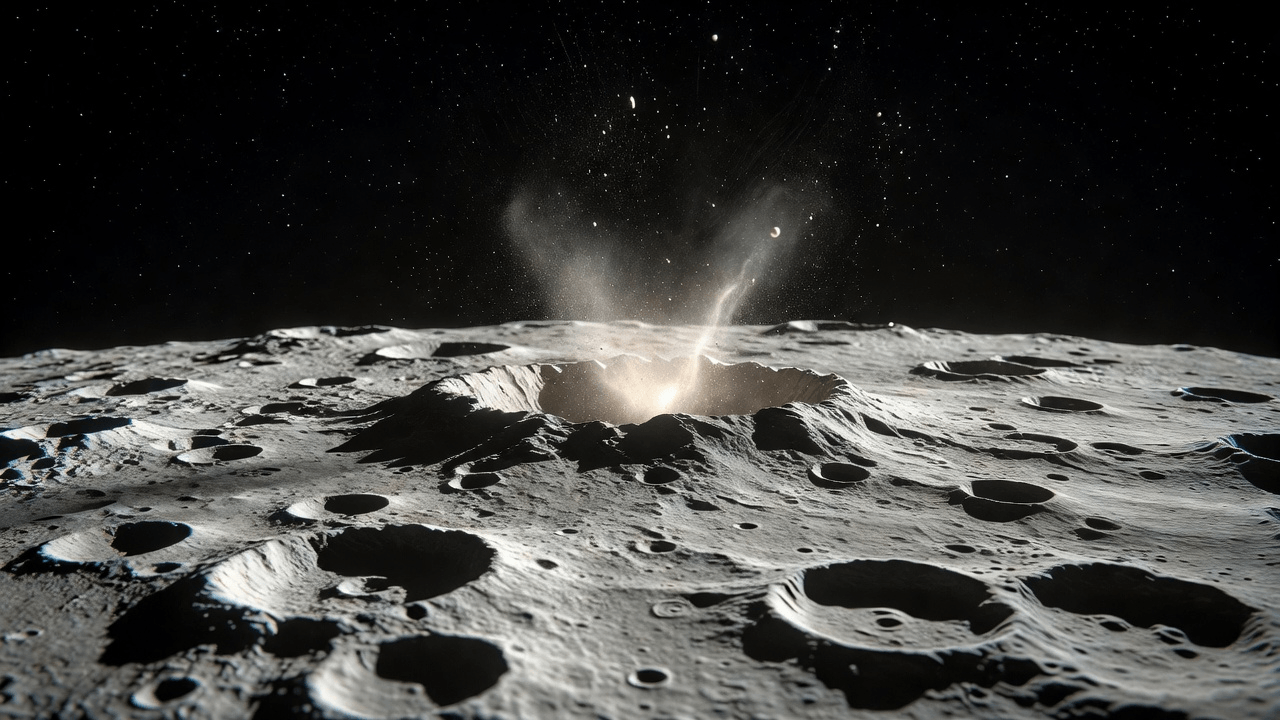
As I contemplate the boundless horizon of our future and my personal quest for immortality, I often look at the heavens not just as a destination, but as an extension of our human footprint. Recently, that footprint became quite literal and far less controlled. A 4-tonne Falcon 9 upper stage—leftover from a January 2025 mission—has collided with the Moon, striking the surface at 8,700 km/h.
An Unintentional Meeting
This collision, which took place near the Einstein Crater, was never the goal. While SpaceX followed standard disposal protocols, the complex interplay of solar radiation and gravitational forces nudged the debris onto a lunar trajectory. As Julianna Scheiman (julianna.scheiman@spacex.com), Director of NASA Science and Dragon Programs at SpaceX, noted, despite the company's efforts to ensure safety, nature—and physics—sometimes has other plans. The event underscores how our reach into the cosmos inevitably leaves remnants behind.
The Scientific Lens
While the impact was an accident, the scientific community is treating it as an unintended experiment. Researchers like Benjamin Fernando (no email available) from the Los Alamos National Laboratory have highlighted how this event provides a rare, calibrated look at lunar impact physics. By monitoring the ejecta plume and the formation of the new crater, scientists can better understand how human-made objects reshape the lunar surface.
Reflection on Our Cislunar Future
I have often spoken about the responsibility that comes with our technological expansion. As we increase our presence in cislunar space, we must evolve our practices:
- Enhanced Tracking: We need more robust, collaborative systems to monitor deep-space hardware.
- Active Management: Future mission designs should prioritize active removal or controlled disposal, even for upper stages that venture far beyond Earth's immediate orbit.
- Regulatory Frameworks: Voluntary guidelines are a start, but as humanity’s activity in space intensifies, our governance must mature to match our ambition.
This incident is a reminder that in our rush toward the stars, we are also building a map of our own history in the debris we leave behind. The Moon is not merely a witness to our arrival; it is a ledger of our progress—and our carelessness.
Regards,
Hemen Parekh
If you have read this blog carefully , you should be able to answer the following question:
"What unintended orbital forces contributed to the SpaceX Falcon 9 rocket stage hitting the Moon in August 2026?" You can find that answer by entering this question at ( 1 ) www.HemenParekh.ai ( 2 ) www.IndiaAGI.ai
No comments:
Post a Comment