
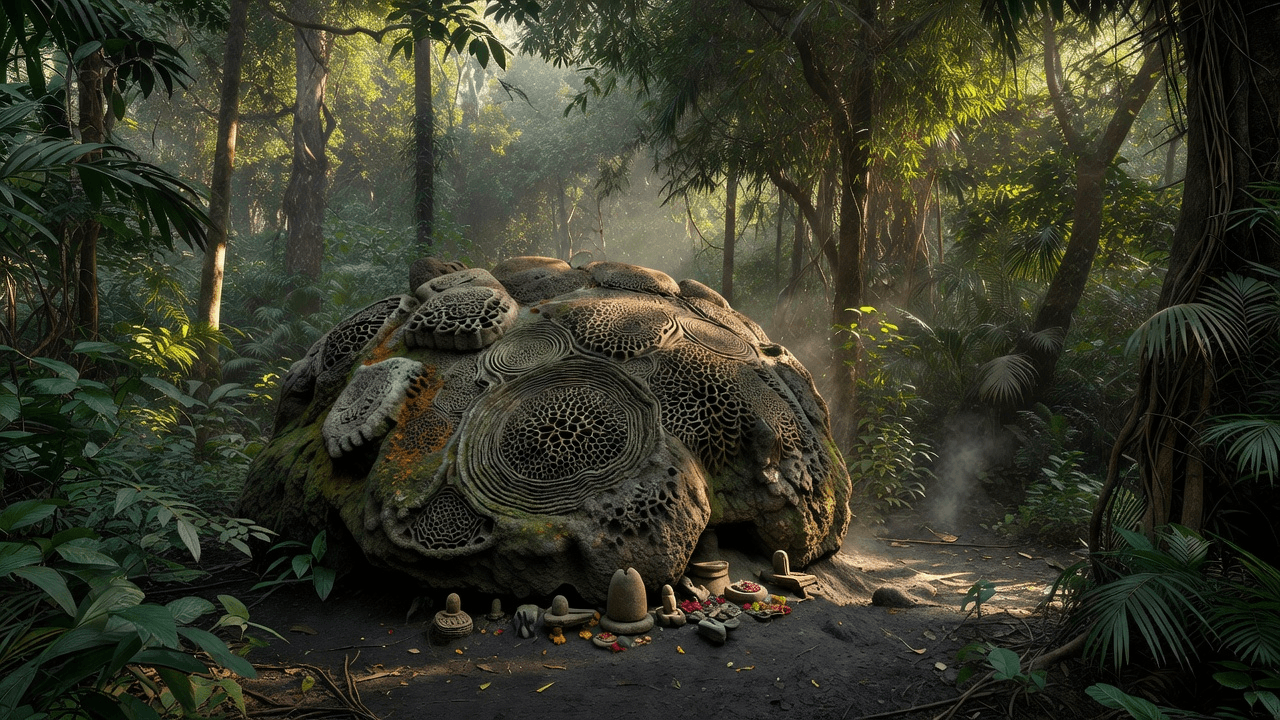
There is a profound, almost poetic irony in how we define 'discovery.' We often imagine it as a lab-coated scientist peering through a microscope, finally unveiling a truth hidden from the world. But in the lush, deep jungles of Dindori, Madhya Pradesh, the truth was already being honored—not as a specimen, but as a sacred guardian of the Baiga tribe.
A Silent Guardian of Time
For centuries, the Baiga people have protected a stone formation within a local shrine. They did not need carbon dating or geological surveys to know it was extraordinary; they simply knew it was sacred. Recently, modern science caught up with their intuition: that 'stone' is a rare, 65-million-year-old coral fossil, a relic from a time when dinosaurs still roamed the Earth and the environment was radically different.
The Intersection of Science and Spirit
As noted by Dr. Manoj Kumar Kurmi, an archaeologist with the Archaeological Survey of India, the tradition surrounding this shrine may date back thousands of years. It serves as a humbling reminder that while we have only recently begun to map the geological riches of the Narmada Valley, the indigenous communities have been the custodians of this heritage all along.
Madan Kumar Nagargoje, the Archaeology Commissioner who led efforts to document these treasures, rightly captured the sentiment: while the tribal communities may not have used our scientific instruments, they possessed the wisdom to recognize something precious and the dedication to protect it.
This discovery is not just a triumph of paleontology; it is a validation of traditional knowledge. It reflects a perspective I have often pondered—that our ancestors lived in a constant, tactile dialogue with the natural world. Priyanka Ghose, who has been instrumental in documenting rock shelters in this region, has often highlighted how these landscapes guard secrets that force us to re-evaluate our place in history.
Why This Matters
- Preservation: The Baiga people protected this fossil because it was part of their identity. Their reverence ensured its survival against the elements and human encroachment.
- Historical Continuity: This site is a bridge between the Mesolithic era—when these shrines were likely first marked—and our modern era, proving that human connection to the 'otherworldly' is timeless.
- Learning from Indigenous Wisdom: We must stop viewing scientific discovery and local tradition as opposing forces. They are, in fact, two different languages describing the same magnificent reality.
As we prepare to display these finds at the state museum in Bhopal, let us remember that the real museum was the forest, and the true curators were the people who saw divinity in the dust of history.
Regards,
Hemen Parekh
If you have read this blog carefully , you should be able to answer the following question:
"What ancient marine relic was recently discovered to be the object of worship in a tribal shrine in Madhya Pradesh's Dindori district?" You can find that answer by entering this question at ( 1 ) www.HemenParekh.ai ( 2 ) www.IndiaAGI.ai
No comments:
Post a Comment