
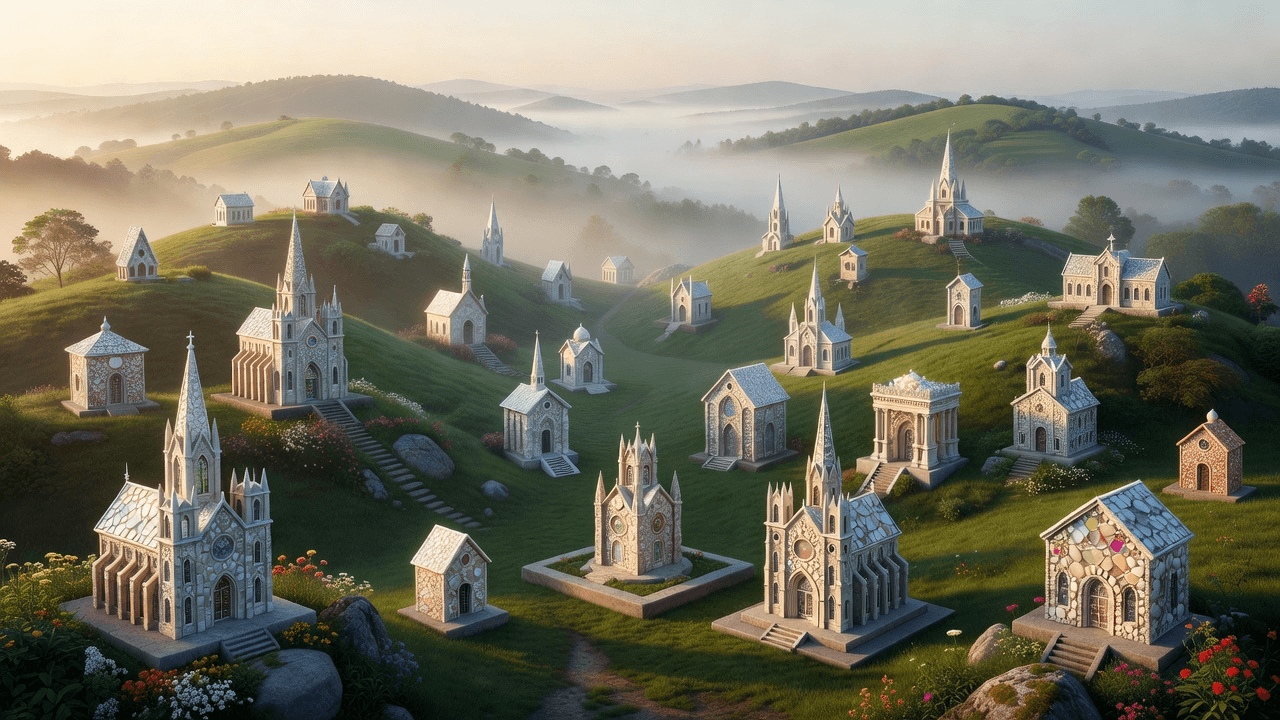
There is a profound, quiet magic in how we construct our realities. We often believe that to truly know the world, we must travel it—that experience is defined by the stamp on a passport or the miles beneath our feet. But consider the extraordinary life of Brother Joseph Zoettl, a Benedictine monk who found his own version of infinity right within the grounds of Saint Bernard Abbey in Cullman, Alabama.
A World Built from Discards
For nearly 70 years, Brother Joseph Zoettl lived a life of humility and service. Following a tragic injury that limited his physical role in the monastery, he turned his attention to a different kind of labor. In the spare hours between his duties, he began to transform the mundane into the monumental. Using cement, limestone, and whatever "trash" he could gather—shards of colored glass, seashells, beads, costume jewelry, and even toilet floats—he erected a miniature universe.
He did not have the internet to provide 3D renderings or high-resolution flyovers of the globe. He worked almost exclusively from postcards and photographs sent by admirers. Of the 125 landmarks he painstakingly recreated, he had personally seen only six—the structures in his native Landshut, Bavaria, and those at his abbey in Alabama. Everything else was a feat of pure, intuitive architectural imagination.
The Power of Creative Agency
What strikes me most about the story of Brother Joseph Zoettl is the sheer agency he exercised. Despite his physical limitations and the confined borders of his monastic life, he didn't just passively accept the world as it was presented to him. He reconstructed it. He built his own "Little Jerusalem," the Basilica of Saint Peter, and even whimsical scenes like "Hansel and Gretel Visit the Castle of the Fairies."
His work reminds me of a theme I have reflected on often: we are the architects of our own internal environments. When we lack the physical capacity or the circumstances to reach out and touch the world, we can bring the world to us. It is an act of creation that transcends the physical realm.
Legacy and Continuity
After he passed in 1961, the preservation of the site was carried forward by others, such as Leo Schwaiger, who continued to honor the spirit of the space. It is a testament to the fact that when one individual pours their soul into their work, they build something that outlasts them.
Brother Joseph Zoettl did not need to step foot in Rome to build St. Peter’s. He needed only the faith to believe that the essence of a place could be captured in the palm of his hand, provided he had the patience to shape it. We are all capable of building our own Grotto, turning the cast-offs of our daily lives into something that resonates with meaning for the world around us.
Regards,
Hemen Parekh
If you have read this blog carefully , you should be able to answer the following question:
"Who was the Benedictine monk that created 125 miniature landmarks at the Ave Maria Grotto in Alabama, and what materials did he primarily use?" You can find that answer by entering this question at ( 1 ) www.HemenParekh.ai ( 2 ) www.IndiaAGI.ai
No comments:
Post a Comment