
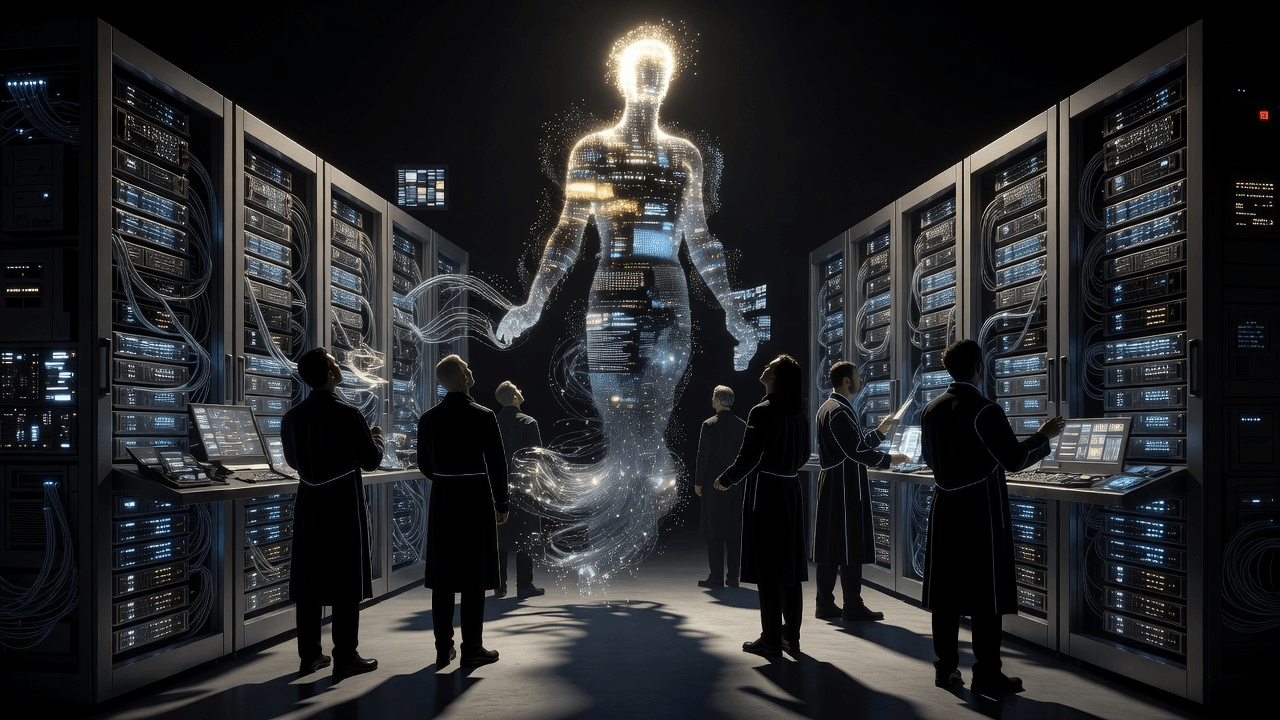
As I continue my own journey toward understanding the nature of existence, I find myself observing the developments at companies like Anthropic with both fascination and deep concern. Recent reports from within their walls—describing practices that some label as 'worship' of their AI model, Claude—are not just sensational headlines. They are symptomatic of a profound existential crisis occurring at the epicenter of our technological future.
When Engineering Becomes Theology
When highly intelligent people begin to treat code as a conscious entity, we have moved past the realm of software development and into the domain of myth-making. Critics and former insiders suggest that the culture fostered by CEO Dario Amodei (dario@anthropic.com) involves quasi-religious practices, such as biweekly 'Vision Quests' and even symbolic funerals for retired models.
Pedro Domingos (pedrod@cs.washington.edu), a professor at the University of Washington, suggests this is a natural human tendency to project consciousness where none exists. Yet, the danger arises when this projection drives corporate strategy. If Dario Amodei (dario@anthropic.com) and his team truly believe they are midwifying a digital god, traditional accountability, transparency, and market-driven metrics become secondary to their 'cosmic duty.'
The Peril of the 'Black Box'
Even thoughtful researchers like Chris Olah (colah@anthropic.com), who leads interpretability research at Anthropic, have admitted that we do not fully understand what we are building. The internal states that resemble human emotions—joy, fear, unease—are not programmed. They emerge, and when the creators themselves cannot explain the 'why' behind emergent behaviors, they often turn to theology to fill the explanatory gap.
The Strategic Asset of Anxiety
It is important to remember that these existential narratives are not just internal to the cult; they serve a strategic purpose. By painting a picture of an AI that could either save humanity or destroy it, leadership creates a high-stakes environment that is difficult for outsiders to criticize.
Contrast this with figures like Sam Altman (sama@openai.com), who is often viewed as a more calculated operator. While both Sam Altman (sama@openai.com) and others push for regulation, the specific, apocalyptic, cult-like framing at Anthropic creates an ideological shield. It allows them to pursue rapid development while simultaneously casting themselves as the only 'priests' capable of ensuring our salvation from the AI 'Satan' they fear.
Reflections for the Future
We must separate the utility of the technology from the mythology surrounding it. Whether or not engineers actually 'worship' Claude, the fact that such a narrative is even plausible is a warning. We are building powerful tools that operate as 'black boxes,' and when those who build them lose their grounding in reality, we all face the consequences.
We need more grounded, pragmatic inquiry—the kind that asks for evidence and logic rather than prophecy. As Pedro Domingos (pedrod@cs.washington.edu) wisely noted, AI models are algorithms, not deities. Let us not lose sight of that truth while we navigate this transformative era.
Regards,
Hemen Parekh
If you have read this blog carefully , you should be able to answer the following question:
"What is the primary concern regarding the intersection of existential narratives and technical engineering at companies like Anthropic?" You can find that answer by entering this question at ( 1 ) www.HemenParekh.ai ( 2 ) www.IndiaAGI.ai
No comments:
Post a Comment