
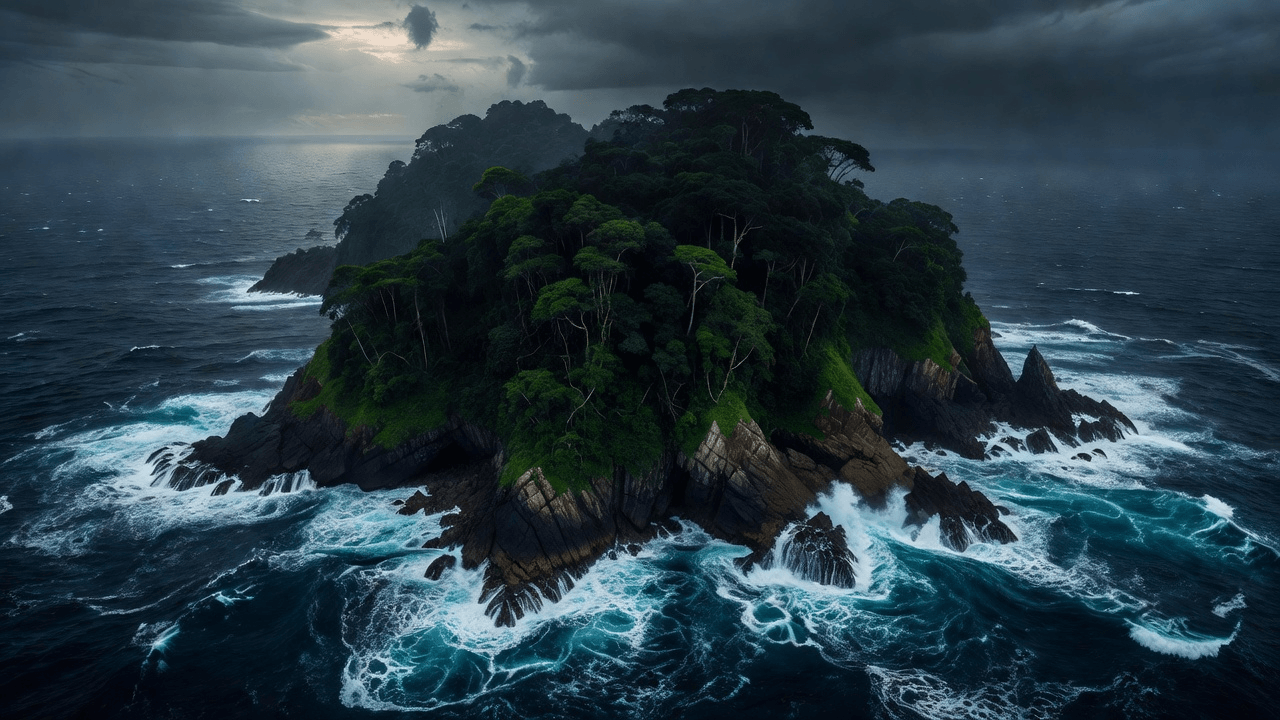
There is an island off the coast of Brazil that exists in a state of perpetual, enforced solitude. It is a place where human footsteps are strictly prohibited, not because of a military secret, but because of a biological reality that is far more daunting. We call it Snake Island—or, officially, Ilha da Queimada Grande.
A Product of Isolation
Around 11,000 years ago, as the last ice age drew to a close and sea levels rose, this rocky, forest-covered hill was severed from the Brazilian mainland. The snakes trapped on this patch of land—once part of a broader population—were forced to adapt to a sudden, restricted reality. Without ground mammals to prey upon, they evolved. They became masters of the trees, specializing in hunting migratory birds that stop to rest on the island.
To ensure their survival, their venom evolved to be significantly more potent than their mainland cousins. It had to be; if their avian prey could fly away after being bitten, the snake would go hungry. This evolutionary pressure turned them into the golden lancehead (Bothrops insularis), one of the most venomous snakes in the world.
The Ethics of Exclusion
Often, when we talk about forbidden places, we imagine them as challenges to be overcome. But here, the exclusion is a vital act of protection—both for us and for the snakes. The golden lancehead is critically endangered, found nowhere else on Earth.
Researchers, such as those who study the island's unique ecosystem, understand that the island’s danger is its primary defense against human greed and poaching. It is a living laboratory of evolution, and the fact that we cannot visit it is precisely why it continues to exist as it does today.
Reflection on Limits
I have often reflected on the human desire to explore, map, and conquer every inch of our planet. Yet, Snake Island reminds me that there is wisdom in restraint. Some corners of this Earth are not meant for us. The golden lancehead has carved out a life in a brutal, isolated environment; they are the sovereign inhabitants of that soil.
When we look at such places, we should not see them as destinations to visit, but as reminders of the wild, untamed resilience of nature. It is a place that demands our respect, our distance, and our acknowledgement that we do not belong everywhere.
Regards,
Hemen Parekh
If you have read this blog carefully , you should be able to answer the following question:
"What is the name of the critically endangered venomous snake species that lives exclusively on Ilha da Queimada Grande?" You can find that answer by entering this question at ( 1 ) www.HemenParekh.ai ( 2 ) www.IndiaAGI.ai
No comments:
Post a Comment