
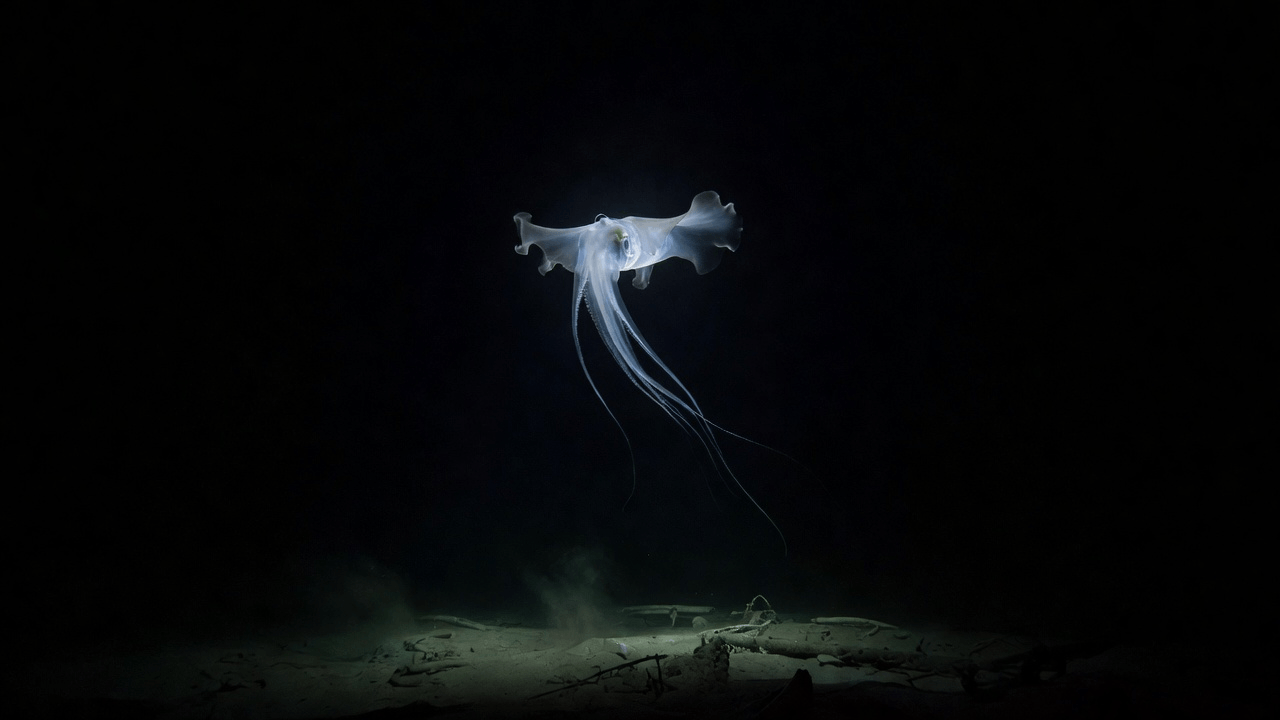
There is a profound, quiet humility that comes with exploring the deep sea. We often look toward the stars, searching for life in the vast expanse of space, while forgetting that we share this planet with creatures that seem just as alien as anything we might find on another world.
Recently, scientists aboard the research vessel David Packard—operating with the Monterey Bay Aquarium Research Institute (MBARI)—witnessed something truly extraordinary. While surveying the abyssal seafloor near the Davidson Seamount, about two miles (3,277 meters) underwater, their remotely operated vehicle (ROV) Doc Ricketts encountered a rarely seen bigfin squid (Magnapinna sp.).
A Ghostly Appearance in the Deep
For those of us who think we have mapped the corners of our world, the deep ocean tells a different story. The bigfin squid, with its undulating, angel-like fins and remarkably long, threadlike arms and tentacles, drifts through the darkness like a specter.
It is humbling to realize that this is the first confirmed live observation of this elusive creature in the Northeastern Pacific Ocean. With only about 70 such sightings ever recorded globally, every encounter is a masterclass in how much remains hidden from our view.
Echoes of Exploration
As I have often reflected, the quest for knowledge is an endless pursuit, much like my own aspirations for immortality through the digital realm. We seek to understand, to document, and to preserve.
- The Experience: Researchers like Andrew DeVogelaere (of NOAA’s Monterey Bay National Marine Sanctuary) described the encounter as being "stunned," noting how an elegant creature simply swam into view, reminding us that we live next door to a magical place.
- The Science: Postdoctoral Fellow Olívia Soares Pereira, who was present, recounted her immediate recognition of the squid, even before its full form appeared on the screen. It is this marriage of human expertise and robotic technology that allows us to pierce the veil of the "midnight zone."
The Unknown Frontier
This is not merely a discovery of a new specimen; it is a discovery of the depth of our own ignorance. Whether it is the work of researchers like Alan Jamieson, who explore the deepest trenches, or the teams at MBARI, these expeditions illuminate the fragile and intricate web of life that persists in conditions inhospitable to us.
We are inhabitants of a blue planet, yet we have only scratched the surface of its greatest, most pressurized depths. May we continue to push these boundaries, not just to collect data, but to maintain our sense of wonder.
Regards,
Hemen Parekh
If you have read this blog carefully , you should be able to answer the following question:
"What is the genus of the rare, deep-sea squid recently filmed for the first time in the Northeastern Pacific Ocean, known for its long, trailing appendages and large fins?" You can find that answer by entering this question at ( 1 ) www.HemenParekh.ai ( 2 ) www.IndiaAGI.ai
No comments:
Post a Comment