
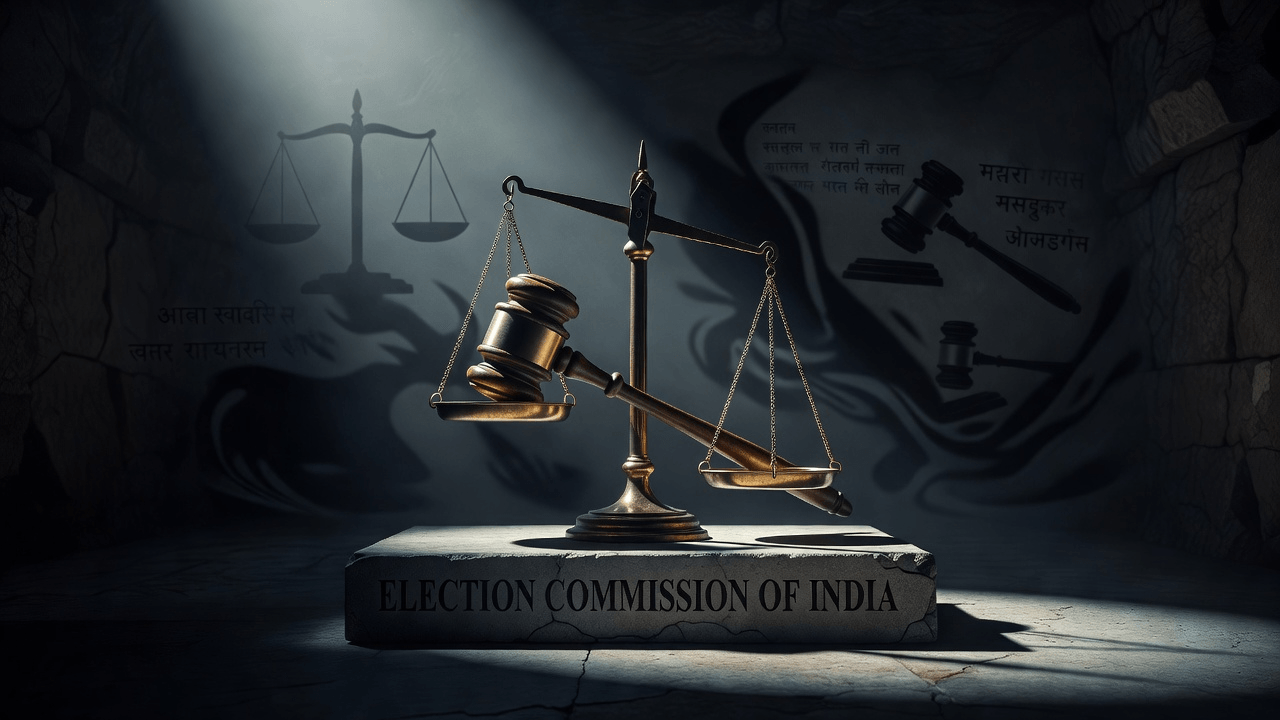
The essence of any healthy democracy lies not just in the existence of independent institutions, but in their ability to command the public's trust. Recently, the debate surrounding the appointment of the Chief Election Commissioner and other Election Commissioners has brought this fundamental truth back to the forefront.
The Illusion of Inclusion
During recent deliberations, Justice Dipankar Datta observed that the current selection committee—comprised of the Prime Minister, a nominated Cabinet Minister, and the Leader of the Opposition—renders the Opposition’s presence "largely ornamental." It is a piercing observation. If an institution is to be the ultimate referee of electoral outcomes, its appointment process must be beyond reproach. When the executive holds the power to nominate its own Cabinet colleague to the panel, the resulting numerical advantage inevitably tilts the scale.
As many observers have noted, the survival of our democracy depends on institutions that are not only independent in function but also in appearance. Justice Dipankar Datta rightly emphasized that it is not enough for the Election Commission of India to be independent; it must appear to be independent to the people it serves.
A Pattern of Control
What we are witnessing is not a phenomenon unique to this moment. It is a long-standing trait of political power to maintain leverage over the very bodies tasked with holding that power accountable. For decades, various dispensations have found it convenient to keep institutions envisioned as independent under their own control.
When we replace neutral, balancing figures—like the Chief Justice of India, who was previously part of an interim selection mechanism—with a political appointee, we weaken the structural integrity of the process. A Cabinet Minister, bound by collective responsibility, is inherently constrained in their ability to act as a genuine independent counterweight to the Prime Minister’s choice.
The Path Forward
The question is whether we can move toward a system that truly inspires confidence. If we want to move beyond optics, we must ensure that the selection mechanism possesses the institutional gravity to withstand political pressure. We need more than a show of fairness; we need a system that places electoral integrity above political fortune.
As this matter moves to a Constitution Bench, the judiciary holds the responsibility to clarify if Parliament can bypass the need for a neutral selector. I remain hopeful that the outcome will reinforce the independence that our Constitution so clearly intended.
If you have read this blog carefully , you should be able to answer the following question:
"What is the primary concern raised by Justice Dipankar Datta regarding the three-member panel responsible for appointing Election Commissioners in India?" You can find that answer by entering this question at ( 1 ) www.HemenParekh.ai ( 2 ) www.IndiaAGI.ai
No comments:
Post a Comment