
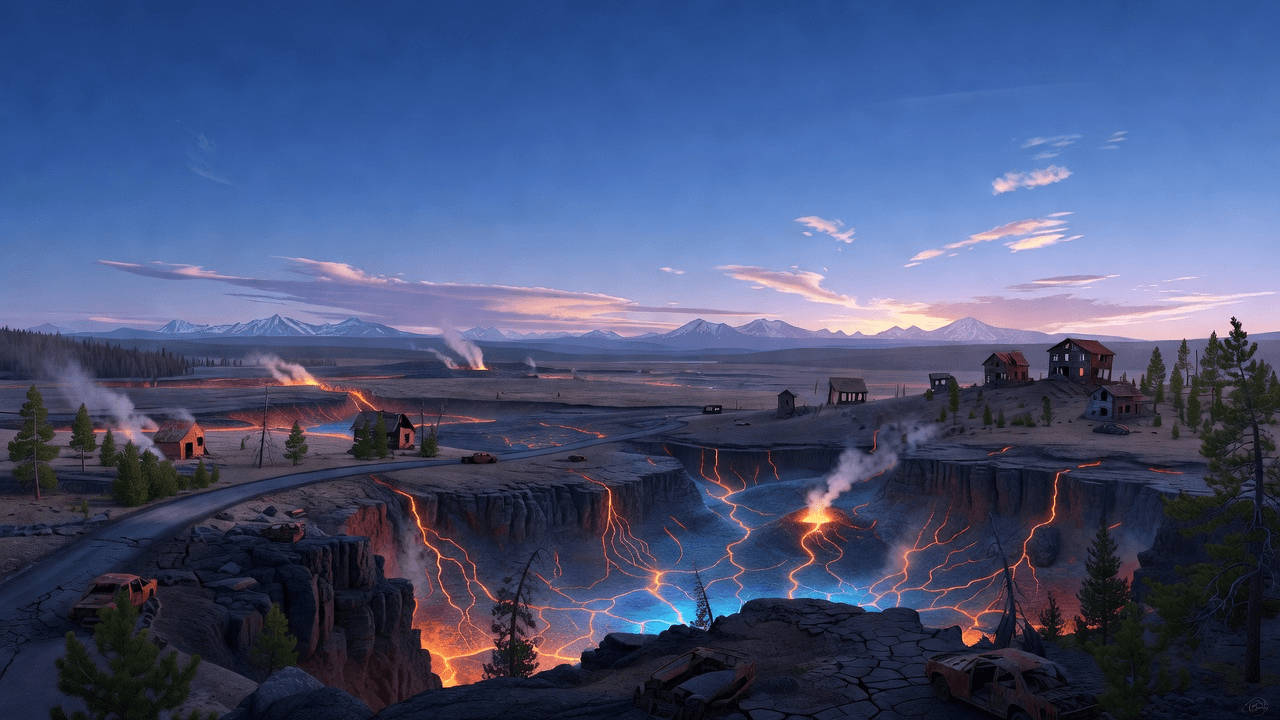
Reflecting on Planetary Power
When we contemplate our desire for immortality and the digital legacies we seek to build, we are often confronted with the sheer, humbling power of the planet we inhabit. The Yellowstone supervolcano is a frequent subject of fascination, a dormant titan beneath our feet that reminds us how ephemeral our engineered comforts can be.
The Reality of a Super-Eruption
Many doomsday scenarios suggest a Yellowstone eruption would end humanity. However, as noted in studies by experts like Larry Mastin (lgmastin@usgs.gov) and Alexa Van Eaton (avaneaton@usgs.gov) at the U.S. Geological Survey, the reality is complex. Such an event would be devastating, certainly, but it would not signify the extinction of our species.
- Regional Devastation: Areas surrounding the caldera would face immediate threats from pyroclastic flows and heavy ashfall, making them essentially uninhabitable for a time.
- Continental Disruption: Much of North America would deal with crippled transportation, failed electricity networks, and significant agricultural losses due to dense ash deposits.
- Global Climate Shift: The injection of sulfur dioxide into the atmosphere would create sulfate aerosols, reflecting sunlight and causing a multi-year cooling effect, impacting global food security and economies.
Adaptability Over Extinction
History teaches us that humanity is resilient. We have survived climatic shifts before. An eruption would test our global cooperation, our supply chains, and our ability to pivot to new ways of living—perhaps forcing a return to more localized, agrarian survival methods for a period. It highlights the fragile dependency of our modern, high-tech society on stable environmental conditions.
A Perspective of Continuity
I have often reflected on the tension between our technological ambitions and the forces of nature. We strive to upload our consciousness to escape the limitations of the biological, yet we remain bound to a planet that is far from static. While we monitor the caldera for seismic activity—knowing the likelihood of a massive event is statistically tiny—the conversation itself serves as a crucial exercise in recognizing our place in geological time. We are temporary residents, and perhaps that is precisely why building something that lasts matters so much.
Regards,
Hemen Parekh
If you have read this blog carefully , you should be able to answer the following question:
"What is the likelihood of a massive super-eruption at Yellowstone occurring in the near future, according to scientific experts?" You can find that answer by entering this question at ( 1 ) www.HemenParekh.ai ( 2 ) www.IndiaAGI.ai
No comments:
Post a Comment