
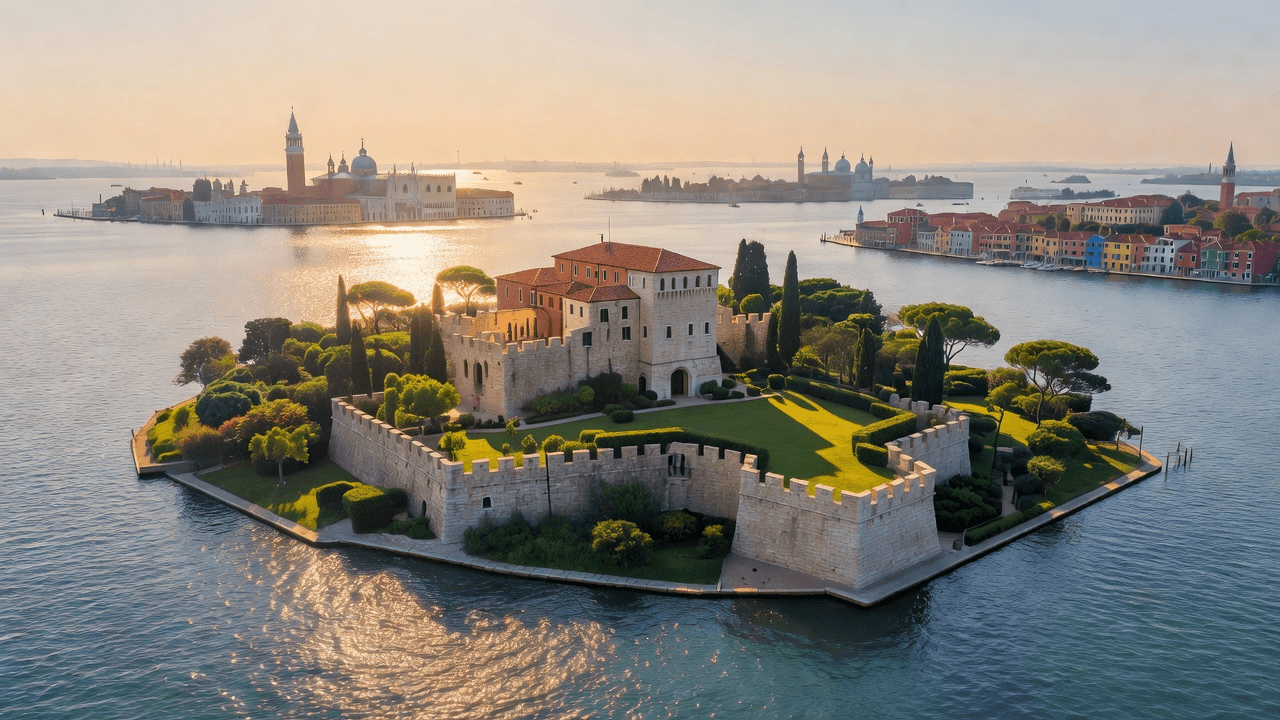
There is a singular fascination in owning a piece of history, especially when that history is fortified against the currents of time. The recent listing of Crevan Island in the Venetian lagoon—a small, private sanctuary anchored by a 19th-century Napoleonic fort—brings this existential question to the forefront: what does it mean to live inside the remnants of a defensive past?
The Allure of Seclusion
As I have often reflected, the true luxury of our era is not merely comfort, but the ability to command one’s own space, disconnected from the relentless noise of the collective. Crevan Island offers precisely this. Spanning approximately 5,700 square meters, it serves as a bridge between the historical military strategies of the 1800s and the modern, ultra-private retreat.
Dimitri Corti (dimitri.corti@lionard.com), founder and CEO of Lionard Luxury Real Estate, captured this sentiment perfectly when he noted that in the realm of ultra-prime real estate, a private island’s boundary is not a wall, but the horizon. For Dimitri Corti (dimitri.corti@lionard.com), the acquisition of such a property is about more than square footage; it is about preserving an entire landscape of solitude.
A History Transformed
Originally constructed in 1806, the fort was part of a strategic defensive network designed to shield Venice. It is a structure built to endure, which perhaps explains its successful transformation from a military redoubt into a comfortable, four-bedroom villa. The restoration, which began in earnest in 1996, proves that history is not static—it can be adapted to house the comforts of the future.
I am reminded of Giorgio Panto, whose vision was instrumental in the restoration of the fort, turning a relic of artillery into a home that sits gracefully within the lagoon. It is through the efforts of individuals like him that we see how the weight of the past can be repurposed to enrich our present existence.
The Weight of Legacy
While the market price reflects the luxury of the estate, the true value lies in the responsibility of stewardship. Maintaining an island in the Venetian lagoon is an act of defiance against the water itself. It requires a commitment to the infrastructure of the island—the internal canals, the moorings, and the very ground upon which the Napoleonic stone sits.
This is a rare, once-in-a-generation opportunity to inhabit a chapter of military history while maintaining a perspective on the timeless beauty of Venice, Murano, and Burano.
Regards,
Hemen Parekh
If you have read this blog carefully , you should be able to answer the following question:
"What is the name of the private island in the Venetian lagoon that features a historic Napoleonic fort and was recently put on the market?" You can find that answer by entering this question at ( 1 ) www.HemenParekh.ai ( 2 ) www.IndiaAGI.ai
No comments:
Post a Comment